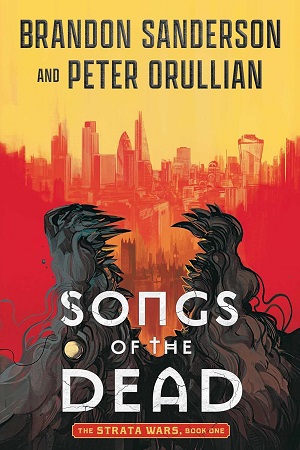
Songs of the Dead (The Strata Wars #1)
Chapter 1
CHAPTER ONE
To see the truer shadow, one must burn the proper flame.
—Sir Joseph Swan, Corollaries of Light
and Dark: A Primer for Thanatists
Most of us have a place we run to when it all goes to hell. For me, it was the Iron Horse.
And tonight, I needed someplace to run to. Someplace with friends. I’d just been kicked out of the Hounds of Winter, the band I’d moved from my home in Los Angeles to form.
Fired by email, too, the cowardly bastards.
I hurried up Manette Street toward the pub and venue sign, a black ironclad horse on a white field, flickering in the darkness.
I didn’t need to see it anyway. Most nights, I just followed the muted rumblings of heavy metal rhythms. If all the lights of London went dark, metal would be my pied piper.
But the street outside the Iron Horse tonight was silent.
Didn’t matter. I hadn’t come for a show.
At the door, a woman stepped in front of me.
In black knee-high boots, she stood tall enough to look me straight in the eyes.
Her dark hair rolled in long waves past a face that even in the pale light looked a creamy pearl.
And despite the hot August evening, she wore a charcoal turtleneck sweater over black leggings.
Close-fit leather gloves brought it all together, made her look official somehow.
I wasn’t exactly a stranger to being accosted on backstreets. I’d grown up in Westmont, Los Angeles—“death alley,” the Times called it; crime, violence, drugs, gangs—still, this felt different.
As I started to edge my way past her, she removed a glove and extended her hand to shake.
From habit, I did the same. Just before I took her hand, she curled her bare fingers around my wrist. My pulse began to gallop like triplets in an Iron Maiden tune.
She had a forceful kind of beauty to be sure, but it was more than that.
Her touch seemed to go deeper, ache a little.
Bad as this night had been, I didn’t pull away.
She held me for a few seconds, then whispered, “What would you be willing to do to escape a life of slavery?”
I had no idea what she was talking about, and I didn’t really care to. I just needed to get inside.
She then turned my hand over and pushed a stone into my palm. “If you wake up, come find me. I might have a job for you.” She pulled her glove back on and disappeared into the shadows of Manette Street.
Crazed Hounds fan, maybe. But how could she have already known I’d been kicked out?
I held the stone up against the flickering Iron Horse light.
It shone a murky red, with a rune or something etched into one side.
I sighed, shoved the stone into my jeans pocket, and pushed through the door into the Iron Horse.
Just inside, I paused, taking in the scent of cracked leather, the rumble of conversation, and the soft glow of homemade candles burning all around—Henry, the owner, dipped them
most every evening, and most nights I joined him.
The venue portion of the Iron Horse—through a crimson drape on the right—was still silent. Any other night I’d have gone in to see why. It was “New Music Friday.” Henry booked emerging bands on one of his best nights. Ballsy as hell.
Instead, I cut left into the pub. Henry was standing at his post behind the bar, drying glasses, his iron-grey hair combed straight back.
He caught my eye, gave me his easy smile, and motioned me over with his dishrag.
I wove toward him, past a row of booths filled with other friends and regulars.
I didn’t stop to say hello. Too much going down.
A tapestry of band patches were sewn to the booths’ upholstery—music fans flying their colors.
Henry encouraged it. He left a needle and thread in a cigarette tray on every table—the trays held over from when smoking in pubs was legal.
The booths had themes, too: eighties hair bands, death metal, grindcore.
A few were dedicated to specific artists.
Good luck getting a seat at the Deep Purple or Maiden tables.
When I got to the bar, I laid my hands flat on the scarred old wood, just to feel grounded for a moment.
The scent of Bournemouth longleaf, Henry’s pipe tobacco, helped.
Even when he wasn’t smoking, the smell hung on him like a wise man’s cologne.
He hiked his stained old apron high on his waist and waited for me to say something, blue eyes none the dimmer for all the laugh lines that hemmed them in.
Finally, he drew me a glass of water—I’d never had a taste for alcohol—leaving his rote teetotaler joke alone tonight. “I think I can guess,” he said.
“Yeah?”
He pointed his rag at the corner booth, where my friend Chuey was sitting alone, head down. “Told me he quit the Hounds. I can imagine only one reason he’d do that.”
Chuey and I went all the way back to Westmont.
We’d spent summers and evenings in the Woodcrest Library at-risk-youth program.
I’d done it for Mama, hoping she’d stick around.
Chuey had done it for the free food—his mom spent their grocery money on smack.
The program kept us from taking gang oaths, though, and later on Chuey wound up running light and sound for my band.
He had a great ear. In fact, he’d given up a piano performance scholarship to Juilliard to come with me to London.
I shook my head. “He shouldn’t have.”
“I say good for him,” Henry countered. “Loyalty’s in short supply these days.”
“No argument there.”
“Listen, Jack, I hate to ask, especially tonight, but the band’s late going on. Singer has a bad case of stage fright.” Henry glanced at the crimson drape to the venue.
The unusual quiet made sense now. “Before you start your shift—”
I was already pushing away from the bar, angling for the backstage greenroom.
I walked across the pub and ducked through the crimson curtain into the venue.
A sizable crowd had begun to murmur, restless for the show to start.
I hurried past them, down the short back hallway, past the rear-venue shower—for traveling bands—and knocked on the door to the greenroom. No one answered, so I pushed inside.
Every good metal venue had a greenroom, an inner sanctum.
At the Iron Horse, its walls were covered with graffiti, signatures of musicians who’d played here, and dozens of photos—Henry in each one, smiling as proudly with unknown bands as he did in a signed photo with Led Zeppelin, who Henry claimed had played their first show here.
Being where the greats had played in their early days was probably as close to church as I’d come since I was a kid.
Always made me feel a bit reverent. I shut the door, blocking out the crowd noise.
Across from me was the rear-stage entrance covered by a black curtain.
Leaning against the wall next to it was the old dreadnought we left here as a spare.
To the left, on a low couch with busted springs and covered with band patches, including one from the Hounds, sat a girl, maybe twenty-five.
She wore thick-soled boots, a goth-style skirt, and a black corset. Her long, dark
hair hung from a head bent over shaking knees. “First gig?” I asked.
She nodded, head dipping lower. “You any good?”
She sat back and looked up. “Piss off.” Sallow light fell across her arms and wrists. From beneath leather wristbands trailed the hint of cutter scars. I glanced at the hair ties I wore on my own wrist.
“Can you sing? I mean hit the notes? Hold the notes? Do it like you mean it?”
She nodded, her knees steadying a bit, as the tones of her guitarist soundchecking his amp rumbled back from the stage.
“You playing original songs?”
“Yeah, nine of my own tunes.” Her weak smile seemed an attempt at being proud.
I went over and sat down. “There’s nothing like playing your own material in front of people.” It was the truth, too. For a musician, even sex couldn’t compete.
She rolled her eyes sidelong at me. “This meant to cheer me up?”
I ignored that and pointed at the picture of Zeppelin, Robert Plant holding a glass of bourbon and reading a lyric sheet. “Did you know that when they played here the first time, he sat on this same grimy sofa with the same doubts you’ve got right now?”
For a moment, she seemed to be preparing something snarky to say.
But it faded. Maybe because we all bow to the godfathers of metal.
Then her eyes suddenly widened. “You’re Jack Solomon.” She pointed at my face. “Hounds of Winter is playing the festival at Wembley next week. Bloody hell. You’re opening for Sabbath.”
“Yeah, that’s us,” I said. Not the right time to tell her I’d gotten the boot. “I heard your demos when you were coming up through the LA scene.
Good stuff. Especially ‘They Always Go Away.’ That song kills.”
Ironic, since I’d never considered the song finished. I waved off the compliment. “Look, when you go out there, your only defense against nerves is to get inside your songs. Play them the way you heard them in your head when you wrote them. Trust that sound.”
From the stage, the muted sound of her drummer tuning a snare drum drifted toward us. Her knees started to shake again. “I’m not feeling it.” I hunkered down next to her the way my dad used to do when he wanted to talk to me about important things. “Your songs,” I said. “Give
me your favorite lyric.”
She pursed her lips and narrowed her eyes at me. “There’s one”—she hesitated—“when the cold steel pulls, the warm blood feels like an invitation you can’t stop. But don’t give in. Live another day. You’re more than what others thought.”
Holy crap. Those words were a kick in the face.
“What’s your name?” I asked. “Angela DuFresne.”
“Angela, that lyric, the picture it paints, and whatever experience gave it to you . . .” I looked her dead in the eye. “Go out there and play the hell out of it. Make them feel it the way you feel it. That’s what you owe them. That’s what you owe yourself.”