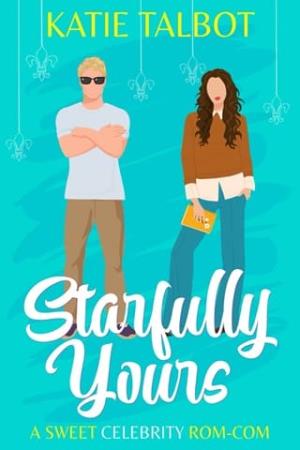
Starfully Yours (Celebrity Love in New Orleans #2)
Chapter 1 Anna
ANNA
You’d think after ninety-nine rejections, I’d stop checking my email at work.
But there I was at Muses Bar, elbow-deep in cocktail napkins and flaming shots, waiting for a miracle. Or at least a tip of over five dollars. My phone buzzed in my apron pocket. I already knew it wasn’t good news.
The subject line confirmed it: Thank you for submitting your story. It was a unique concept, but unfortunately…
The dreaded unfortunately. I didn’t bother reading the rest. I knew exactly how it ended.
I’d written ten novels and four short stories in the past five years: romance, cozy mystery, literary fiction, dystopian horror, ghost pirates, even a retelling of Great Expectations. A few had earned polite interest, but each one had ended up here, in my inbox of rejections.
The first one had stung. The ninety-ninth felt like the universe was sending a clear message: give it up, Anna.
Behind me, my friend’s familiar voice sliced through my sulking. “Anna, please tell me you’re not looking at another rejection email. If you cry into someone’s margarita, I’ll charge you for it.”
“I’m not going to cry.” I shoved my phone into my apron. “But yes, it’s another rejection.”
The voice belonged to Marie Antoinette, my co-worker and best friend. She sauntered over, waving a towel dramatically. She insisted that everyone call her by her full name, claiming that if you’re named after royalty, you don’t do anything halfway.
“Was that the big one hundred?” She narrowed her perfectly lined eyes at me. “Have we hit triple digits yet?”
“No, it was ninety-nine.”
She leaned against the bar as if she had all the time in the world. “Oh, honey. That’s a milestone. We should celebrate. Champagne, maybe? Or cake? Let them eat—”
“Don’t say it,” I warned, grabbing a dirty martini glass and shooting her a look.
She sighed dramatically. “Fine. But are you still planning to quit at one hundred rejections?”
“I am.” I set the glass down harder than I intended. “One hundred rejections, and I’m done. No more writing. I’ll officially retire my pen, or keyboard, or whatever.”
My friend arched a skeptical eyebrow. “But what about that fancy award you won in college? What was it called again? You were supposed to be the next big thing.”
The reminder stung more than I wanted to admit. “It was the National Emerging Writers’ Prize. And that was years ago. I peaked at twenty-two. All downhill from there. I’m a failure.”
“Failure, schmailure. You know what I always say: I haven’t failed. I’ve just found 10,000 ways that won’t work.”
“Who said that?”
“Me. And Thomas Edison.”
I didn’t respond. The truth was, I had won the National Emerging Writers’ Prize for a deeply personal story about my mom, who died when I was young. It was raw, emotional, and the most vulnerable thing I’d ever written. People loved it, but I hadn’t been able to replicate that magic.
Marie Antoinette studied my face, her teasing tone softening. “You’ll get there.” For a second, I almost believed her.
But before I could respond, reality crashed in, reminding me that the rejection letter wasn’t even the worst part of my day. I groaned and rubbed my temples. “Oh, and get this—I need to find a place to stay. My cousin Lucy’s having another baby, and apparently, they need the nursery back.”
She arched an eyebrow. “Another baby? Is she starting a daycare or something?”
“Right?” I sighed. “My aunt and uncle said I could stay with them, but, uh, no, thank you. They’d turn it into a family intervention about how I’m the only Amato who isn’t married with children.
Aunt Delores would spend all day giving me pointed looks about my life choices, and Uncle Ray would pull out his calculator to explain how much money I’m wasting not working a ‘real job.’ I’d rather live in the walk-in freezer here at Muses. ”
She whistled. “Ouch. Nothing like a family intervention to put the ‘fun’ in dysfunction. Honestly, the freezer might be the more comfortable option. Where are you going to go?”
“I’ll figure something out.”
The truth was, I didn’t know what I was going to do, and the rejection email had just solidified the growing pit in my stomach. As much as I hated to admit it, I was running out of options.
Before Marie Antoinette could respond, Mrs. Brodie appeared, her turquoise earrings jingling as she carried a pitcher of sangria. She had a knack for showing up at just the right time. Or at least when you needed sangria. “I couldn’t help but overhear. You need a place to stay?
I hesitated. “Uh, yeah. But don’t worry, I’ll figure something out.”
“Nonsense,” Mrs. Brodie said with a wave of her hand. “Topher’s got a little cottage on the back of his vacation property right here in the Garden District. His last tenant moved out last year, and it’s been sitting empty ever since.”
“Oh, I wouldn’t want to intrude.”
She dismissed that with another wave. “It’s no intrusion at all. In fact, you’d be doing us a favor, keeping it from falling into disuse. It’s small, but charming. Needs a little fresh air and someone to open the curtains. You can stay as long as you need.”
“Really?” I asked, a flicker of hope warming my chest. “I mean, if you’re sure.”
Mrs. Brodie beamed. “Topher’s friend is staying at the big house, but I doubt you two will even cross paths. And don’t worry about rent for the cottage. It’s not like anybody’s using it.”
She gave me a wink, then added, “I’m heading out as soon as I deliver this sangria, but I’ll get you the keys tomorrow.”
As she floated off, I let myself smile. A cottage. In the Garden District. A little cottage on Mrs. Brodie’s son’s property was a far cry from crashing on someone’s couch or dodging my aunt and uncle’s “helpful” lectures. For the first time in a long time, something had gone right.
Maybe things weren’t so bad after all. Sure, my latest story had been rejected, and I was dangerously close to giving up on writing altogether. But I still had one more try in me. And wouldn’t it be something if my one-hundredth attempt at getting published was the one?
The story practically wrote itself: “After 99 rejections, award-winning writer Anna Amato finally broke through and published the Great American Novel.” I could already imagine the headlines, the late-night interviews, and the Pulitzer acceptance speech, where I would charm the crowd with my tale of perseverance.
One more shot. One more story. And then I’d see what the universe had to say.
I was wiping down glasses when Marie Antoinette’s sudden intake of breath caught my attention. She was staring at her phone, her expression a mix of dread and panic.
“What’s that face?” I asked.
She pushed the phone into her apron. “Nothing,” she said quickly. Too quickly.
“You’re a terrible liar. Show me.”
She sighed dramatically and handed over her phone. “Fine, but don’t freak out, okay?”
My stomach dropped as soon as I read the headline: Mardi Gras royalty to tie the knot: A love story for the ages. And there he was—Theodore Beauregard IV. Better known as Beau, my ex. Grinning in a tuxedo, arm around the picture-perfect woman he’d left me for.
“Oh, come on.” I shoved the phone back. “Couldn’t they just headline it ‘Local jerk to marry rich lady’ and be done with it?”
She frowned. “Are you okay?”
“I’m fine,” I lied. “It’s ancient history.”
Except it wasn’t. My chest tightened, an ache I tried to ignore. I’d spent five years pretending I didn’t care, convincing myself I was over Beau. But seeing their perfectly staged engagement photo, complete with a glowing caption about love and destiny, made me feel small.
A love story for the ages. At least someone was writing a good story. Too bad it wasn’t me.
I was wiping down a sticky part of the bar when the door swung open, and the atmosphere shifted. The hum of conversation softened, and a few heads turned.
I didn’t look up at first, but I felt the energy change.
A tall figure stepped inside, hunched over as if he didn’t want to be noticed. Marie Antoinette nudged me. “That’s a look,” she whispered.
He was wearing a baseball cap pulled low and sunglasses—even though it was well past sunset. His face was mostly obscured. He was clearly trying not to draw attention, which, ironically, only made him more conspicuous.
“Sketchy,” she murmured.
I rolled my eyes. “Probably just a tourist trying too hard.”
He approached the bar, glancing over his shoulder as if he expected someone to jump out at him. His blue eyes darted toward me. “Is Josephine Brodie here?” he asked, his accent crisp and undeniably English.
“She just left,” I said. “Can I help you with something?”
“No, that’s all right,” he said, his hand twitching toward the door. But before he could leave, a surge of people pushed in behind him—a rowdy, boisterous group blocking his escape route.
Trapped, he hesitated before reluctantly sliding onto a barstool. “Seltzer water, please,” he said, avoiding eye contact like the crowd might swallow him whole.
I poured the drink, set it in front of him, and leaned an elbow on the bar. “And who should I say is asking after Mrs. Brodie?”
“Call me Nigel.” He glanced behind me at the sign advertising Pimm’s Cup. “Nigel Pimmington.”
I raised an eyebrow. “Pimmington? That sounds… distinguished. Where are you from?”
“The English countryside.”
I tilted my head, amused. “Oh, really? What part?”
“A quaint little village,” he said, taking a sip of his drink.
I gave him a once-over. “So, Mr. Pimmington, when you’re not sipping Earl Grey and strolling through the heather, what do you do for a living?”
He hesitated just long enough to be suspicious. “I’m a blacksmith.”
I couldn’t help but chuckle at what was so clearly a line. “A blacksmith? Like, with an actual forge and an anvil?”
He gave a tight nod, giving a nervous look at the gathering crowd before turning back to me. “Yes. It’s a… respected trade in my village.”
“Mmhmm.” I leaned a little closer. “And what exactly do you forge?”
“Horseshoes,” he said smoothly. “And… shields.”
I tried not to laugh. “Shields? For what? Local dragon attacks?”
“For jousting,” he said.
I blinked. “You’re telling me jousting is still a thing in England?”
“It’s a niche sport,” he muttered.
“Well, if you’re ever in need of a damsel to rescue,” I said, my voice somehow going all coy without my permission, “I’ve been told I look good in distress.”
What did I just say?
Heat rushed to my cheeks. I wasn’t usually that girl who flirted so brazenly with customers. But something about him, whether his ridiculous story or his stupidly good posture, was throwing me off my game and replacing it with a completely different game.
His shades dipped low enough that I could catch the look in his bright blue eyes. He looked startled at first but then amused. “Do you faint easily? That’s a key qualification.”
“Only if someone’s waving a sword at me,” I replied, before I could stop myself.
Seriously, what was happening right now?
Was I... enjoying this?
Before I could process whatever I was doing or saying, something in the room shifted. Laughter dimmed. Chairs scraped. The air got tight, like a balloon stretched to its limit.
“That’s him,” someone whispered.
“No way,” another voice gasped, breathless.
I glanced toward a nearby table. A woman was pointing at Nigel while her friend frantically typed on her phone. The others were already leaning in, laser-focused.
Nigel’s posture stiffened. His eyes widened, and he clenched his jaw. His voice was low and urgent. “You have to hide me.”
I raised an eyebrow. “What are you, the headliner at a Renaissance fair or something?”
He didn’t laugh. He just looked at me, pleading. “It’s… complicated. Please.”
Something about the way he said it, with a hint of panic, his eyes not leaving mine, made my pulse skip a beat.
“Follow me, Lancelot.” I gestured toward the back.
Then I held up a hand like I’d spotted something urgent up front. “Hey, everyone, someone left their phone at the bar, and it’s been getting some fascinating texts from a girlfriend stuck at home!” I said it loud enough for half the bar to swivel their heads.
With the crowd distracted, Nigel slid off the stool, head down, as I eased him behind the bar and guided him through the back to a small office. Behind us, the crowd remained fixated on the fake misplaced phone, utterly oblivious to our escape.
Once the office door clicked shut, I crossed my arms and faced him. “So, Nigel Pimmington, care to tell me what you’re really doing here?”
He sighed, rubbing the back of his neck. “Maybe we could skip the interrogation? I’m trying to lie low.”
His English accent had vanished, and he pushed his sunglasses onto the top of his cap.
My stomach flipped, and my brain put the pieces together.
His jawline was sharp, and his dark blonde hair was tousled, giving him a rugged charm.
His blue eyes were startlingly bright, framed by lashes that seemed unfairly long for a man, and the faint scruff on his face added to his appeal.
“You’re Luke Fisher,” I said, my voice barely above a whisper.
Hollywood’s golden boy. And somehow, he’d ended up at my bar.