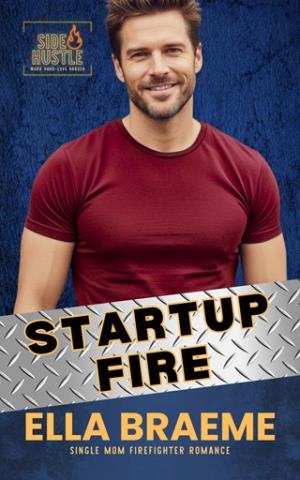
Startup Fire (Side Hustle #15)
Chapter 1
Sleep Interrupted
Ring. Rrrrring.
Wayne pulled the pillow over his head.
Nope. Not happening.
He'd just gotten home from a mutual aid call that had turned into a twelve-hour nightmare.
The industrial fire in McCaysville had required every available crew within fifty miles, and Wayne had spent most of the night hauling hose lines through a labyrinth of machinery.
The acrid smoke had gotten into everything, and even after the station shower, he could still taste it at the back of his throat.
His muscles screamed. And some persistent jackass was leaning on his doorbell like their life depended on it.
Rrrrring. Rrrrring. Rrrrring.
“For the love of—” Wayne threw the pillow aside and squinted at his phone. Ten thirty in the morning. He'd managed exactly two and a half hours of sleep.
The ringing stopped.
Thank God.
Wayne closed his eyes, felt his body start to sink back into the mattress, felt the blessed pull of unconsciousness—
Knock knock knock knock knock.
He was going to murder someone.
Wayne rolled out of bed, his body protesting every movement.
He could still smell smoke—on his skin, in his hair, somewhere.
Probably just paranoia, but he couldn't shake it.
His reflection in the hallway mirror showed exactly what he felt like: a man who'd been dragged backward through hell and spit out the other side.
His hair stuck up at odd angles, pillow-creased and wild.
Screw it. Whoever was interrupting his desperately needed sleep could deal with what they got.
He yanked open the front door, prepared to unleash a string of profanity that would make his fire crew proud.
Instead, he found himself staring at a woman who looked like she'd just stepped out of a coffee commercial.
She was maybe early thirties, with short dark hair that somehow managed to look stylishly tousled instead of messy, and brown eyes that were bright and friendly.
She wore jeans and a fitted t-shirt under an open flannel, work boots, and carried a portfolio case under one arm.
Her expression was pleasant, expectant—like someone arriving for an appointment they'd been assured was all arranged.
“Wayne Drummond?” Her smile was warm but professional. “Hi! I'm Jessica Hartley. Jess. My grandmother said you'd be expecting me? About the workshop space?”
Expecting her? Wayne blinked, trying to remember if he had actually agreed to anything. But of course he wouldn’t have, as the barn is his safe space. The name sank in. “Hartley? Brooke Hartley’s granddaughter?”
The woman in front of him nodded enthusiastically. “Yes, that’s her.”
“Nope. Never talked to me about my barn. Not interested in sharing space." Wayne started to close the door.
Her smile faltered, confusion replacing the friendliness. “Oh. I—Grandma said she'd spoken to you about it? About me using your forge setup for glassblowing? She said you'd agreed—”
“I never talked to your grandmother.” Wayne could hear how harsh he sounded, but he was too tired and too irritated to soften it. “I don't know what she told you, but I'm not running a community workshop. The barn is private.”
“But she said—” Jess stopped, and Wayne watched realization dawn across her face. Her cheeks flushed. “Oh God. She didn't actually ask you, did she?”
“Nope.”
“I'm so sorry. I should have—she was so certain, and I just assumed—” She took a step back, clutching her portfolio case. “I'm really sorry for bothering you. I'll talk to her about—”
“Look,” Wayne interrupted, because now he felt like a jerk for snapping at her when she'd clearly been set up by her meddling grandmother.
“It's not personal. I just got back from a twelve-hour fire call. I’m all dirty, I smell like an ashtray, I haven't slept, and I'm not in the mood for—whatever this is.
But even if the timing was better, the answer would still be no. I don't share workspace.”
She nodded quickly, still backing away. “Of course. I understand. I'm sorry again.”
But as she turned to go, she paused and looked back at him. “For what it's worth? You really don't smell like smoke. I'd tell you if you did—I work with heat and glass all day, I know the smell.”
Then she was heading down his porch steps, and Wayne was closing the door and locking it before his exhausted brain could process whether that last comment was reassuring or if she'd somehow clocked his paranoia about it.
Wayne woke six hours later to his phone buzzing with texts from the fire crew group chat.
Chief Murphy wanted to debrief the McCaysville call in a meeting at the Caffeine Drip tomorrow afternoon, usual time.
Jake was complaining about the smoke smell still in his truck.
Brandon had sent a GIF of someone collapsing into bed with the caption “me rn.”
Wayne sent back a thumbs up and hauled himself to the shower.
He didn't care that he'd already showered at the firehouse.
This time he scrubbed again, spending twenty minutes under water as hot as he could stand, working shampoo through his hair three times until he was absolutely certain there was no lingering smell.
The familiar ritual helped the way it always did. His muscles started to unknot.
By the time he emerged, wrapped in a towel with steam fogging the bathroom mirror, he felt almost human again.
His stomach growled, reminding him he hadn't eaten since—when? Yesterday afternoon? He'd grabbed a protein bar at some point during the fire, but that was it.
Wayne pulled on clean jeans and a t-shirt, then padded barefoot to the kitchen.
The house was quiet, just the hum of the refrigerator and the tick of the old wall clock his mother had hung decades ago.
Sunlight slanted through the windows, turning everything golden. Late afternoon, probably close to five.
He made himself a sandwich—three sandwiches, actually—and ate standing at the counter, his mind already drifting to the barn and the project he'd been working on before the mutual aid call interrupted everything.
The heart pendants for the breast cancer research fundraiser. He'd promised he'd have a dozen ready by next week, and he was only halfway through. The metalwork was delicate, time-consuming, each piece requiring careful attention to get the curves just right.
Wayne pushed away the thought of why this particular project mattered so much to him—too raw, even after six years—and finished his last sandwich.
The barn called to him. That familiar pull, the need to work with his hands, to lose himself in the rhythm of hammer on steel.
He grabbed his boots by the door and headed out across the backyard.
The September air was perfect—warm but not hot, with just enough breeze to make the pine trees whisper.
His property backed up to a stretch of woods that gave him privacy from the neighbors, and the workshop sat about fifty yards from the house.
His grandfather had converted the old barn back in the eighties—gray concrete block walls and a metal roof. Fireproof, solid, and built to last.
It was his favorite place in the world.
Wayne unlocked the side door and stepped into the familiar space.
Afternoon light filtered through the high windows, illuminating dust motes and the organized chaos of his workshop.
His metalworking station occupied the north side—forge, anvil, racks of tools, works in progress hanging on the wall.
The rest of the space held his HVAC equipment and supplies for his day job, plus the odds and ends of general storage.
Everything exactly where it should be.
He fired up the forge, feeling the heat bloom against his face, and selected the piece he'd been working on before the fire call. A half-finished heart pendant, the metal still needing the final curves and spirals that would make it elegant instead of clunky.
Wayne positioned the heated metal on the anvil, working the piece into another spiral. He could hear his old mentor's voice in his head: Make your components in batches, boy. All your spirals at once, all your curves. Then assemble. That's how you make a living at this.
He knew it was inefficient. Knew he could cut his time in half by standardizing the process, making a dozen spirals, a dozen curves, then putting them together assembly-line style.
But his hammer came down with steady precision, forming this spiral, for this heart. The next one would be different—each one was. Had to be.
It wasn't about efficiency. It was about intention. Each heart made whole, from start to finish. Each one its own thing.
Maybe that's why he only made them for charity.
Wayne lost himself in the work. Heating the metal to just the right temperature, shaping it with careful taps of his smallest hammer, checking the curve against his template.
The repetitive motion, the focus required, the way the metal responded to heat and pressure—this was meditation. This was peace.
This was his.
An hour passed, then two. He finished the pendant and hung it next to the others. The physical exhaustion from the fire had been replaced by the good kind of tiredness that came from creating something.
The light through the windows had shifted to the orange-gold of approaching sunset when Wayne finally banked the forge and stepped back to examine his work.
Seven pendants hung from their individual hooks on the wall, delicate curves forming stylized hearts, each one slightly different but all recognizably part of the collection.
His mother would have loved them.
His stomach reminded him he hadn't eaten since the sandwiches hours ago, and he was pretty sure there was leftover pizza in the fridge. Maybe he'd grab that, catch the game on TV, and actually have a normal evening for once.
As he locked up the barn and headed back toward the house, Wayne caught himself scanning the driveway, looking for an unfamiliar car.
Looking for her.
He shook his head, disgusted with himself. She wasn't coming back. He'd made himself perfectly clear. And even if she did come back, the answer would still be no.
His barn. His space. His sanctuary.
Nobody else invited.
That was how it had to be.