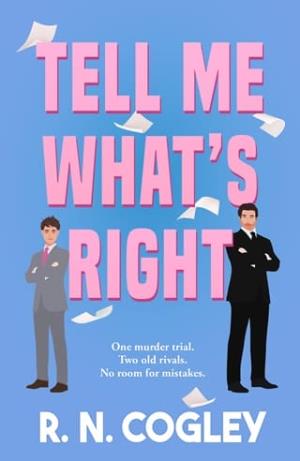
Tell Me What’s Right
Chapter 1
I never thought my life would turn out this way.
I never thought I’d end up like this: tears burning in my eyes, a hollow feeling in my stomach, and my heart broken into two jagged pieces.
I did everything right, or at least I thought I did.
But I guess it’s true what they say: you can’t plan for everything in life.
Up until now, I genuinely thought you could craft the perfect life as long as you were prepared.
For a while, this thought seemed to ring true.
Provided I was well prepared, I could excel in secondary school, win a scholarship to attend a prestigious university in Dublin, achieve first-class honours in my undergraduate degree, sit and pass the gruelling examinations to become a solicitor, have a handsome boyfriend with a stunning house in a posh area of Dublin, and have my dream job. The perfect life.
But this picture-perfect life fell apart.
When I look back on this time, it’s like the person who lived this life is someone else, someone that isn’t me.
When I think of how parts of that flawless life fell to pieces, my insides knot.
‘Everything happens for a reason,’ Marilyn Monroe once said.
‘Sometimes good things fall apart so better things can fall together.’ I find this difficult to believe.
Now, at the ripe old age of twenty-six, I’m not returning to the place I’ve called home for the past four years.
I’m going somewhere else, headed in an entirely different direction.
I’m on the motorway that connects Dublin to Wexford, driving to Gorey.
Cars are speeding past me like I’m parked, even though I’m doing exactly the permitted one-hundred-and-twenty kilometres per hour speed limit.
The rules are there to be followed, not broken.
I stop for diesel at a Circle K service station.
By this point, my car – a tiny red hatchback – is running on fumes.
I look up at the price of diesel and wince.
The giant neon numbers remind me of the ongoing fuel crisis, another crisis to add to the already apparent housing and economic crises that are ravaging the country.
I reluctantly plug the nozzle into the hole and watch as every litre diminishes my meagre bank balance.
I don’t get paid until tomorrow morning.
At the cashier’s desk, my heart is hammering.
My car took eighty euros’ worth of diesel, and I have no clue if there’s even eighty cents left in my bank account after paying my half of the monthly utility bill for a house I can no longer call home.
Tom, my now ex-boyfriend, often took care of the financial side of things when the month was coming to a close, especially when it came to the mortgage, fuel and other household bills.
‘Don’t you worry about a thing. I’ll keep us afloat until you get paid,’ he’d tell me.
He was so good to me. Too good to me. I didn’t deserve him back then.
“Just the diesel, yeah?” the cashier asks me. He’s as uninterested as I am nervous.
“Ye… yes,” I say.
Without looking at me, he asks, “Cash or card?”
I gulp. “Card, please.”
Shakily, I insert my card into the machine and enter my pin. As the payment processes, my heart continues to hammer, so much so that I can feel it throbbing in my neck. I breathe a sigh of relief when a green tick appears.
“Want a receipt?”
“No, thank you. Have a nice day.” Like I could bring the diesel back if I wanted to.
The cashier doesn’t offer a reply.
After using the toilets, I get back on the road.
As I travel closer to Wexford, my surroundings become greener.
Fields filled with grazing cattle and ditches full of wildflowers breeze by me.
If I were anyone else, I’d bask in these images.
‘I’m home!’ I’d scream. My country roots would spring up inside me, and I’d be the proudest country boy the city has ever seen.
That isn’t me, though. I’m not that boy.
I’m different – neither a country boy nor a city boy.
Too country for the city, too city for the country.
Sometimes, I feel like I don’t really fit in anywhere, a feeling that was solidified by the comments made by Tom’s mother after she first met me.
Comments that, I fear, Tom now agrees with.
I navigate through pot-holed, narrow roads to pull up to my twin brother’s driveway.
Even in the evening light, the cute bungalow is just as beautiful as the day I first saw it.
The exterior walls are magnolia, and the key stones are painted chocolate-brown.
The rickety shed beside the pumphouse is still one strong wind away from total collapse, the tree in the front garden hasn’t grown any bigger, and the tall washing lines that I helped erect are still standing.
My brother’s car is parked in the driveway, the shiny metal exterior glistening in the diminishing sunlight.
I park on the street, metres away from the large tree.
I’m staring at the baby-blue front door from the confines of my car, but I’m not attending to any of it.
My mind is racing, thinking about all the actions that led me here.
“You did everything right,” I whisper, “and you still failed to keep your perfect life.” Pulling down the sun visor, I take a good look at myself.
My wavy hair needs to be cut, there are a few white-headed spots that merit squeezing dotted around my face, and my skin is pale and puffy.
Tears are mounting behind my eyes, so I quickly shut the visor, rocking my little car.
If I stare at myself any longer, I’ll cry.
Out of nowhere, my phone buzzes on the passenger seat beside me. I wipe my face and answer it with haste.
“Hello?” I say. My voice is hoarse, and I clear my throat to bring it back to normal. “Hello?”
“How are things, Nick?” the person on the other end, my work colleague Melissa, says gently. Her voice is quieter than usual, meaning that she’s probably still at work, crouched underneath her desk to make this call.
I sigh. When I started at O’Leary this time will be no different.
But this time is different. I don’t have Tom beside me, and I don’t have a beautiful home to go back to.
Cautiously, I open the driver’s side door and step onto the road.
I’m proud of myself for reaching my brother’s front step without shedding a tear. Before I allow my knuckles to graze his front door, I hiss once more at the thought of Ben Kehoe. Then I knock gently and am welcomed inside.
“Oh, Nicky.” Brendan, my twin brother, sighs as he hands me a cup of tea. His expression is filled with sorrow. “I was so sorry to hear about you and Tom.”