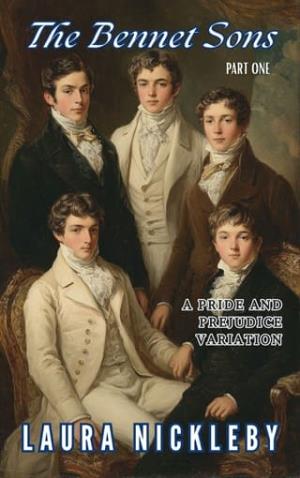
The Bennet Sons (Pride and Prejudice Variation, Part One)
Prologue
It was the kind of summer afternoon that demanded nothing more pleasant than the cherished ritual of tea. The heat, though softened by the shade of the sycamores lining the approach to Lucas Lodge, pressed gently against the windows, encouraging drowsiness and stillness in equal measure.
The parlour, arranged with its usual modest pride, wore the season well—its pale blue curtains drawn halfway to protect the furniture, its rug just brushed by sunlight that had split in golden stripes across the floorboards.
There was no breeze to ruffle the linen on the table, nor to carry the hum of insects from the garden into the room.
The dominant sound was the measured clink of silver against porcelain as Lady Lucas poured the second cup.
“My dear Mrs. Bennet,” she began with a note of pleasant inquiry, “you are most uncharacteristically silent this afternoon. I must presume you are either unwell or entertaining a scheme.”
Mrs. Bennet, seated across from her on a chair slightly lower than her hostess’s but cushioned to nearly equal height, responded with a soft smile—a smile not born of amusement exactly, but of long practice and careful management.
“When one has five sons, Lady Lucas, a little silence must be hoarded where it can be found. As for my health, it suffers only in the pursuit of their welfare.”
At this, Lady Lucas laughed—a light sound, quickly swallowed by the still air. “I daresay your sons would be horrified to be charged with your decline. They seem, each of them, in quite enviable health.”
“They are,” Mrs. Bennet agreed, her voice softening with maternal pride as she reached for her teacup, observing the gleam of sunlight against the gilt rim with a momentary pensiveness.
“And as long as they remain so, I shall continue to be merely fatigued, and not felled.” She paused, her fingers tracing the rim of the cup with absent affection, before adding with a touch of wry humour that drew a sympathetic smile from her companion, “James grows daily more dependable. I do hope he will secure a suitable match—heaven knows, the last thing I need is a meddlesome daughter-in-law I cannot be rid of for the rest of my days. With how good-natured, trusting, and na?ve he is, he’s quite capable of making a most unsuitable choice. ”
“And the others?”
“Kit—I mean, Christopher—prefers anatomy to society, and Miles speaks of nothing but sermons and sin—though I suspect he favours the latter, at least as a topic of conversation. Both are studying at Oxford, following in Elias’s footsteps, though they are home now for the summer recess.”
“And Laurence?”
“Restless. Heroic in ambition and mood, if not yet in action. He was most dreadfully disappointed that the war concluded before he had the chance to purchase a commission. I suspect he would have preferred Waterloo delayed by a fortnight solely for his benefit.”
Lady Lucas made a polite noise, not quite a chuckle.
“He is young, my dear. Time may yet provide him with new wars to romanticise. And Elias?” she added softly, her tone shifting to one of gentle curiosity, as though the name itself evoked a tender memory that caused Mrs. Bennet to still for a moment.
There was a pause—a measured, deliberate moment of quiet in which Mrs. Bennet smoothed the napkin on her lap with unnecessary precision. When she looked up again, her smile remained, but something had settled in her eyes, some thought less comfortable than the rest. “Elias remains himself.”
“Which is?”
“Quiet. Exacting. Easily missed in company, and even more easily remembered afterwards.” She paused. “He is reading law with Mr. Phillips in Meryton.”
Lady Lucas stirred her tea, though the cup was already perfectly blended. “It is a shame he doesn’t visit us as frequently as he used to. He and Charlotte always understood one another so well.”
“They did.” Mrs. Bennet spoke gently—without regret in her tone, but not without its echo in her bearing. “Which was precisely the danger.”
Lady Lucas’s spoon paused in its orbit. “Danger?”
“Of the quiet kind,” Mrs. Bennet said. “Not scandal, certainly. Nothing untoward ever passed between them—she was already spoken for by the time he left for Oxford, and he, being what he is, would never have acted rashly. But when two young people spend their hours in such easy accord—when they share their silences as well as their words—it becomes rather too tempting to mistake friendship for future.”
“You believe there might have been an attachment?” Undoubtedly, Lady Lucas’s favourite activity was to ask questions.
“I believe they were wise enough never to name it. And I believe that if left unchecked, it might have become something that neither of them—nor their families—could afford.” She adjusted the angle of her teacup.
“It was a kindness, then, when Mr. Collins returned to Hertfordshire looking for a wife. Charlotte was… willing. And Elias had his studies in front of him. There was no need to speak of anything at all.”
Lady Lucas blinked slowly, her expression unreadable. “You introduced them.”
“I have just encouraged a conversation.” Mrs. Bennet’s smile was soft, deliberate. “Our cousin required a sensible woman, and my friend’s daughter required security. And my second son, for all his good sense, required protecting—from a future that could never be his.”
Lady Lucas set her spoon aside with great care. “And does he know it?”
“He should, I expect. He is too stubborn to listen to me. He only takes advice from Mr. Bennet. But Elias bears no resentment. He was always clear-eyed, even when he was not entirely unfeeling. He respects Charlotte’s choice and admires her comfort at Hunsford. As do I.”
There was a pause between them. The light on the rug had shifted by a finger’s width.
Then Lady Lucas said, almost absently, “You did it for her, and I am grateful for that and greatly indebted.”
“I did it for him, too,” said Mrs. Bennet quietly.
“And because a mother’s duty is not to encourage dreams, but to prevent regrets.
Not that either of them would be so foolish.
But when two young people grow accustomed to each other’s company—when they read the same books, pass the same glances, finish each other’s thoughts without effort—it becomes rather too easy to forget that neither has anything to offer the other but companionship.
And that, for two sensible persons with no fortune between them, is rarely sufficient. ”
“You believe they were—attached?” Lady Lucas asked.
“I believe they were wise enough not to speak of it. And yet... I saw it. I saw how Charlotte’s eyes softened when Elias disagreed with her.
I saw how he deferred to her opinion without remark, how he sought her out in crowded rooms. Neither of them ever named it, but affection need not be declared to become dangerous. ”
“And so you encouraged Mr. Collins.”
Mrs. Bennet did not blush. She did not lower her eyes. “I allowed the match to proceed. It was never my intention to direct Charlotte toward Mr. Collins, but when it became clear that he meant to offer for one of my sons’ friends—or relatives—it seemed the only reasonable course.”
Lady Lucas’ smile tilted, just slightly. “And I encouraged Charlotte to accept.”
Then she said nothing for a long moment.
The silence was filled by the ticking of the mantel clock and the distant sound of one of her younger children—a boy, perhaps, though it was difficult to tell at such a remove—shouting in the orchard behind the house.
Sir William was away for the day, having gone to Meryton on some vague errand connected to the town council.
The children were under the maid’s indifferent eye.
“You are not unkind, Mrs. Bennet,” Lady Lucas said at last. “But you are not always merciful, I daresay.”
“I am not a mother of daughters,” Mrs. Bennet said quietly. “My sons must make marriages that strengthen their futures. A poor match—a marriage without sense or portion—would hurt them more than it would hurt Charlotte.”
“And Elias?”
“He understands. He does not speak of it.”
“No,” Lady Lucas said, setting her cup down, “but I wonder if he ever will.”
The tea had long since cooled. Outside, the shadows had begun to stretch across the lawn, reaching toward the gravel path in that leisurely fashion peculiar to late summer afternoons.
From the orchard came the sound of children’s laughter—young Miss Amelia Lucas had apparently fallen into a patch of long grass and been rescued with exaggerated heroism by her younger brother.
Their shrieks echoed through the open windows, unheeded by the two ladies who remained fixed in their chairs, their conversation no longer idle.
Lady Lucas shifted slightly, as though she might rise, but did not. Instead, she leaned forward, setting aside her cup with unusual care. “You know, I once thought Elias would be the safest of your sons.”
Mrs. Bennet turned to her, brows lifted. “Safe? In what sense?”
“In the sense that he seemed content to observe rather than to act. He never courted attention, never sought admiration. He was simply present. Listening, thinking, always so calm. One never expected sudden declarations or wild affections from Elias.”
“No,” said Mrs. Bennet softly, “but it would have been the quieter sort that carried furthest. If he had spoken to Charlotte, even once, even indirectly… I might not have been able to intervene.”
Lady Lucas looked away, her gaze fixed on some distant spot in the garden where a bee hovered uncertainly over a clump of clover. “And yet I wonder,” she said, after a moment, “if they did not say more to each other in their silences than most couples manage with speeches.”
Mrs. Bennet said nothing.
“You do not regret it?” Lady Lucas asked, without accusation.