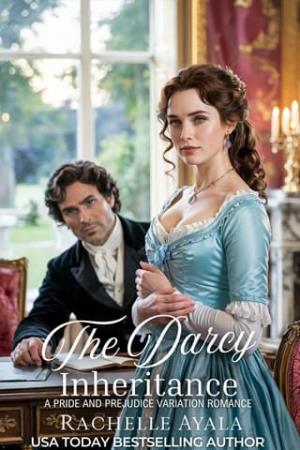
The Darcy Inheritance (Darcy and Elizabeth Forever: Pride and Prejudice Variations)
Chapter 1
CHAPTER ONE
AN UNEASY ASSEMBLY
Fitzwilliam Darcy sat beside his father’s sickbed. The fire was too warm, and the air heavy in the stuffy room that had become a prison of illness and impending grief.
“Father, I’m here.” He leaned forward, his heart clenching at the gray pallor of the once-robust face.
The labored breathing rasped as his father’s mouth formed words. “Promise… me…”
“Yes, Father… What should I promise?” Fitzwilliam clasped the cold hand between his warm ones, as if his youth might transfer vitality back to the failing body before him.
William Darcy’s hand, once strong enough to control the most spirited horse, trembled as it gripped his son’s wrist. His eyes, clouded with fever, suddenly cleared with alarming lucidity.
“Never… trust a… a… Bennet.”
Fitzwilliam’s brow furrowed. “Who are the Bennets?”
But William Darcy’s eyes had already begun to glaze, his grip loosening as his breathing became irregular. “Promise… never trust…”
“I promise, but who are they? What did they do? Father!”
The only answer was the death rattle that would haunt Fitzwilliam’s dreams to this day.
Which Bennets? And why?
Hertfordshire, 1811
“Come now, Darcy. You cannot hide at Netherfield all evening when half the neighborhood is eager to make your acquaintance.”
Darcy glanced out the window of the manor house his friend Charles Bingley had leased to acquaint himself with the arts of estate management. Beyond the manicured gardens, Hertfordshire spread in gentle hills and modest farmland—pleasant, but hardly remarkable.
“I rather doubt estate management includes appearance at a country assembly.” He adjusted his cravat, though it required no adjustment.
Bingley’s reflection appeared beside him in the window glass.
“Caroline has already selected her gown, and Louisa declares herself quite eager for the entertainment. You must come, of course. It would be the height of rudeness to decline, and I am determined to make a good impression on our neighbors.”
“I assure you, their good impression will diminish rapidly upon actual acquaintance.” Darcy turned from the window, taking in his friend’s earnest expression with exasperation and reluctant affection.
“Nonsense! You do yourself a disservice.” Bingley clapped him on the shoulder. “Besides, there will be dancing. Even you cannot object to a country dance.”
“I assure you, I can and do object to dancing with strangers of no particular breeding or accomplishment.”
Bingley’s expression fell. “If you remain here alone, Caroline will undoubtedly develop a headache and insist on staying to keep you company. Then Louisa will refuse to leave Caroline, and Hurst will not stir without Louisa…”
The young man possessed an unfortunate talent for moral blackmail while painting an amusing picture. Darcy had observed this particular skill employed against Caroline’s shopping expeditions and Hurst’s drinking habits with equal success.
“Very well,” Darcy relented with the air of a man accepting his own execution. “But I shall not promise to be pleased about it.”
Bingley beamed. “Excellent! The carriage will be ready at half past six.”
An hour later, Darcy found himself jostling in a carriage over rutted country lanes with a beaming Bingley, his two sisters, and Mr. Hurst, who looked like he’d discovered a wet fish in his handkerchief.
“I hear the Meryton assemblies attract the best families in the neighborhood,” Caroline Bingley observed, adjusting her feathered turban with studied carelessness. “Though I suppose ‘best’ is a relative term in such a backwater.”
“Now, Caroline,” Bingley chided. “We must not judge before we have even arrived.”
“I am merely preparing Mr. Darcy for what he is likely to encounter,” she replied, offering Darcy a smile that was clearly meant to establish their mutual superiority and common sympathy.
Darcy inclined his head but made no reply. He could scarcely tolerate his friend’s ostentatious sister, who believed herself the best suited to become mistress of Pemberley, a position he had decided to bestow on nobody in his present acquaintance.
The assembly room, when they finally arrived, possessed all the refined elegance Darcy had expected—which was to say, none whatsoever.
The long room boasted low ceilings with exposed beams, whitewashed walls adorned with simple sconces, and a small musicians’ gallery at one end where four lackluster musicians sawed away at their instruments.
The evening was unseasonably warm, and with fifty bodies already filling the space, the air had grown stagnant. Darcy’s right temple throbbed with the stirrings of a headache.
“Oh… look at that,” Caroline observed. “Quite provincial, don’t you think? And utterly lacking in sophistication. Those flowers appear to have been gathered from someone’s garden this afternoon.”
“How charmingly rustic,” Louisa Hurst agreed, her fan working vigorously against the heat.
Their entrance caused an immediate stir. Conversations halted mid-sentence as heads turned to inspect the newcomers. Darcy straightened his shoulders and assumed the impassive expression that had served him well in countless London ballrooms.
A round gentleman with an elaborate waistcoat and expansive smile bustled toward them. “Mr. Bingley!” he called, performing a bow of such excessive depth that Darcy feared for the security of his buttons. “Sir William Lucas welcomes you to Meryton. And your distinguished guests as well.”
Bingley shook the man’s hand warmly. “Sir William, a pleasure. May I present my sisters, Miss Bingley and Mrs. Hurst, my brother-in-law, Mr. Hurst, and my dear friend, Mr. Darcy of Pemberley in Derbyshire.”
“Mr. Darcy!” Sir William’s eyes widened appreciably. “Indeed, we are honored. I, myself, was knighted by His Majesty after my term as mayor of Meryton—a trifling distinction compared to your consequence, of course.”
Darcy acknowledged the introduction with the barest inclination of his head, already scanning the room for a quiet corner where he might observe without participating.
“You have arrived at the perfect moment,” Sir William continued effusively. “The first set is about to begin. I am sure several of our local young ladies would be most gratified by your attention.”
What followed was the inevitable parade of introductions. Various tradesmen masquerading as gentlemen and their wives were presented, along with a bewildering array of daughters, all presented with such obvious matrimonial intent that Darcy began to calculate the distance to the exit.
“Mr. Philips, our local solicitor, and Mrs. Philips,” Sir William announced, gesturing to a middle-aged couple. “And Mr. Goulding of Haye-Park, with Mrs. Goulding and their son.”
Each new introduction increased the throbbing in Darcy’s temple.
The heat of the room, combined with the press of bodies and the incessant chatter, created an atmosphere that bordered on the intolerable.
He caught Bingley’s eye, silently communicating his displeasure, but his friend merely smiled and continued his animated conversation with a local matron.
“You must allow me to introduce you to my dear friend, Mr. Bennet,” Sir William continued, leading them toward a lean gentleman with intelligent eyes and an expression of barely concealed amusement.
Bennet.
The name slid like ice down Darcy’s spine. His father’s words, unexamined for years, suddenly echoed with renewed clarity: Never trust a Bennet.
“Mr. Bennet,” Bingley said warmly, extending his hand. “I have heard excellent things about Longbourn. I understand you have considerable acreage under cultivation?”
“Indeed, I do.” Mr. Bennet’s voice carried a slight rasp, the tone of a man accustomed to dry observation. “Though I fear my farming methods would hardly meet with your approval. I am sadly neglectful of the latest agricultural innovations.”
Darcy studied the man closely, searching for a clue as to why his father would have warned against this family specifically. Mr. Bennet appeared unremarkable—a country gentleman of modest means and sardonic temperament. Nothing about him suggested outright danger.
“Mr. Bennet has five delightful daughters.” Sir William swept his hand toward a group of young ladies standing nearby. “May I present Miss Jane Bennet, Miss Elizabeth, Miss Mary, Miss Catherine, and Miss Lydia.”
Ah, so there was a different sort of danger for unmarried gentlemen of means. Darcy stiffened his posture into an impervious shield.
Five young ladies stepped forward, curtsying as Sir William presented them to Darcy, Bingley, and his sisters. Darcy’s gaze moved automatically across their faces, cataloging details with the dispassion of long practice.
The eldest, Miss Jane Bennet, possessed a serene beauty that would be much admired in any drawing room—fair hair, delicate features, and a gentle smile that spoke of kindness and goodness.
The middle daughter, Miss Mary, was plain and serious, while the youngest pair appeared barely out of the schoolroom and giggled with the sort of nervous energy that suggested trouble.
Then his eyes found the second daughter, and the world shifted in a way that defied rational explanation.
Miss Elizabeth Bennet possessed what his aunt Catherine would dismiss as inferior beauty—no golden curls, no porcelain complexion, no fashionable pallor.
While her sisters were fair and sturdy, Miss Elizabeth’s hair was a burnished mahogany that caught the candlelight in auburn highlights.
Warm golden skin suggested time spent outdoors, and striking dark eyes that were shapely and spirited.
Her figure, though slight, carried a natural grace that made the affected postures of Caroline Bingley appear stilted by comparison.
She was, he realized with something approaching alarm, completely lovely.