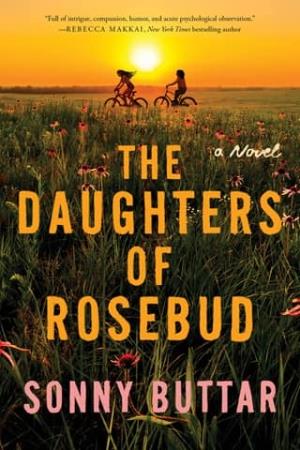
The Daughters of Rosebud
Prologue
There is a story our parents told us only once.
When they received their immigration papers from America, they considered leaving one of us behind in Pakistan to live with relatives, believing that one child would be easier to take care of than two.
Leaving a child for a time, or forever, with a relative is not unheard of in the culture I come from.
Once our father was successful, they would send for the one left behind.
Asma asked, “Which one of us were you going to leave?”
My mother shifted uncomfortably and waited for my father to speak.
Abu said, “The bad one.”
I remember everything about the memory but my father’s face.
No amount of racking my brain can conjure whether he was smiling or serious.
We were outside on the patio, a large concrete slab at the back of our house.
It was a hot summer night, the pavement still releasing its heat long after the sun’s retreat, leaving us in the shadowy, cool embrace of dusk.
Abu was grilling chicken legs slathered in barbecue sauce, proudly holding tongs in one hand and a spatula in the other.
It couldn’t have been our first summer because there was the picnic table—they were so proud of that old thing, which gave splinters if you slid down it in the wrong direction.
Ever since we had seen townspeople eating and dancing under the stars at the summer fair, soft music puffing out from the pavilion, dinners outside carried an air of joy.
We felt like we were doing something special.
Just a recently immigrated family from Pakistan in a small country town in the middle of America having a typical Sunday-night barbecue.
There was a sense of pride, like we had gained admittance to a secret club.
The Being American club. There is an easiness in the memory.
It carries none of the hardscrabble anxiety of our first summer when everything seemed awash in fire.
Ami called us from swinging to come help set the picnic table.
She had probably made rice with chickpeas and a corn salad with chopped tomatoes and cucumbers from her garden, fresh with mint and cilantro and a little tangy with chaat.
Asma and I sat opposite our parents. They were in a rare talkative mood.
The truth is that no matter what happened later, we were a form of happy in those early years.
This image comes back to me all the time.
I cannot corroborate it. There is no one left to ask.
It is as though it holds the key to everything that came afterward.
Maybe if I can recall the missing pieces, then I might finally be able to let go of this weight I carry.
Maybe it will help me understand and find some forgiveness. For them. For me.
But memories, like dreams, are slippery things.
They refuse to let go. The act of remembering, the attempt to capture, corrupts the memory itself, and all I’m left with is a fuzzy image of the picnic table.
A blank space for my father’s expression, my mother’s eyes helplessly trained on him, and Asma and I trying to figure out which one of us was the bad one.
Sometimes I get a sense, in the split second before the phone rings, of who is calling. Especially when it’s Mamoo and, a long time ago, when it was Asma. I have no explanation for it. It just happens.
Last week, I felt dread climb my legs and stop at my chest, the constriction so tight that for a moment I thought there was something physically wrong.
And then the phone rang.
I let it ring and ring.
A few years ago, I found a clipping of a newspaper article by the local paper about my family’s arrival to our little rural town.
It is dated 1977, the year after we immigrated.
In the picture, Asma is eight and I am seven.
Abu must have been forty-two years old and Ami twenty-five.
I have no recollection of sitting for the photo.
But there we sit in our living room, a sweet family unit looking like we belong.
To each other. To Rosebud. To this country. There is no sign of what is to come.
My mother with her corona of not-quite-curly hair sits on the couch with us girls, a dupatta loose around her neck.
She looks like a third child, smiling timidly.
Asma and I, stick thin, are wearing matching shorts and velour tops of an indeterminate color.
We sit so closely that we appear like one normal-size child with two heads.
Asma leans forward with a toothy smile for the benefit of the camera, a large gap visible in the top row.
I am partially obscured, hiding behind Asma’s forwardness.
Abu sits on the arm of the sofa looking somber, his hand on Asma’s shoulder squeezing it or holding her back.
The black-and-white pixelated photo, washed out to a yellowish gray, makes it impossible to tell.
The people in the picture feel so wholly unconnected to me, they could be characters in a movie.
My parents look young and innocent, their faces open to life.
The article says we came to America for opportunity and a better life.
We did not come to America for opportunity or a better life.
We came to America because our uncle Javed, our Mamoo, sponsored us.
He said we should come, and so we did. It is easy to see my parents going along with the idea, with no plan or understanding of what was on the other side.
But the truth is that I never really knew them, so how can I say what compelled them to come?
Other than in their final act, they so rarely showed agency in the big decisions.
Maybe all immigrants are foolhardy. How else does a person sever themselves from their family, their language, their land, and everything they know? I imagine that they, like most everyone who immigrates to this country, thought life would be easier in America.
I am now approximately an age equidistant between the ages of my parents at that time, and I find it impossible to imagine such an undertaking. The force of will required to break free from the gravitational pull of my life, however small it may be, is inconceivable.
The phone has started ringing all the time now. In the morning as I step out of the shower, in the evening as I wash my dishes. It could be a friend or a telemarketer. But by the nameless pit in my stomach, I know it isn’t.
I miss Asma, sometimes with an absence so fierce it feels like a phantom limb is trying to grow back. She has been gone for almost as long as she was here.
I am still living a half life. Neither young nor old. Neither here nor there. Neither wholly Pakistani nor wholly American.
I am a teacher, blessed each August with a new crop of seven-year-olds. I have a few friends, none of whom know my past. I have Mamoo and, until not too long ago, Aunty.
I read a lot. I think a lot. I feel myself waiting. I just don’t know for what.
Finally, I answer the phone.
“Salma? Beti?”
My breath is knocked out of me as though it is gym class and I have fallen on my back from the climbing rope.
I brace myself against the wall. It is my father.
I have not spoken to him in almost twenty years, and I believed that I would never hear his voice again.
You do not get to call me daughter. I feel dizzy, no longer knowing where or when I am.
I smell the sweetness of roasting onions and the sharp, earthy smell of crushed coriander.
I swear I hear the heavy-gauge iron lid my parents brought with them from Pakistan adjusted repeatedly until it finds its fit on the pot it belongs with.
I smell rice steaming. His breathing is labored.
He must be over seventy now. What must he look like at this age?
I immediately feel guilty for wondering.
At the top of the list of all the things they denied me is the ability to see Asma and each of them grow and change.
I am not an angry person; anger never seems to enter the room where I live. Maybe that explains my stuck-ness. I have seen how it burns bright and cleansing. Asma ran hot and periodically laid waste to people, beliefs, and anything that got in her way.
“Salma?” he asks.
“What do you want?” I whisper. I am a child again, afraid of losing love.
I am an adult, full of terrible memories.
I want to excise all feelings. I want to be a robot.
I don’t want to know what he might be feeling or where he is or how he’s spent the last eighteen years.
I don’t want to know whether he thinks about Asma every single day.
I don’t want to know the nature of his relationship with Ami.
He doesn’t deserve empathy or curiosity or decency.
Mamoo shields me from knowledge, and I happily let him; it is easier to not want to know too much.
“Beti, my shame has brought me cancer. It is in my lungs.”
As if to prove it, he coughs in a gruesome way and then sips something.
Was his voice always so gravelly and frail?
Is it because he’s dying, or has he learned remorse?
I remember walking with him to get ice cream after our first day of school in America.
The way he smelled of exhaust fumes and sweat after a shift and went straight to take a shower.
The wonder on his face as he settled himself into his chair.
If I think about it hard enough, maybe now I could remember his expression at the picnic table.
I don’t respond. I also don’t put the phone down. I hate myself for not hanging up. I hate myself for helplessly feeling curious. Just listening to him, permitting him a voice, makes me feel like I am betraying Asma yet again.
“It wasn’t your fault. It was all because of me.” His voice cracks.
He thinks he can show up after almost twenty years and make this announcement and release me? When Mamoo and Aunty and the countless therapists I’ve seen have not managed to help me remove my cloak of guilt? I like that cloak, and I will not let it go. It is a permission slip, my license to suffer.
There are things I will never forget. His eyes the last time I saw him. The way his body slumped when they read the verdict.
“I am at the end. Can I see you?”
Oh, how history repeats itself. Family patterns, even those we have no awareness of, never die.
They are the high-pitched laughter, the fleeting expressions of confusion, the shapes of eyes passed down from one generation to the next.
Once Abu returned to Pakistan for his own father’s death, and everything changed upon his return.
Sometimes I play a game called “What would Asma tell me to do?” Since she is ever present in my head and I know exactly what she would say about almost everything, her instructions are easy to hear.
We engage in a kind of low-level, constant dialogue.
Usually, she is affirming and tells me to listen to myself and to do what feels right to me.
She reminds me that I am a rule follower, more dutiful than she was, that I live my life in service of others, fulfilled by their happiness, and to accept that about myself.
Sometimes she points out the absurdity of a situation, and we share a laugh.
She tells me to get on with my life. That I owe her more than throwing mine away waiting.
But what should I do about this phone call? She remains silent.
“Salma?”
My life is in two parts. The part that came before, marked with the indelible imprints of immigration and its hoary twins, displacement and awe. And the part that came after, where I still live.
As much as I think about Asma, my mind continuously flicking over where she is supposed to be, I avoid the time that connects the before and the after.
I do not venture into that gray time. There is too much pain in that place.
It takes all my power to keep it at bay.
There are too many unanswerable questions.
About my parents. About Asma. About me and my role in what happened.
Now that the past has come for me, Asma does not guide me or tell me what to do.
There are things that need to be said. Words I must write as a means to explain the world. To explain myself to myself.
I am the bad one after all.
I held Asma’s life in my hands three times. Once I saved her. Once I condemned her. This time, I will remember.