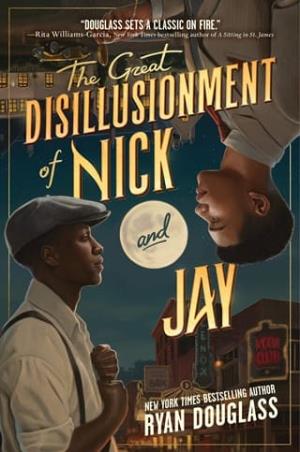
The Great Disillusionment of Nick and Jay
Chapter 1
Time always moved slowest when I wanted something. I wanted to know why Isaiah had invited me to talk.
He didn’t say what was on his mind, but I knew it was about what I did on the porch in that moment of poor judgment all those
years ago. It had been the pit of my shame ever since. I knew the day would come when we’d have to talk about it. I just didn’t
think it would be today.
I sighed and fell back against the wooden shelves. It was nearing the end of my shift and the time showed 4:54 p.m.—only six
more minutes until I was free.
Free from brushing mud out of shoelaces, polishing church shoes, and attaching straps to slingbacks.
Warm air blew through the room’s window—the only breeze I had in this place. It was always hot in here, on account of Mr.
Wallace’s protest against air-conditioning. “The world don’t need more machines,” he said. “More machines means more toxins.
More toxins means shorter lives, for all humankind.”
Mr. Wallace was a shoe-shiner but make no mistake—he was whip-smart. I never would’ve connected air-conditioning to doomsday, but it made sense I guess.
I wiped sweat from my forehead as the floor creaked beyond the door. Mr. Wallace was approaching the backroom from the parlor.
I quickly closed my pocket watch to sort the remaining shoes into boxes, but then Mr. Wallace opened the door and the watch
slipped from my fingers, rolling across the carpet and stopping at his shoe.
He reached one of his long arms down over his belly and picked up my clock, eyebrows tensed as he handed it back to me. “You
dropped something,” he said.
“Thank you, sir.” I took the watch and tucked it into my shirt pocket.
My mentor looked around at the mess. “How long does it take to box a few shoes, young man?” he asked, his tone carrying a
sting of judgment.
“Sorry, Mr. Wallace,” I said. “I got distracted.”
By all my memories with Isaiah, I didn’t add. The fact we’re growing different, like a sweet gum and a black gum, each in its own swamp.
Mr. Wallace looked at me like he knew something was wrong. “What’s on your mind, son?”
What would I say? Friendship meltdowns?
I could talk to him about some things. More than I could talk about with Pa—that’s for sure. But I knew what was between me and Isaiah was for us to work out.
Mr. Wallace sat on a stool with fatigue. He’d worked for generations. His shop was a staple of the community. It had outlasted
every business that popped up and called it quits soon after.
“If it’s about your father,” Mr. Wallace said, “you know what I’m going to say, Nick.”
Ah, there was a change of topic that felt daunting, but somehow more approachable. He’d advised me on my issues with Pa before.
Like a rooster in the morning, he told me to forgive him—forgive him! Cock-a-doodle-doo.
“With respect, sir, I can’t forgive somebody for something they ain’t sorry for,” I said, before he got around to saying it.
“You stay waiting on people to apologize to you, all them grudges gon’ crush you like a ripe grape!” he said. “Do you want to win, or do you want your grudge to win?”
“I suppose I want to win,” I mumbled.
He leaned back with righteousness. “So . . . ask yourself what your father’s choice in denying you apprenticeship is teaching
you about your own sovereignty. Take the lesson, leave the pain.”
“Sovereignty, sir? Like power?”
“Not quite.” Mr. Wallace pulled a dictionary out from a drawer under the shelves. “That would be the A definition. I, myself, prefer the B definition.”
He looked like an explorer in his loose canvas pants, spouting out knowledge.
“Freedom from external control, or autonomy,” he read from the dictionary, while looking at me over his glasses.
“Your sovereignty is your choice. It’s what leads you in life.
If you intend to be a writer, it shall be that you become one, whether you have your father’s blessing or not.
” He closed the dictionary and placed it back in the drawer.
“See, we don’t need apprentices and masters,” he went on. “It’s the structure of things, not by necessity, but because each
of us makes a choice to uphold this order. In reality, each of us needs only the discernment to guide ourselves.”
It’s funny. I knew I could do things and be someone without my father’s blessing, but I so desperately wanted it. He was my
blood. All I had since Mama passed and Daisy moved away.
I began sorting polish into the pockets of a wooden case. “Papa thinks I don’t got enough brains to write for The Star,” I said. “So, if I do end up writing, it would have to be for someone else.”
“Did he say that?” Mr. Wallace asked. “That you don’t have brains?”
“Naw, but he implied it.”
“Perhaps have another talk with him and ask for his reasoning—ah, ah,” Mr. Wallace said, pulling a black canister from my
hands. “Careful, this shouldn’t be with the polish.” He placed it on a side table.
“What is that, sir?”
“Toxic chemicals that will burn your skin to the bone if you touch ’em!” Mr. Wallace crooned like a dramatic stage performer. “I should have warned you before
leaving it out on the worktable.” He stretched to pull a safe box down from a top shelf. “Mrs. Millie has forgotten the combination
to her late husband’s safe box and has asked me to crack it open.”
Mrs. Millie was my neighbor. She was about seventy years old, and one of the first to buy land some twenty years ago from Mr. Gurley when he started selling plots to Negroes looking for a new start.
Lots of my elders was coming from tenant farms where they worked like slaves for a tunic and some cornmeal.
Since Greenwood was new, we still acted like folks on the run. We were real secretive with our money, like storing cash in
a shoe-shiner’s shop secretive. If the white folks ever came to loot us, they’d go straight for the banks, never here.
Mr. Wallace screwed the top off the canister. He dipped a pipe cleaner into the soppy stuff and then rubbed it along the door
of the safe. “This locked safe? Think of it like your life. You could waste it trying to find the perfect series of clicks
to open the door. Or you could work smarter and not harder.” He continued to delicately rub the substance in a rectangle.
I could already smell burning steel from what it was doing.
“There are many ways out of a trapped situation,” my mentor said calmly. “Not just one combination. My personal favorite is
sulfuric acid, otherwise known as grease. This stuff is highly dangerous, son—you may want to stand back.”
In seconds, the grease caused the metal door to curl and melt off the safe, sending tendrils of dark smoke into the air between
us. Inside was an ocean of banded dollar bills.
“What?” I exclaimed. “That’s slick!”
Mr. Wallace let out a long whistle as he pulled some money out and inspected it, seeming impressed. “Never knew Old Man Francis
had it like this.”
He was fascinated with the sight of money—typical for the son of Easter Wallace.
His father was a reckless kleptomaniac who stole his old master’s safe before escaping his farm for Greenwood.
He taught his son safecracking, and though Mr. Wallace followed a more legitimate career, best believe he still knew how to crack one open.
“Say, out of curiosity, how do you make that st—” My question hadn’t left my mouth before a hard object smacked me on the
side of the head, landing with a clack at my feet. “Ow!”
The object was still rattling slightly between my brogans—a small pebble that had been hurled in from outside.
“What in the—?” Mr. Wallace limped toward the window and barked, “Who’s there?”
“Sorry!” came a familiar voice. “I didn’t mean to throw it that hard.”
I felt a throbbing in my temple as my old friend’s open hands appeared in the shop window.
“Sorry, Mr. Wallace,” Isaiah repeated.
“Don’t be throwing rocks through my windows, boy!” Mr. Wallace screamed.
I started laughing.
“Sorry!” Isaiah called, backing away across the grass. “Sorry!”
Mr. Wallace turned around. I stood up and ran toward the window, sprouting out of it so my upper half could be outside.
“A pebble?” I asked. “Really?”
“Just trying to toughen you up.” Isaiah sauntered forward with a smile, drawing closer to me across the field. “What time do you get off? I wanna show you the Vanderbilts’ estate.”
Ah, the Vanderbilts. They were the rich family he’d become a groundskeeper for. Isaiah moved up in life faster than me, that’s
for sure.
I pulled out my watch and found the hands showing five p.m. “Right about now! But I’m supposed to be home before the sun goes
down.”
“Well, move back! I’ll help you finish up.”
I moved, and he climbed clumsily through the window and landed with a thud.
Mr. Wallace was stringing up a money bag with Mrs. Millie’s cash. He raised an eyebrow at Isaiah. “You break something, you
paying for it!” he said, then left to go back up front.
Isaiah looked judgmentally at him and then my work quarters. “What’s got his buttons in a bunch?”
“He’s sensitive to violence,” I said. “Mr. Wallace is a gentle man.”
“Is that why you work here?”
“No,” I said, fitting two shoes in a box like puzzle pieces. “I work here because I don’t have a choice.”
I could feel Isaiah rolling his eyes. “Nick, you always have a choice in being a shoe-sniffer.”
“What a terrible way of framing it! We all need a shoeshine every now and then.”
“Not the point.”
“Then what is the point?” I turned to face him and then caught our reflections in the wardrobe mirror.
Even our fashions were more at odds lately.
I wore a flat cap and loose shirt with suspenders to hold my knickerbockers up.
He wore a blue suit that fit his muscled form and a matching fedora that complemented his square face.
Isaiah’s hair underneath was in close-cut, brushed waves.
His complexion was a warm, reddish brown, like chestnut. Mine was similar, but a bit darker.