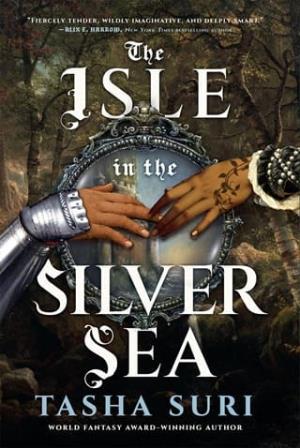
The Isle in the Silver Sea
Part One
Long ago, there lived a knight who was tasked by the Queen to kill a terrible witch.
All witches are terrible, of course, but this one was especially wicked.
The witch lived upon a grand mountain range, in a sprawling palace of bronze ore.
There, she spun ore into fire, and fire into scrying glass, and made great mirrors that she hung upon her mountain peaks so that she could watch the good folk of the Isle and drip evil dreams into their eyes.
Every man and woman and child who glimpsed her mirrors became afflicted with nightmares so dark and so vicious that many perished from the horror of them alone.
“The witch must die,” the Queen proclaimed, her white face solemn beneath her golden crown, “before she drives all the Isle to madness with her nightmares. Are you brave enough to kill her, dear knight, and pure enough of heart to survive the poison of her magic unscathed?”
The knight kneeled before the Queen and bowed his head.
He was broad and tall with hair like yellow wheat and eyes as blue as the sky at midsummer, and his heart was so radiantly pure that some said light shone from his face like a beacon.
He knew the witch, for they had crossed paths before, and he understood that her wickedness was as deep as his purity.
“I will not return until I have run my sword through her beating heart,” the knight vowed.
He took his steed and his sword and rode for many days, from the Queen’s Palace to the salt-swept coast, through forests of wizened trees and glades of fae and gnomes and all manner of trickster creatures, until he arrived at the bronze-peaked mountains of the witch’s domain.
He knew if he gazed into the copper light of her mirrors her poison would touch him, so he bound a cloth over his eyes and followed the guidance of his pure heart.
His heart led him upon the mountain into her palace.
Around him the air smelled of meadow grass and heather, winter’s mead and summer’s honey, but he knew these scents were illusions and that around him lay nothing but a palace of bones, rich in the smell of smelted ore and fire and charnel smoke.
He heard the whisper of silk skirts and a woman’s laughter, and knew that a witch of profound ugliness had lurched toward him wearing an illusion of beauty.
He held his sword aloft, and the witch laughed again.
“You cannot kill me in my own palace, where my magic is strongest!” the witch cried.
“I can, and I shall,” the knight declared. “Because my heart is pure, and I serve the Eternal Queen, who rules everlasting.”
“If my magic cannot defeat you, then remove the cloth upon your eyes,” commanded the witch.
The knight refused. He struck with his sword and smelled her blood on the air. It spat and sizzled where it touched the earth.
“Look at me,” implored the witch before he could strike again, “and I will release all the people of the Isle enthralled by my enchantments. I vow it on my magic. May it wither if I lie to you now!”
A witch vowing on her magic is as good as a knight vowing on his honor. So the knight removed the cloth from his eyes, because he could not allow good people to suffer if it lay in his power to do aught else.
When the knight beheld the witch he saw a fair maiden with skin as white as unspoiled milk and hair spun from gold. But he knew this was an illusion, because witches are rotten by flesh and by nature.
Too late, he realized that behind her stood a vast bronze mirror inscribed with words of magic. The sight of it bled poison into his eyes and fire into his blood. With a cry, he covered his eyes once more, but it was far too late.
“It is the mirror of change,” the witch gloated. “It will turn your goodness to wickedness, and the hate in your heart to love. Your own purity will destroy you and make you mine!”
Overcome, the knight went to his knees and professed his ardent love for her.
The witch kept her word and released every good Isle-blooded man and woman from her enthrallment. She considered it a worthwhile sacrifice, for she now possessed the knight, and she knew his sword would lay waste to the Isle if she only asked.
For many days the knight served the witch and committed terrible deeds on her behalf.
His sword dripped blood and turned the mountain snow red.
But the witch’s inevitable ruin lay in the spell she had cast upon him.
One day she looked into his eyes and saw her own poison of change within them reflected back at her.
His love was a mirror she had foolishly gazed upon, and now it ensnared her.
In a moment, her wickedness was turned to goodness and her hate to love. And she fell into his arms and wept, repenting all the evil she had done. She kissed his eyelids and kissed his mouth as she wept, and the love in her kiss broke the enchantment upon him.
The knight remembered himself, and wept also, for the spell had transformed the witch into the fair maiden she had long pretended to be, and the sight of her made his false love into true. But he had made a vow to the Queen, and he could not break it.
He ran the sword through her heart and through his own, and they died together, the knight and the witch.
In the end, the knight acted wisely, for he knew love was the ruin of them both, and only death could set them free.
He did not know then that their love was a Great Tale—an Isle-feeding fable, a love story to nourish the forests and fields, to make the Isle’s birds sing and its adders slither.
Their tale made incarnates of them, and like all incarnates they will return to live their tale and love and perish for a hundred thousand lifetimes and beyond. Indeed, they will love and die until the day comes when no more stories are born and told at all.
On that day, the Isle will crumble into the sea, and be lost forevermore.