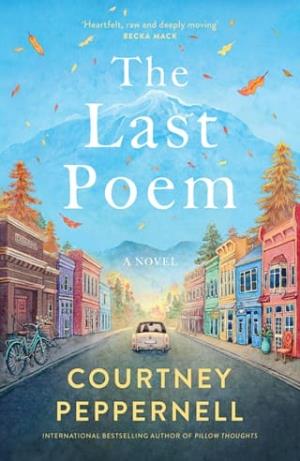
The Last Poem
Prologue
Wren
We are all going to die—at some time, at some place, and in some way, because all life ends eventually.
How is never guaranteed, when is a mystery, and why is one of life’s most pondered questions.
But what anyone will tell you is that the world will still carry on, even in our absence.
The garbage trucks still collect the trash, the bills still arrive in the mail, the cars still fill the freeway, the sun still rises and sets.
Since the day my fiancée, Lucy, died, I knew that the world would carry on without her, but my world stopped.
The trash piled up, the bills went unpaid, the car sat in the street for months on end, and the sky, like many other things in my life, lost all its joy and color.
Since that day, I have been waiting for a morning when I open my eyes and her face is not the first thing I see.
I have been waiting to listen to the rain and not hear her footsteps in between its soft patter.
I have been waiting for a sun-drenched afternoon when I don’t hear a knock at the door and think that it is Lucy coming home.
We lived in a townhouse in Manhattan. It was a beautiful brownstone, its timber finishes polished despite its age.
Marigolds grew on the windowsills, and potted plants lived on the stoop.
We had a balcony that overlooked a courtyard, wisteria twisting along the fences in lazy, fragrant spirals.
In the summer I would sit and write from a small iron table on the balcony, shaded by the vines, and in the winter I worked from my office, nestled in front of the fireplace with Lucy often curled up nearby, reading or simply watching the flames.
I wrote everything, novels, books of poetry, collections of essays, and at the center of it all was Lucy.
I wrote about my love for her, about the life we built together, about the adventures we shared and the quiet, ordinary moments that made up our days.
Those books became bestsellers. The poetry collections earned me literary awards, and my novels garnered critical acclaim.
Lucy, always my biggest cheerleader, had begged me to try my hand at a young adult fantasy series, an idea that had lurked in my brain but which I’d nearly dismissed.
In the end, The Lost Archives, a series about a secret academy, enchanted books, and a hidden history that was never supposed to be uncovered, somehow became a runaway success.
It dominated bestseller charts, was translated into dozens of languages, and was eventually adapted into a movie trilogy.
My essays were featured in The New Yorker and The Atlantic, and my name became synonymous with intimate, lyrical storytelling.
The press loved me. I was B.W. Paisley, an author who, according to The New York Times, “could make even the simplest moments feel profound.” I gave interviews, appeared at literary festivals, and attended galas, all with Lucy by my side.
Together, we were the couple people admired, perfectly imperfect, unapologetically in love.
We had a combined social media following of fifteen million.
Life had miraculously turned out the way I had always dreamt it would be: I was a successful author, I was engaged to the love of my life, and I was happy.
On quiet Sunday afternoons, Lucy and I would stroll through Central Park, caramel lattes in hand, planning our wedding.
We’d marvel at how we had managed to create such a life together, weaving our dreams into reality.
We felt unshakable, as though nothing in the world could touch us.
Until one evening, it all came crashing down.
We were driving home from a charity gala in New Jersey.
Lucy worked as an art dealer and, because of her job, we often attended those kinds of events: dressed up, smiling for donors, slipping shrimp cocktails onto tiny napkins.
The city lights blurred past the windows, and I remember feeling tired but happy.
“I’ve been thinking about writing another poetry book,” I said as casually as I could, though it would be my first in a decade. “With the wedding coming up, thinking about my vows has sort of put me back in the mood.”
Lucy grinned. “I’m sure your editor will be excited to hear this.”
“I may have already mentioned it to Peter,” I admitted.
Lucy giggled. “I bet he squealed at the thought of his agent commission. So, how long have you been secretly writing poetry?”
I shrugged, a little sheepish. “Oh, not very long. I’d almost forgotten how to string a stanza together.”
“You could never forget,” she replied, softly. “You’ve always loved writing poetry.”
I smiled. “I’ve always loved writing poetry about you.”
Lucy laughed, her breath catching in her throat, her eyes glistening. “How many poems could you possibly write about me?”
But I was never given the chance to respond.
It was as though a bomb went off, and the world exploded.
The sound of brakes screeching filled the air while glass shattered into sharp raindrops around us.
Lucy’s arm instinctively reached out across my chest, as though she could hold me in place as the vehicle skidded across the road.
We slammed into something, and suddenly I was overwhelmed by the smell of motor oil, of burning rubber, of blood.
Someone was screaming and I wondered in a daze who it was, until I realized the sound was coming from me.
Then complete silence enveloped us. It was as though time had stopped, like we were in a vacuum of empty space, and the only thought in my mind was of the woman I loved. I reached over to Lucy and—
“I love you, Brooklyn,” she said, with her final breath.
I’d do anything to give her the answer to her question.
I could write about her forever.
I spent a week in the hospital. First responders had to cut us both from the vehicle.
I had a fractured femur and a deep gash in my head that required twelve stitches, but that was it.
My Lucy, though, was pronounced dead on arrival.
My mind shut down and would only offer me bits and pieces of the accident in short bursts, my memories slowly and stubbornly returning as the weeks wore on.
Once they decided I was strong enough to handle the truth, the investigators came to me.
They told me a young pedestrian, all of five years old, had been struck and paralyzed, and that a John Doe had been injured in a separate vehicle, his condition critical.
Their words were careful, their tone measured, as though there were pieces missing.
Of course, the media devoured the story.
The accident wasn’t just a tragedy; it became a spectacle.
The press covered it relentlessly, twisting every detail, hungry for blame and scandal.
They painted Lucy as reckless and irresponsible, her name dragged through headlines and talk shows.
I became collateral damage, my grief laid bare for public consumption: “B.W. Paisley Injured and Her Fiancée Dead”; “Fatal Collision; A Night of Revelry Turns Sour”; “Tragedy on the Turnpike”; “B.W. Paisley Crash Being Investigated by NYPD.” Paparazzi camped outside our brownstone, their flashbulbs lighting up the windows like strobe lights, chasing me down the streets of New York as if grief alone wasn’t enough to destroy me.
There were thousands of comments spiraling across social media; most were just people wanting to share their condolences, but others were accusations.
The NYPD eventually claimed the accident had been Lucy’s fault and that it was caused by her negligent driving.
They even tried to insinuate that she may have been under the influence, despite the fact that she hadn’t had a drop to drink at the event.
I was no longer “B.W. Paisley, celebrated author.” I was “B.W. Paisley, tragic survivor.” The same press that had once built me up now dismantled my life, piece by piece.
I stayed numb in those weeks after the accident.
I could barely remember Lucy’s funeral. In the months that followed, my lawyers dealt with lawsuits that did not feel justified, but I didn’t pay them much attention.
I just couldn’t; everything felt so dark without Lucy.
There would be no more walks in Central Park, no more wedding planning, no more falling into her arms at the end of a long day and feeling as safe as I could ever hope to feel.
Instead, I had effectively become a widow, at twenty-nine years old. And of course, I stopped writing.
One afternoon almost a year later, staring out at the withered wisteria in our courtyard, I got a call from our wedding caterer, confirming the recipe for my grandmother’s pecan rum bars—my favorite treat growing up.
Lucy had planned them as a surprise. It was such a Lucy thing to do, and the weight of her loss hit me harder than it had in all the preceding months.
How was I supposed to exist in a world without her?
I suddenly realized I couldn’t be Brooklyn Paisley anymore. Not without Lucy.
I packed Lucy’s clothes, everything but her favorite sweater, and left the boxes at Goodwill, fleeing before I could watch them be unceremoniously sorted into dollar bins and color-coded racks.
Then I told Peter, my literary agent, that I was taking a couple of weeks off—to get some space, to return to writing the poetry manuscript.
And he believed me. As though, somehow, a few days away was all I needed to grieve the fact that the love of my life had been gone a year.
The truth was, though, I already knew I wasn’t coming back anytime soon, I just couldn’t bring myself to say it aloud.
He spluttered something about how much faith my editor had in me, how she was ready to make me an offer for the poetry book, but I had already stopped listening.
I pushed away all other obligations into a corner of my mind and packed a single suitcase, taking Lucy’s sweater, my favorite notebook, and a scrappy collection of cardboard drink coasters with me.
Then I fled. What started as one week turned into two, then three, and then I stopped counting.
I drove from city to city, then state to state, searching for Lucy.
The highways were lined with tacky billboards, their clashing colors and chaotic layouts all blending together like a carnival gone wrong.
Lucy, with her art dealer’s eye, would have torn them apart.
Green on blue? What are we, in elementary school?
she would have quipped. Her job wasn’t just about selling art, though; it was about connecting people.
She was always traveling, networking with collectors, curators, and artists alike, raising funds to promote work she believed in.
No matter where she went, she would always bring home a coaster from a local bar for me.
It was her small way of letting me know she was thinking of me even when she was far away.
I visited upscale wine bars and sat on rickety stools at places with sawdust on the floor.
I followed the coasters and drank at nearly all the bars she had been to, trying to find her in the bottom of a bottle of cabernet.
I could almost see Lucy sitting beside me in the passenger seat or feel her hand resting on my knee as I drove.
The farther southwest I drove, the stronger that presence became.
The miles blurred together, and so did the days.
I’d stop at roadside diners and gas stations and get coffee in paper cups that was so hot it scalded the roof of my mouth.
I didn’t know what I was searching for exactly.
A sign? A miracle? Some proof that Lucy was still out there, somewhere?
Every so often, I’d spot something out of the corner of my eye—a flicker of movement, a flash of dark hair—and my heart would skip, thinking Lucy really was there. Only it wasn’t her. It was never her.
Until the day, six blurry weeks later, I arrived in Everston, Colorado, a small town tucked into the foothills of the Rocky Mountains, where the peaks rose sharp and jagged against the sky.
The winding mountain road twisted through pine trees and rocky cliff edges, leading to a town of colorful and weathered buildings, nestled in the shadow of the hills.
By chance or fate—I didn’t know what I believed in anymore—I stayed.
Because, as I drove down that final stretch into Everston, Lucy appeared beside me in the passenger seat—so real, it took my breath away.
Her dark hair fell in soft waves around her face, her amber eyes sparkling with the sharpness I loved and missed.
She wore my old flannel shirt, sleeves rolled up to her elbows; the gold necklace I’d given her last Christmas glinted in the sunlight.
She looked at me with that familiar half smile, the one that always felt like it held a secret just for me.
“You found me,” she said, her voice warm and teasing, as if she’d never left at all.
“Where have you been?” I asked, breathless.
“I’ve been here,” she replied. “Waiting for you.”