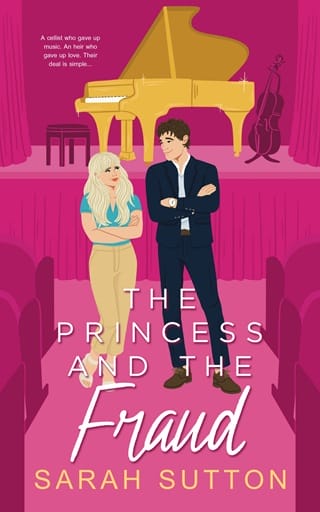
The Princess and the Fraud (Luxuries of Love #2)
Chapter 1
CHAPTER ONE
JUNE
A fter five years of clawing down a certain path, fighting tooth and nail to leave the past in the past, I now teetered on the edge of the same precipice I’d tried running from. Every lie I’d told myself had led me here, where the truth hung heavy in the air. Every step I’d taken to break free had only pulled me back, dragging me full circle—to the very cliff I’d faced five years ago.
Metaphorically, anyway.
Physically? I sat before a sputtering outdoor gas fireplace, its flames flickering and on the verge of dying out. The pit was tucked behind the gilded, cult-like compound where the rich gathered to worship themselves—AKA Massey Hotel & Suites and the Alderton-Du Ponte Country Club.
Yeah, I was in a mood. Today sucked.
I let out a slow breath, disturbing the flight path of the mosquito that’d been buzzing around my head for the past hour. It seemed to have a debate of its own. To bite her, or to not. I had more than enough skin exposed—I’d stripped off my teal Alderton-Du Ponte polo after my shift, leaving me in a simple black tank and my khaki pants that came down to my ankles. Enough skin for the bloodsucker to have a field day, but no. The mosquito buzzed, but never landed, almost as if its sole purpose wasn’t to suck my blood, but to keep me company. To bite her, or to not .
My debate was far less simplistic. To jump, or to not.
Metaphorically, anyway.
After a twelve-hour shift at Alderton-Du Ponte, the most exclusive country club on this side of Connecticut, what sane person didn’t have an existential crisis? And it wasn’t any simple shift—the “Wedding of the Century” was happening tomorrow, which meant, as the “Princess of Alderton-Du Ponte”—or, really, the “Staff Princess”—I had my hands full with every single department’s final preparations. It meant prepping the reception area, stocking the bar, deep cleaning the restrooms, checking in with the valet. It meant I ran my tail off, flip-flopping all over the grounds, not given a moment to stand still.
I should’ve been grateful for the distraction, especially today, but I couldn’t even pretend.
As the day went on, and the list of chores grew, my metaphorical precipice called to me.
Do I jump? had been the soundtrack to every command. Mr. Roberts telling me to re-drape the linen in the ballroom because it didn’t look right. Do I jump? Mrs. Pine snapping at me that I the golden lace for the centerpieces was supposed to be an inch from the center, not through the center. Do I jump?
And then pulling out my phone at the end of my impossibly shift, finding the time 10:32PM staring back at me, and yet not a single text message. If I didn’t reach out first, not a single person in my life would seek me out. Not Caroline. Not Annalise. Not… Grant.
Not even on the anniversary of my mother’s death.
Do I jump from my metaphorical cliff?
It was unreasonably cold for mid-June. I wished I’d left my polo on, and not in the backseat of my clunker. The mosquito fell quiet.
Initially, I’d come out here and just stared at the pitiful flames before me—the gas in the firepit must’ve been running low—and just waited for someone to wander over. The hotel was at max capacity, so surely someone would seek out the smoker’s lounge eventually, right? Wrong. Judging from my aching butt in the patio chair, I’d likely been out here for hours, but no one had come.
My gaze wandered to the right of the patio space, to a big section of Alderton-Du Ponte that jutted out. From the outside, the building was ugly. There was a black door set into the brick building, but no windows otherwise. There was no landscaping done around it, either, making it just a giant box in the middle of lush green grass. An eyesore seemed to be the common consensus amongst the socialites.
It was the emergency exit door to the Du Ponte Music Hall. A stage was behind that door. My metaphorical cliff sat behind that door, locked away to be nothing but a temptation. Tonight, though, for the first time in five years, after despair sank into me like teeth, I truly let myself imagine what it’d be like to give in.
Do I jump?
“Is the east coast always this cold in the summer?”
Despite sitting in a public area, my even-paced heartbeat jumped into my throat at the sound of the low baritone. I turned in my patio chair, finding a man standing near the mouth of the courtyard, hands in the pockets of a pair of what looked like loose cotton pants. He had on a long-sleeved shirt, the top two buttons undone and exposing skin.
“Good lord,” the stranger said mildly as he came closer, peering at me. More specifically, peering at my tank top. “You’re not cold?”
“It’s June,” I said, the rusty sound of my voice startling me further. It’d been the first time I’d spoken in hours.
“It’s also fifty-five degrees. With wind.”
I believed it. I had goosebumps. “The fire helps.”
The stranger took the invitation. He stepped closer to the fire, stretching his palms toward it to soak in its heat. The flames weren’t high enough to fully illuminate his face, only exposing a hint of a square jaw and wide eyes. From the vague outline, he looked my age, maybe. Twenty-four, twenty-five. That was my guess.
“It’s a little late to be coming out for a smoke,” I said, knowing I should probably be more wary of the stranger who’d approached so late at night, but I didn’t unfold my legs.
“I could say the same thing. You waiting to bum a cigarette off of someone?”
“I don’t smoke.”
“In fact, neither do I.” His words became slightly strained as he fell into the chair across from me, as if he’d been relieved to be off his feet. “Nor, it seems, do I sleep. Though perhaps, given that it’s nearly one in the morning, you and I are in the same boat on that one as well.”
The cadence of his words definitely screamed affluent. Nor, perhaps . They slipped so easily from his tongue, as if he rarely used anything else. Then again, on this estate, it was more common to find someone who spoke in dollar signs than not. The only broke ones on the property were the staff.
Even with the obvious financial divide stretching between us like a border between two countries, something inside me sighed, as if I, too, had been relieved of some weight. Finally, a soul to talk to. Finally, someone .
“So, then.” He leaned back in the wicker chair, eyeing me. The gas firepit gave off no smoke, but the flames were so low that the night still hung between us like its own haze. “What brings you, Ms. Non-Smoker, to this dark patio instead of warm and in bed?”
Oh, why was I out here? What brought on this existential crisis had been a domino of things that seemed never-ending, a list that I really shouldn’t unload on a stranger. “I was waiting for someone.”
“A romantic rendezvous?” He arched a brow. “Should I leave?”
Now I did laugh. “Not like that. I meant I was waiting for someone to show up. Anyone.”
“For anything in particular?”
I opened my mouth, but this time, the words were hesitant. “Just to talk.”
He leaned forward, close enough that the orange glow of the flames stretched up further and flushed his face. Definitely my age. “Well, I’m here now. And I’m all ears.”
When I imagined unloading on a stranger, I’d envisioned them old, hard of hearing, wise. Not young, wearing Italian leather loafers worth more than my apartment, and one of the most handsome men I’d ever seen.
That word— handsome —zapped me, even in my thoughts. Guilt, sharp and cold, chased away the urge to spill my secrets. East coast , he’d said. I took a guess. “You’re here for the Conan-Huntsly wedding tomorrow?”
A corner of his lips twitched, gracefully allowing the change in topic. “A mind reader, is she?”
“Most of the guests are from California. That’s where the bride and groom are from.” They’d come back to Annalise’s hometown for the wedding, probably because her mother would’ve rather sold her soul than allow her daughter to be wed anywhere other than the Alderton-Du Ponte Country Club. “Which do you know? The bride or the groom?”
“Groom. You?”
He didn’t know I worked here. It took me a long moment of debate, whether I wanted to be honest. “I don’t know either of them,” I lied, looking away. “But from all the decorations I’ve seen, their wedding will be beautiful.”
“The Wedding of the Century, as they’re calling it.” If I didn’t know any better, I’d almost think there was scorn in his tone. “Some streaming platform is filming the whole thing, did you know? It’s all very grand.”
“You sound bitter,” I told him lightheartedly. “You’re not harboring secret feelings for the bride, are you? I’m not interrupting the secret rendezvous, am I? Sneaking away the night before her wedding?”
And the stranger responded in the same dramatic vein. “Oh, indeed. I was all set to follow my heart, but now you’re here, so I suppose it’s a missed opportunity. Tragic, really.”
A small smile touched my lips, and it felt strange. The muscles in my cheeks almost ached with it. Apart from the last five minutes, I couldn’t remember the last time I’d smiled. Even just a little bit.
“So.” He shifted into a more conversational posture, propping an elbow on his chair’s arm and resting his head on his fist. “Tell me whatever had you seeking someone out tonight. It has to be something. Otherwise, as I said before, you’d be in bed.”
“Do you have something? Is that why you’re not in bed?”
The flames almost made his eyes look like they were glowing. “You tell me yours, and I’ll tell you mine.”
It was how he looked at me that prickled my skin. I wasn’t a ghost wandering through the Alderton-Du Ponte walls. I was real. “I want to jump,” I told him.
“Jump,” he echoed. Then stiffened. “Like, off a bridge?”
“A metaphorical bridge. I want to metaphorically jump.”
He relaxed. “All right. I’m following you. Metaphorically. Why do we want to jump?”
We . Of course, it didn’t apply to him, but that word— we —instantly softened something inside me. My existential crisis was no longer limited to me and the now-silent mosquito.
“I’m a cellist,” I found myself saying, but the words instantly soured on my tongue. They were foreign, too, a confession I hadn’t admitted to anyone in half a decade. Words I’d sworn to never say again. And yet they’d slipped out so easily to this stranger. “I mean, I play the cello.”
“Which makes you a cellist,” he said. “If you play the cello, you’re a cellist.”
The firmness in his voice left no room for negotiation. “No, I used to play. I can’t play now.”
“And why’s that?”
“My mother died.”
I thought the words would feel grander, as calling myself a cellist had. Maybe it was because I was too focused. Just as the stranger watched me closely, I watched him. Meaningless condolences didn’t fall from his lips. He didn’t offer niceties or standard lines. Instead, his eyes simply never left mine, waiting if I wanted to go on.
“Today’s the five-year anniversary of her death, so it wasn’t… recent or anything.” I dropped my gaze to the fire, but the flames became fuzzy, replaced with an image that overlayed it. “But sometimes, it feels recent. Like, if I think back to it, it feels like it was just yesterday.”
Just yesterday I’d spun the ring around her finger while she took her last breath. Both the blink of an eye and not. Five years since I’d last seen her smile, held her hand, heard her laugh. Both the blink of an eye and… not.
“How did she pass?”
“Thyroid cancer. Anaplastic carcinoma. She was gone four months after diagnosis.”
There was no pity in his gaze, but empathy . Pure and bare. “My grandmother’s sick. Pancreatic cancer. She was doing well for a while, despite the diagnosis, but now she… isn’t.” He paused to clear his throat. “So, I know what you mean. How strange time feels as it passes.”
For a long beat, both of us were silent as we regarded each other, the fire hissing between us. Just two people who understood what it was like to experience something so crushing, letting it take our breath away.
“But, anyway—the cello.” He cleared his throat again, sitting up straighter. “What’s your favorite piece to play?”
There were two sides of me. One side rebelled at the question, desperately shaking its head and telling me not to answer. The other side, the side who’d been silent in the dark for so long, begged me to admit it. Even if it was just in a whisper. “Elgar’s Cello Concerto.”
“The first movement?”
I immediately saw the question for what it was worth: an inquiry of skill. Elgar Cello Concerto in E Minor was iconic, with the first movement being one of the more well-known movements to play, but by far the easiest of the four. “Second.”
Admiration glinted in his eyes. “I’ve heard the spiccato is tough.”
“It is a little challenging,” I agreed, and something in me clicked into place—a mechanism stiff from disuse, but still functional. “But it’s rewarding. It’s not a technically hard piece, but the emotional depth and interpretation is why I like it so much. You can really infuse the movement with emotion, you know? The timing, the tone, the articulation—knowing when to give the music space to breathe and when to lean into the sort of out-of-breath pacing. It’s amazing. I love focusing on those interpretive aspects.”
It’d been a long time since my cello geek-speak had come out, so much so that I couldn’t believe half of the words that’d rushed out from my lips. The stranger had unraveled it within me first, mentioning spiccato . A word no one in my life would even have known to say, let alone what it meant.
He knew. That one word alone revived me like a sunbaked plant receiving its first drop of water.
“I’m similar when I play,” he said. “I never cared much about perfect execution. My instructor tried to drill technique into me, but I was always more focused on feeling the music—letting it carry me rather than controlling it.”
“ Exactly .” A thrill raced through me. “You play?”
“Piano.” His lips curved, almost self-deprecatingly. “Emotional expression is everything to me when I play. Sometimes it seems like the one time I can fully let my guard down.”
“It’s the best feeling in the world, letting yourself be honest through music.” And suddenly, I was a balloon with no more air, deflated. “But I… I can’t play. Because my mother died.”
When he simply raised his eyebrows inquisitively, I went on.
“My mother knew nothing about the cello.” My lips quirked a little. “She didn’t get music . I’d explain interpretations of pieces, and it’d go over her head like I spoke a different language. She hated when I’d turn on classical music in the car. But she… she loved listening to me play.”
I’d been unnaturally gifted with the cello from the beginning, when I’d tried it during fourth-grade band class. The teacher had brought out the string instruments, and something about the cello clicked . Instructors used terms like “prodigy” and “genius,” but I didn’t feel like some virtuoso. I simply was a girl who loved the instrument, and loved the sound it made.
If I closed my eyes and pictured it, the weight of the cello between my knees would appear like a ghost pressure, my mind filling in the blanks of my fingers still curving around the bow. The muscle memory was mocking.
My hands were empty now, and the gap between my legs felt as hollow as my chest.
“She even had me to start a YouTube channel when I was young and record my covers, so she could listen to them whenever she wanted.” A confession that used to make me cringe, now I just smiled. “She was my number one fan.”
His voice was gentle. “And so you stopped playing because she wasn’t here to listen to you anymore?”
I found myself looking over at the hall’s emergency exit once more, at the door inset into the brick walls, thinking about the stage beyond that door. Always perfectly within reach, but I always held myself back. “That’s part of the reason, I guess. I’ve put that part of me in the past.”
“It’s interesting that you say it’s in the past,” he murmured, “when you, yourself, called yourself a cellist on instinct.”
“And that, Mr. Stranger, is my metaphorical bridge.”
“To return to the cello, or…”
“To buy a house.”
“A house .” Amusement danced across his features. “A metaphorical house?”
“A real one.” It was the true reason I’d put the cello down, but that was a backstory far too long, far too personal, to unload on him. At least, in its entirety. “It was my mother’s dream house. I’m working to afford it.”
“How much is it?”
I glanced at his Italian leather shoes. “You going to offer to buy it for me?”
“Should I?”
I couldn’t stop the grin that split across my face, and watching his own lips lift in return eased more weight from my chest. “You can’t,” I told him, hugging my legs. “It’d be cheating.”
“Someone is offering to buy you a house, and you decline ?” He gave his head a slow shake of disapproval. “You should be in bed. You’re clearly not thinking straight.”
“Those sorts of favors come back to bite you.” I narrowed my eyes. “ Especially when they’re made by handsome strangers.”
He arched a brow. “Handsome?”
My lips parted at the slip.
“I’m more of a fairy godmother than a genie,” he went on, giving up the line of teasing while sitting back in his seat. “No consequences for a wish.”
I didn’t quite believe him. Not when he was so effortlessly charming. Those kinds of people were even more dangerous.
The stranger’s gaze traced me slowly. “Let’s go back to your bridge.”
My bridge. Abandon everything and go back to the cello, or stay on the path I’d been on for the last five years. It sounded so simple—yet cruel, in more ways than one. It’d been a bridge I’d wavered on for a while, but tonight—it was the first time I truly considered jumping.
“Tonight, I’ve just been… wondering. What it’d be like if I jumped. The house, my job, my friends, my boyfriend—what would happen to it all? What would life be like?” The fire steamed me now. My chair was too close. “My friends, my boyfriend—they all knew about my mother’s anniversary, but no one said anything. And shouldn’t they be curious how my day went? If I was okay?”
I always reached out first, for everyone. If it’d been any normal day, I might not have noticed. Grant, Caroline, Annalise. Their faces flashed in my mind’s eye. Before Annalise moved to California two years ago, the four of us had been close. But Annalise moved, and Grant moved, and Caroline spent more time flying out to the west coast to spend time with them than she stayed in town. And I, who didn’t have a limitless credit card, was stuck in Connecticut working, waiting until everyone thought to come back.
Here . So deeply and wholly unhappy.
My voice was almost curious when I spoke again, soft and sad. “Before, I was able to keep going because I had a team behind me. But it feels like I’ve only just now turned around to find out that no one was really there.”
“Screw them.” The stranger’s expression was perfectly blank, tone matter of fact. I blinked in surprise. “If they can’t find five minutes in their day to reach out on the anniversary of your mother’s death, screw them. To hell with everyone who is making you feel this way.”
Him saying it like that, so simply, interjected a bit of clarity—as if I took a gasping breath after having my head forced underwater. “How do you know I’m not the bad guy in this situation?”
“Because I know what the bad guy looks like, and you don’t look like me.”
I arched a skeptical brow. “You’re a bad guy?”
“I’m not a good one.”
I waited, but only his silence stretched, not his elaboration. He didn’t look away from me, but the light in his eyes grew somewhat distant, as if, he no longer saw me. My mother always told me, “ Lovisa, if a guy tells you he’s no good, believe him ” which, yeah. It didn’t stop the surge of intrigue from swelling within me, though. Maybe it was because the man before me looked nothing short of impressive—expensive shirt, designer pants, Italian leather shoes. Nothing about him screamed bad .
Or, maybe, in that moment, I didn’t care. Loneliness bit into my bones like teeth. Even if he was bad, I’d rather have him listening than no one at all.
“Bad guys don’t usually play piano,” I told him.
“No?”
“You have to be honest to play the piano. Bad guys are rarely ever honest with themselves.”
His smile was a wilted one.
I tilted my head a little. “Do you ever feel like you wake up and realize that this isn’t the life you thought you’d have? That you just… resent it all?”
It was a guilty sort of question, one that sounded more like a confession. Words I’d never spoken aloud—never even let myself think—finally coming to light. Apparently, it was a night full of that. All because of this stranger.
He didn’t miss a beat. “All the time.”
“And what do you do about it?”
“Absolutely nothing.”
I hadn’t realized how deeply I’d been hoping for sage advice until he didn’t give it. The magic fix-all I’d assumed a stranger would impose on me was nothing more than a placebo. “Oh.”
“But I do nothing. You should do something.” He suddenly leaned forward, forearms resting on his knees. “You should jump. Metaphorically. You should choose the cello. My final answer.”
Choose the cello. To leave my mother’s dream behind, to choose my own. He said it so simply. It was his eye contact . Steady. Unbreaking. Invested. It lured me in, despite everything, the connection humming behind my ribs like a tangible thing. “Jumping isn’t exactly free.”
“Do what the smart people do. Marry rich.”
I snorted at his candidness and the boyish smirk on his face. Marry rich . “Maybe I should,” I told him, letting a small grin touch my own lips. It felt so natural to mimic his expression. His was a smile designed specifically to invite the other person to share in the amusement. “Know of any young heirs of marriageable age?”
“How much money we talking? Millionaire?”
“Please.” I scoffed. “Go big or go home. Billionaires only.”
The warm grin he wore split wide, and, for the first time all day, it was like the weight had wholly lifted off my chest. “I’ll look around for you. Surely, we can find one, hmm?”
The firepit’s hissing seemed to grow a little louder, as if it were chuckling with us.
“I don’t even know where I’d go,” I said finally, sighing at the weakening flame. “If I were to get away, I don’t know where I’d get away to .”
“I hear California’s pretty nice. I might know a guy who lives out there, if you wanted to stop by and see him sometime.” He gave a little shrug. “Maybe you can both run away.”
A different sort of pressure pinched behind my ribs. This time not painful, but still all-consuming. “Depends.” I blinked at him expectantly. “Is he a billionaire?”
He tilted his head. “Not quite, but he hopes to be someday.”
“ Hope —sounds like a scam if I ever heard one.”
This time, our laughter twined together, echoing in the night.
It was then that I saw the fine line that stretched between us, one side friendly banter, the other side flirtation. It’d been a long, long while since I’d flirted with anyone. I wasn’t sure I’d ever flirted in my life, at least not on purpose, but it felt so easy now. Maybe it was because of my counterpart, a beautiful stranger with a warm firelight flickering across his features. An unseasonably cold night that became warmer with the blaze and him across from it.
“I have a boyfriend,” I blurted. “I mean—I know I said that earlier. I just?—”
“I’m getting married.”
I froze, blinking, because out of everything he could’ve possibly said, that hadn’t been on the list. Something fell within me—something I refused to name.
“Not tomorrow, if that’s what you’re worried about,” he continued, as if there was nothing wrong. “I’m not the groom of the wedding of the century. I’d offer to shake your hand if it didn’t mean leaning into the fire. But I’m Aaron—Aaron Astor.”
And just like that, my already unsteady world tipped off its axis entirely. That drop of water that revived me earlier once more evaporated. I might not have recognized his face, but his name . Around here, everyone knew that name. He wasn’t any random rich figure roaming the grounds—he was one of the most influential guests Alderton-Du Ponte had in years.
He was Aaron Astor, son of the biggest travel agency empire in North America, and fiancé of Margot Massey, heiress of the hotel I wallowed behind.
I instantly regretted ever opening my mouth. He might’ve nodded, posed a question here and there, but Aaron Astor—whose golden life was so pearly and perfect—most definitely understood none of it. Hadn’t related. As soon as I’d seen the Italian shoes, I should’ve known that someone like him never would’ve understood someone like me.
The hollowness returned, yawning wider inside of me. “Oh,” I murmured—the word slipped out.
The man—Aaron—tilted his head. “Oh?”
It seemed so mocking now. He seemed so mocking now. Offering to buy me my mother’s dream house, turning something I’d worked so hard for into something so flippant. Years of training kept my poker face from slipping, kept my resentment from showing. I stood, body aching from how long I’d been sitting. “Thank you for lending your ear,” I said stiffly. “I should head in.” And head home, sleep off this godforsaken day .
“Did we solve your dilemma already?” he asked as he slid to the edge of his seat, sounding genuinely confused. “Of if you should jump? Because I didn’t think?—”
“I just needed to get things off my chest.” I moved to the firepit and twisted the gas knob, cutting the flow. We plunged into darkness, with nothing but the lights from the hotel to illuminate us. I could barely make out his features now, wishing that was how it’d been from the start. “I’m sorry luck had it that you were my punching bag.”
“I wanted to be.”
I hated that my body reacted to those words. Sit down , my heart coaxed. What would it hurt? “I have an early start tomorrow,” I said, forcing the thoughts down. “And I?—”
“I believe we agreed you’d tell me your problems, and I’d tell you mine.” Aaron’s voice was casual, but now that I knew who he was, I found myself looking for the condescension in it. The superiority. “You’re running away before I have the chance to.”
I gave him my signature Alderton-Du Ponte smile. “I’m sure my advice would be mediocre to what you need, Mr. Astor.”
His face fell at that— Mr. Astor . My tone had given myself away. “You work here ?”
I tried to think of something to say, but ended up merely tipping my head in a small, polite bow, before I turned around again.
And didn’t get more than three steps away before Aaron called after me. “I’d—” he started, and then paused, letting the one word hang in the air, almost as if he wasn’t sure he should finish his sentence. “I’d love to hear you play it. Elgar’s Cello Concerto.”
My throat tightened. Of course, the first person I shared my secret with had to be Aaron Astor. Along with his words, a cold, cold breeze washed across me. You ignored me earlier , I could almost hear my mother saying. Don’t ignore me now .
“Look up Lovely Little Virtuoso on YouTube,” I told him without turning. This time, my hands did tighten to fists. “I’m afraid that’s the only way you’ll ever hear me play.”
“You shouldn’t keep living a life you resent.” His voice almost sounded sad. “You should jump.”
Everything in me rebelled hearing him say it now. The statement reeked of privilege. As if anyone could change their circumstances because they wanted to. As if the universe answered to determination, not dollar signs.“Thanks for the advice.”
As I walked away from him, I landed on an answer to my existential crisis. The debate that had me sitting out here for hours, I finally decided.
I couldn’t jump. I couldn’t abandon everything because I wanted to—I couldn’t be that selfish.
And even if I did, knowing it was because I took Aaron Astor’s advice would haunt me.
The dark feeling that’d washed over me earlier chilled me again now, and this time, there was no ignoring its name. Disappointment . The emotion made no sense, but it was there.
What did Aaron Astor know about living a life you resented? Nothing. Absolutely nothing. And I’d be a fool to listen to him.