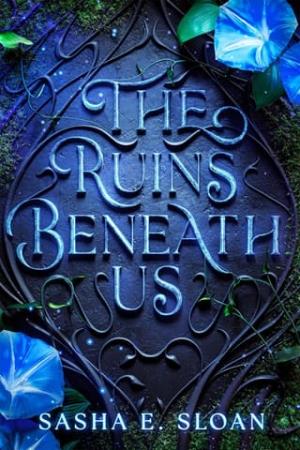
The Ruins Beneath Us
Chapter 1
ne door, two locks, and a gate. That’s all that stands between me and freedom.
I find myself gazing out the window of my attic in the hour after waking.
It’s just before dawn, and I can hear Mother downstairs in the kitchen.
She always cooks a big meal before a trip.
The commotion is comforting, so I listen for a while: cracking eggs, a whirring whisk, sizzling butter. I’ll take all the comfort I can get.
My night was nearly sleepless. I spent it rehearsing the same speech I’ve been prepping for weeks, awaiting a morning like this one.
This time will be different.
I eventually rise and tug on a linen work dress.
My wardrobe is simple, far from the luxurious gowns I’ve read about in books.
Mother values practicality over everything, and it’s not like I have anyone to impress out here in the Ironwoods.
I glance in the mirror and fold a silken kerchief in a triangle before fastening it over my long hair, making sure the sides of the fabric cover the tips of my ears—a habit I’ve had since I was little.
Touching my earlobes, I murmur an incantation I’ve been practicing for concealment.
Then I fasten my apron and slip on boots before checking under my bed for the satchel I packed the night prior.
It contains gloves, snowshoes, extra woolen socks, and a two-week supply of dried meat—everything I’ll need for the journey north.
Mother is a Healer, and one of the best in the world at her craft.
Her work often demands long journeys to procure rare ingredients or tend to her patients.
We make our living brewing potions for markets across the Midlands.
Today, she’s leaving for Sulnik, the icy kingdom to our north.
The road is dangerous—slick in the colder months and a bandit’s paradise in the thaw, or so I’ve been told.
But I don’t worry too much about Mother. She can handle herself.
She wouldn’t say the same about me.
I tiptoe downstairs and find her tying her bootlaces by the door. In a hurry, apparently. There’s a plate for me on the table, but hers is already in the washbasin. I sit and tuck in cautiously, tracking her expression like a weather vane.
Mother’s face is beautiful, lightly lined and highly expressive.
She tells me she’s over three hundred years old, but to any human she would look middle-aged at most. Thick dark hair sits atop her head in a heap of braids.
Her eyebrows pinch when she’s nervous, and this morning, they’ve formed a jagged peak.
“There’s plenty of food in the pantry,” she says by way of hello. “Everything’s labeled. You’ll have to finish the everhart while I’m gone.”
“No problem,” I say, sighing. I can always expect instructions on her way out the door.
“I was also thinking you could start on the all’s-cure,” she continues, casting me an uncertain look. “There’s a full moon next week, and the meadowblood is coming to seed. You’ll have to ensure the cauldron is clean before you start.”
I fight the urge to roll my eyes. I’ve trained as her apprentice since I could talk, and all’s-cure is one of dozens of recipes I have memorized. But nothing escapes her scrutiny. Mother has a potioneer’s mind: detail-oriented to a fault. She’s always criticizing my work or warning me to slow down.
“And we could use another batch of silvertongue.”
“I’m on it.” I fiddle with my fork, strategizing my moment of opportunity. “Do you need help loading the cart?”
“No, thank you,” she says. “I’m not taking much to trade.”
There goes my speech. Half my argument was that I could help her peddle her wares. “Why not?”
“This is more of an investigatory trip,” she says, fastening a cloak around her shoulders.
“What does that mean?”
“Nothing you need to worry about.”
I swallow my irritation. Before I turned eighteen, I hoped adulthood would mean she’d stop treating me like a child in need of sheltering. But Mother’s been protecting me for so long, I’m not sure she knows how to stop.
“So, you’re not going to Sulnik?” I ask, trying to sound casual.
She sighs. “I’m going to a village near the border to investigate some rumblings about a plague. There’s no proof, just rumors. But I figured it’s worth a visit, to see if I can help.”
Her tone tells me I’ll get no further details. I frown, skewering an egg yolk. Rumor of a plague explains her apprehension but doesn’t bode well for my plans. I recalibrate my argument while she checks her bags.
I’ve never seen Mother in anything except her work clothes: a no-frills tunic, skirts with numerous pockets, and a belt for her personal quiver of potions.
The belt is notched with six hooks, strung with six finger-length bottles.
Labels aren’t necessary. We know the color and shape of each by heart.
After running her fingers over the set, Mother scoops up her apothecary bag by the door and steps out into the cold.
Normally that might suffice for goodbye. Mother isn’t sentimental, and she travels too often for either of us to get gooey about it. But I’m determined to say my piece—investigatory trip or not—so I grab my cloak and follow her outside.
She brushes snow off the wagon while I stroll to the paddock. Our horse, Tucker, trots over and presses his big head against my chest. I tickle his velvet nose while Mother circles our yard, mumbling.
Mother is a creature of routine. Setting the wards that protect our cottage is an important piece of our parting ritual.
The spells will conceal the cottage, sight and sound, so long as one of us stays inside the boundaries.
I’ve never been good at spellwork. That’s just one of the many ways I fall short in her eyes.
As she makes her laps, I catch myself staring at her ears.
The surgeon’s handiwork is commendable. If I didn’t know what to look for, I couldn’t pick out the scars where the long, tapered tips were docked into humanoid stubs.
She cut her ears around the time the Verdish Empire seized control, a common practice for Elves seeking anonymity.
When Mother was growing up in these mountains, they were still part of Evermore, the ancient kingdom of Elves that once controlled the heart of the Midlands. But that was three hundred years ago, before the Long War, when a human tyrant waged a bloody campaign to steal the land for himself.
His name was King Verdin. History knows him as Verdin the Vanquisher.
Originally, he ruled over a small coastal kingdom called Dornak in the north, but Verdin wanted more.
Hungry for expansion, he set his sights on neighboring Evermore and determined the best way to reach his goal was by seeding division.
Humans have long mistrusted magic, which is intertwined with Elven culture and religion.
Verdin leveraged that fear, propagating the lie that Evermoreans secretly aspired to use magic to gain dominion over humankind.
He proclaimed that runic spellcraft was evil, and that those born with magical abilities should be hunted to ensure peace throughout the land.
The Midlands have long been plagued by magical daemons from the realm of the dead, so Verdin blamed the Elves for their existence, falsely casting these daemons as Evermorean servants.
He spread his hatred far and wide, rallying an army intent on destroying the Elven kingdom. A century of senseless bloodshed ensued. Verdin ordered Evermore’s capital razed by dragonfyre, an act of cruelty that brought the Elves to their knees. He died smiling.
His son and grandson continued his violent legacy, forcing our people into further and further retreat. The Elven leader, King Amos, last of the great Aldain dynasty, died of a broken heart after seeing what was left of his subjects. His wife, Queen Soleste, surrendered their home to Verdin’s kin.
Evermore became part of the new empire, renamed Verdinae in honor of the Vanquisher—a new kingdom in which all magic was outlawed and the land claimed by humans.
Under the new world order, speaking the old Elven language and worshipping our Gods are punishable by death, making it almost impossible for Elves to exist peacefully in Verdinae without giving up our core beliefs.
After the collapse, my mother and the few surviving Evermoreans faced dismal choices: flee, die, or learn to live in the shadows.
The smart ones got out early and found refuge in friendlier kingdoms like Sontaag or Ursandor.
The lucky ones died quickly. But Elves like Mother, who couldn’t bear to abandon her homeland, learned how to hide.
Despite years of begging, she has refused to clip my ears like hers.
I always argue rationally that I’d be safer without them.
She always counters with a rousing speech about my beautiful Elven heritage and the indomitable spirit of Evermore.
Sometimes I’m tempted to hack them off myself.
But that’s just one of plenty of ways we don’t see eye to eye.
For example, she still believes that Evermore will one day be restored to its former glory.
I’ve never told her just how far-fetched I find that idea.
In the centuries since the Long War, Verdin’s descendants have only continued his legacy of hatred.
The Verdish Church and their anti-magic philosophies are stronger than ever.
Almost no Elves remain in our homeland. And if anyone knew that I was born with magic, I’d be executed on sight.
A fact Mother has never let me forget.
After lapping three times, Mother seems satisfied with her spellwork. I put a halter on Tucker and lead him to the cart, and she fastens his harness while I scratch his head.
This is my moment. I won’t get another chance. With Mother’s back to me, and with the big horse for assurance, I find the courage to finally say, “Mother, I have a proposition. Before you say no, please hear me out.”