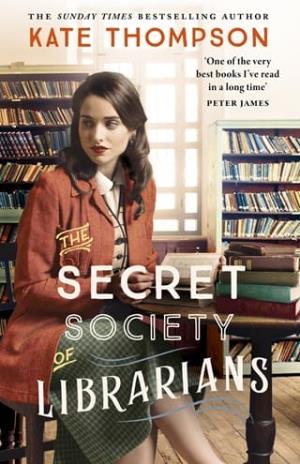
The Secret Society of Librarians
Prologue - Joyce
Prologue
Joyce
During the third annual meeting of the Secret Society of Librarians, British Prime Minister Neville Chamberlain declared war on Nazi Germany.
The SSL, as they called themselves – because who didn’t love an acronym – had gathered at their usual bolt-hole for the weekend.
Joyce’s uncle had an attic flat that smelt of stewed prunes and paperbacks in Bloomsbury, where the great and good of the female library world gathered for one weekend every year to grouse about their male bosses and drink Gin & Its so strong they’d blow your eyeballs out.
But this year, proceedings had a gloomy air, and it was nothing to do with the aftermath of Evelyn’s homemade gin.
The static from the wireless reverberated Chamberlain’s voice right into Joyce’s skull.
‘I have to tell you now that no such undertaking has been received, and that consequently this country is at war with Germany.’
The declaration was followed by a dust-laden silence.
Joyce glanced around the table at all the strong, capable women who made up the Secret Society of Librarians.
Jo from historic Exeter Library. Grace from Channel Island paradise St Helier Library in Jersey.
Beth from bustling Coventry Central. Evelyn from salt-brined Plymouth.
Annie from the market town of Barnstaple.
And she, Joyce Kindred, from just up the road in Camden.
Clara, from beautiful Carnegie gem Bethnal Green, was due to arrive any minute.
The only member absent from the proceedings – despite being very much a lynchpin of the group – was its founder, Dorotha. Dorotha was in Poland, where she currently lived.
What a disparate group they were. They hadn’t a huge amount in common. Apart from a love of books, a passionate belief in the transformative power of reading and a determination that libraries were invented for all, not the privileged few.
Turned out that’s all you really needed in order to hang on to your sanity.
They’d all met over the stacks at a Library Association Summer School at the London School of Economics in the summer of 1936.
Ostensibly, the six-week course had been to prepare them for their Library Association exams, but in reality it had given them so much more than a working knowledge of the Dewey Decimal system.
It had given them an unofficial sorority, a community of like-minded souls who understood the sting of being passed over for promotion in favour of a Library Boy with infinitely less experience.
There were no rules or secret handshakes.
They left that kind of thing to the men’s clubs.
The only unofficial rule was to be kind and supportive.
It was Evelyn who broke the silence. It usually was. ‘Well, we may as well have a drink,’ she reasoned, sloshing a large slug of gin into seven teacups. ‘Soften the edges.’
The sun muscled out from behind a cloud, and a stream of sunshine filtered into the room, striking the bookshelves. The hardback spines dazzled russet and gold.
‘What ought we drink to? The advance of fascism?’ scoffed Annie.
‘No,’ Joyce paused as they all turned to look at her. ‘To Dorotha,’ she insisted.
At the mention of their friend and founder, trapped in Poland, a collective shudder ran through the group.
‘Have you seen the news?’ Jo asked. ‘Poland’s on fire!’
Beth held up her hand. ‘Please don’t, Jo. I can’t bear it.’
‘Dorotha is tough,’ Joyce insisted.
The group raised their glasses to Dorotha and tried to wipe from their minds the horrendous Pathé news footage they’d seen of columns of Polish refugees fleeing bombed cities and towns.
Annie lit up a Black Cat and surveyed them through the blue haze. ‘Joyce is right. Dorotha’s the toughest woman I’ve ever met. She’ll find a way to turn this war to her advantage. Which is precisely what we ought to be doing.’
‘Black market?’ Beth gasped.
‘No, you dolt,’ Annie teased. ‘To opportunities.’
‘I don’t follow,’ Joyce said, taking a drink and appreciating the warmth that snaked down her throat.
Annie’s shrewd blue eyes flickered over the group. ‘The only thing certain with war is change.’ She curled her voice deliciously around the word. ‘Admit it, isn’t that something we’ve longed for all these years? That maybe a ray of light might creep into our respective workplaces.’
‘Come on, who here is really happy with the direction their careers are taking?’
Annie turned to Joyce. ‘You got passed over for a sixteen-year-old boy despite the fact you’ve acres more experience than him. In fact, darling, I’m sure I’ve knickers older than him.’
She turned to Beth. ‘And Beth, dear heart, don’t tell me you’re happy with only being allowed to run children’s story time.’
‘I like children,’ she protested.
‘So do I, but you’ve got a master’s from Oxford, for pity’s sake. You should be running that library, not sitting cross-legged reading Milly-Molly-Mandy.’
Annie ran her hand through rumpled chestnut curls, dislodging kirby hair grips. ‘This is our chance for actual change.’
‘I wish I shared your optimism, Annie,’ Evelyn remarked, ‘but we’re a naval town in Plymouth. If there’s bombing, you can bet we’ll bear the brunt, and some . . .’
She tailed off, and Joyce reached over and squeezed her friend’s hand. Evelyn’s father had barely said one word since he was swallowed up into the hell of the Battle of Jutland.
‘War is an abomination,’ Evelyn murmured.
‘I agree, Evelyn darling,’ Annie said breathlessly, flinging her arms wide and scattering ash. ‘But I think we need to be alive to opportunity.’
Her voice was smoky and crackling, reminding Joyce of all the good things in life, like sitting in front of a log fire with a good book and hot buttered toast or an autumnal walk on Primrose Hill at twilight.
Emboldened by the alcohol, Joyce nodded. ‘Annie’s right. War’s here, whether we like it or not.’
A noise sounded from the hallway.
‘Cooey, sorry I’m late.’ A blast of autumn air swept into the room, shortly followed by Bethnal Green’s children’s librarian, Clara Button. She breezed into the room smelling of pencil shavings and lily of the valley.
‘You’ve heard, then,’ she said, unknotting her headscarf. ‘Would you believe I’ve already been called into an emergency meeting at the library?’
‘Already?’ Joyce asked Clara. ‘What have you been discussing?’
‘Three of our male librarians have already left and signed up since Friday. Peter and I have been working out how we can fill the void.’
‘See,’ Annie remarked. ‘It’s happening already. Our lives are going to be changed beyond measure.’
Clara nodded. ‘Peter and I were musing on this. It’s not easy to assess exactly what the public will want.’
‘Escapist fiction most likely,’ Beth remarked. ‘We’re a nation of readers. War’s only going to increase the demand for books.’
‘Shorts and mercies, here we come,’ Grace laughed, raising her drink. ‘If it’s got a half-naked, swarthy scoundrel on the front, order it in. The good women of Jersey like a juicy read.’
‘But how are we to fulfil our roles properly?’ Jo asked. ‘You can bet that once more of the men get conscripted, women will have to step into their shoes. People’ll be busier than ever.’
‘She’s right,’ Evelyn nodded. ‘Library attendance will be the first thing to slide.’
‘Well, that’s easily solved,’ Joyce said. ‘If people can’t get to the books, we’ll take books to the people.’
‘Is this about your idea for a mobile library again?’ Beth laughed.
Joyce had never hidden her ambition to start a mobile library in Camden. Everyone thought her barmy, but she knew how many vulnerable and elderly people there were in her borough who loved books but simply couldn’t get to the library.
‘There’s an elderly lady called Mitsy who I deliver books to, on the hush-hush. My superior Hildegard would skin me alive if she knew, but I see the joy my visits bring her. Imagine how many Mitsys there’ll be when this war ramps up.’
‘Joyce is right,’ Clara insisted. ‘A library is more than a repository of books. It’s freedom and escape. It’s down to us, friends, to deliver that magic.’
The group digested Clara’s words.
‘It’s settled, then,’ Evelyn announced. ‘That should be our first and only wartime rule. If people can’t get to the books, we take books to the people. All in favour, raise your teacups.’
Slowly, all seven women lifted their teacups, before clinking them together. Joyce felt the stirrings of excitement just thinking about the potential of what might be achieved by such a novel scheme.
‘So, if we’re going to be so busy delivering books, how are we to stay in touch?’ Beth ventured. ‘I hate to sound pessimistic, but these weekends’ll become a thing of the past.’
Joyce nodded. ‘She’s right. Free time will become rationed. Look at Clara. She’s already missed most of the weekend.’
‘I’ve got it,’ said Beth, tapping a red fingernail on the tabletop. ‘We start up a monthly circular instead. We take it in turns to mail out to the rest of the group what we’re doing.’
‘I love it. Kind of like a bibliophile bulletin.’ Grace laughed.
‘Dispatches, but for librarians,’ Evelyn agreed. ‘I’m in.’
‘What’ll we call it?’ Annie asked. ‘Secrets of the Stacks?’
‘Nice. But does it hit quite the right note?’ Joyce ruminated, pursing her lips as she thought. Then, in the silence, she heard the voice, whispering urgently in her ear. The female writer who embodied the truth and integrity that Joyce sought, her voice a clarion call.
One must have the habit of freedom and the courage to write exactly what we think.
And thanks to Virginia Woolf, it came to her.
‘What about “Libertatem per Lectio”?’ Joyce asked, her eyes shining. ‘It stands for “freedom through reading”.’
Seven cups were once again raised in agreement, and in a smoky attic in London WC1, the Secret Society of Librarians toasted their dear friend Dorotha and the future – whatever it held.
Eight minutes later, a siren sounded.