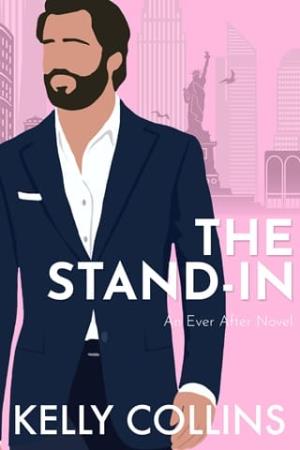
The Stand-In (Ever After #3)
Chapter 1
CHAPTER ONE
IVY
Hospital time is its own creature. Rubbery, slow, and sticky.
It operates by a distinct set of rules, separate from the way time moves in the rest of the world.
Out on the street, minutes are currency, spent on emails and red lights and coffee orders.
Here, minutes are something to be endured, stretched thin until they snap.
I watch him from the uncomfortable metal-framed chair in the corner, the thin upholstery scratching against my skin like sandpaper, my body rigid, my heart hammering a jagged rhythm against my ribs.
I shouldn't be here.
Legally, morally, ethically. Pick a framework, and I am violating it.
I should be in an Uber speeding toward the state line.
I should be hiding in my apartment with the blinds drawn, ignoring my phone.
At the very least, I should be anywhere other than Room 304 of River Bend Memorial, wearing a ruined bridesmaid dress and watching the chest of the man I assaulted rise and fall.
I look down at my wrist.
A plastic bracelet circles it, printed on thermal paper that is already starting to curl at the edges. I twist it, the sharp edge digging into my skin, grounding me in the terrifying reality of the last two hours.
Visitor: Ivy Sullivan. Relationship to Patient: Fiancée.
The word stares up at me in bold, black, pixilated letters. It mocks me. It screams of fraud. It is a lie so massive, so impulsive, and so incredibly stupid that I still can't quite believe the syllables left my mouth.
I didn't plan it. I am a planner, that is my job, my identity, my entire reason for existing on the payroll of Ever After, Inc.
I get paid to mitigate disasters ranging from sudden downpours and vendor no-shows to warring relatives and wardrobe malfunctions.
I have contingency binders for my contingency binders.
But I did not plan for this.
It had been a reflex. A pure, unadulterated survival instinct hijacking my frontal lobe.
I had been standing in the crushed gravel driveway of the estate, shivering in the cool evening air, watching the red strobe of the ambulance lights bounce off the manicured hedges. The EMTs were moving fast, loading the stretcher into the back of the rig.
And then I had seen him—Mason.
Mason Kincaid. My best friend's fiancé. A brilliant lawyer who is lovely at dinner parties but knows the penal code better than I know the color wheel. He was standing near the garden gate, phone pressed to his ear, his face set in a grim, pale expression I had never seen directed at me before.
He wasn't angry. He looked terrified for me.
"I know," I'd heard him say into the phone, his voice low and urgent. "I saw the whole thing. It's bad, Henry. If Taylor presses charges, it's battery. Maybe felony assault depending on the medical report. I can't fix this if the police file a report tonight."
My blood had turned to ice.
Mason is the calmest person I know. If Mason thinks it's bad, it's catastrophic.
In that split second, the future had played out before me like a horror movie.
The police report. The mugshot. The headline: "Wedding Planner Goes Rogue, Assaults Venture Capitalist at Altar.
" It would be the end of everything. Ever After, Inc.
would be buried under litigation. Maddy and Savvy would lose the business we'd built from nothing.
I would be unemployable, bankrupt, and dragging my friends down with me.
And then, twenty minutes later at the hospital intake desk, the barrier had come down.
"Ma'am? You can't go back there," the triage nurse had said, blocking my path to the double doors. She looked exhausted, holding a clipboard like a shield. "We're still stabilizing him. Policy is strict for head trauma—immediate family only."
Immediate family only.
The words echoed in my head. If I stayed in the waiting room, everything unraveled. Brooks would wake up alone. He would be confused, then angry, then vengeful. He would call his lawyer. He would call the police.
I needed a few minutes alone with him to explain, to beg, to convince him that ruining my life wasn't worth the paperwork.
Get in the room, my brain screamed. Just get in the room.
So I had opened my mouth, and I had lied.
"I'm his fiancée," I'd said, and that was close enough to family for them.
And now, here I am. The fiancée. Sitting in the dark, waiting for the man I tackled into a piece of Renaissance statuary to wake up and destroy me.
Brooks shifts in the bed.
The movement is small, a roll of his shoulders, but it drags a groan from his throat that sounds like gravel grinding together. The sound scrapes against the quiet of the room, making me flinch. He grimaces, his brow furrowing as he fights to pull himself back to consciousness.
I hold my breath.
He blinks. Once, twice. His eyelids look heavy. His dark eyes wander, unfocused and swimming, scanning the sterile white tiles, the heart monitor, the IV bag dripping saline into his arm.
Then, the wandering stops. His gaze lands on me.
He doesn't smile. He doesn't look confused.
He stares at me for a long minute. The quiet thickens until I can barely breathe through it.
His gaze presses down on me like a physical thing.
His eyes are sharp, stripping away the hospital haze with terrifying speed.
This isn't the look of a groggy victim waking up from a nap; it's the look of a man scanning a contract for a loophole.
"Water," he rasps. His voice is a wreck, dry and cracked.
I jump up, grateful for a task, any task, that doesn't involve explaining myself. I grab the plastic pitcher from the bedside table, my hands shaking enough to splash a little water onto the tray. I pour it into the small cup and fumble for the bendy straw.
"Here." I step up to the rail, holding the cup out. "Small sips. You've been out for a while."
He ignores my advice completely. He leans forward, his face twisting in a sharp grimace as he moves and wraps his lips around the straw. He drinks with a thirsty intensity, draining half the cup before dropping his head back against the pillows with an exhale.
He closes his eyes again, his chest rising and falling in shallow, careful breaths.
It's unfair, really.
A man who recently face-planted into a marble cherub has no business looking this good.
Even with a bandage taped to his temple and hospital lighting washing him out, Brooks Taylor is annoyingly handsome.
Dark hair, messy in a way that looks editorial rather than traumatic.
High cheekbones. A mouth that, under different, non-litigious circumstances, I might spend time thinking about.
If I wasn't hyperventilating about a potential prison sentence, I might even be attracted to him.
"Head," he mutters, interrupting my internal assessment. "Ribs."
"You have a concussion," I say, my voice sounding thin in the small room. "Grade two. And significant bruising on your right side. But the CT scans were clear. No internal bleeding. No fractures."
He opens his eyes again. The lingering confusion in his expression vanishes, replaced by a cold realization.
"You," he says.
"Me," I agree. I keep my face neutral, the same practiced mask I use when telling a hysterical mother-of-the-bride that the reception tent is leaking.
He lifts his hand, the one without the IV, and touches the square gauze bandage taped to his temple. His fingers graze the tender skin, exploring the bump underneath. Then his hand drops, and he looks at me. The temperature in the room seems to plummet ten degrees.
"You hit me," he says.
It isn't a question. It is a statement of fact, delivered with zero emotion.
"I intercepted you," I correct him, instinctively reaching for corporate euphemisms. "You were moving toward the altar with disruptive intent. I performed a necessary event management maneuver."
"You tackled me," he says, louder this time. His voice is gaining strength, the rasp smoothing out into something harder. "You tackled me. Into a statue."
"It was a cherub," I say, as if the specificity matters. "And it was a garden installation, not a statue. And you were about to ruin Mark and Laurie's wedding. I couldn't let you object."
"I wasn't going to object," he snaps. He tries to push himself up, but his arms tremble, and he collapses back against the mattress with a sharp intake of breath. He glares at the ceiling, frustration radiating off him in waves. "God. You're insane. You are actually psychotic."
"I'm professional," I counter, though the ground beneath my feet feels like quicksand. "There is a difference."
He turns his head on the pillow to look at me, his eyes dark and furious. "I was going to save my friend from making a massive financial mistake."
"By stopping the ceremony?"
"By telling him the truth! Laurie isn't who she says she is. She's a liability. A gold digger."
"A gold digger?" I repeat, staring at him. A laugh bubbles up in my throat, hysterical and sharp. "You think Laurie is marrying Mark for his money?"
"I know she is," Brooks says, his eyes dark. "I ran a background check. Her credit is frozen. She has zero liquid assets."
"Her credit is frozen because her identity was stolen last year," I correct him. "And she has zero liquid assets because they're all in a blind trust. Brooks, Laurie doesn't need Mark's money. Her trust fund is twice the size of his."
The silence that follows is deafening. The heart monitor beeps steadily, mocking him.
Brooks blinks. The anger on his face wavers, replaced by genuine confusion. "What?"
"She's a Vanderwaal," I say. "On her mother's side. She uses her dad's name to avoid exactly this kind of judgment from people like you. She paid for the wedding, Brooks. Every cent. The flowers, the venue, the open bar you would have enjoyed, had you not decided to play hero."
He stares at me. I can practically see his brain rewiring, recalculating the risk assessment in real-time.