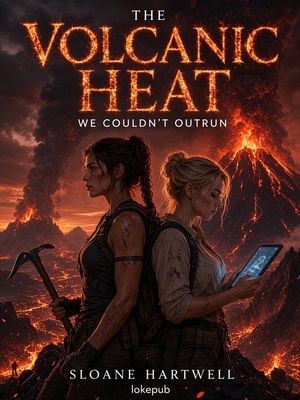
The Volcanic Heat We Couldn't Outrun
CHAPTER 1
Ashfall Morning
The ash began before sunrise.
Naia knew it by the sound.
Not the volcano itself. Kaimana rarely announced itself so dramatically. Most mornings, the mountain was a pressure beneath the island—a low, almost imagined presence beneath floorboards, roads, and sleeping houses.
This was different.
A faint dry ticking moved across the roof of the guide station.
Ash.
Naia opened her eyes.
For several seconds she stayed still, listening.
Tick.
Tick.
Tick.
The sound was delicate enough to be mistaken for rain.
But rain had weight.
Ash whispered.
She pushed herself upright on the narrow cot in the room behind the guide station and looked through the half-open window.
The eastern sky was beginning to pale.
Mount Kaimana rose beyond the village, its upper slopes still dark against the predawn blue. The summit was hidden beneath a thin smear of gray drifting seaward.
Nothing dramatic.
Nothing worth waking the village for.
Yet.
Naia swung her feet onto the floor.
The concrete was cold.
She pulled on her field trousers, a faded shirt, and the worn canvas jacket hanging from the back of the chair.
Her father's jacket.
She hesitated for half a second before putting it on.
The canvas smelled faintly of salt, smoke, and old weather.
She zipped it halfway and stepped outside.
The village was quiet.
Kaimana sat between two kinds of water: the ocean surrounding it and the clouds that occasionally arrived from the west carrying enough rain to change the island's mood in an afternoon.
This morning, the ocean was calm.
The trade wind moved steadily from the east.
Good.
The ash plume was going out to sea.
Naia looked toward the mountain.
The dome was still growing.
Slowly.
Predictably enough.
A faint orange glow showed for a moment beneath the upper cloud before disappearing again.
She didn't need an instrument to tell her the extrusion was continuing.
The mountain had a rhythm.
You listened long enough, and eventually you learned which parts mattered.
Naia turned toward the guide station.
She had tourists arriving in forty minutes.
The mountain could wait.
Her phone vibrated on the workbench.
She glanced at the screen.
Tama.
Naia smiled despite herself.
She answered.
"You're awake."
"You're surprised?"
"You're calling before six. That's suspicious."
A sleepy laugh came through the speaker.
"I wanted to check you're alive."
"Disappointing, isn't it?"
"Very."
Naia began checking the gear laid across the bench.
Two radios.
Spare batteries.
First-aid kit.
Water.
Masks.
Headlamps.
Emergency blankets.
A compact gas monitor.
She checked each item automatically.
"How's home?" she asked.
"Mom says you're impossible."
"Mom says that every week."
"Exactly. Consistency."
Naia smiled.
On the other end, there was a pause.
Then Tama said, quieter, "You still doing the upper trail today?"
Naia looked toward the mountain.
"Not today."
"That's not what I asked."
She tightened a strap on the emergency pack.
"Tour group. Lower route."
"Good."
There was another pause.
Tama had inherited their mother's ability to make silence feel like a question.
Naia sighed.
"I'm fine."
"I didn't say you weren't."
"You were about to."
"I was thinking it."
"Same thing."
Tama laughed again, but it faded quickly.
"You know you don't have to stay there forever."
Naia stopped.
Outside, another soft layer of ash landed against the window.
She looked at the mountain.
"I know."
"Do you?"
"Yes."
"Because sometimes it feels like you're waiting for it to decide something for you."
Naia's fingers tightened around the radio.
There were some conversations you could have with family only if you were willing to lose them.
She wasn't.
Not before breakfast.
"Go back to sleep, Tama."
"I'm serious."
"I know."
"Naia."
"I'm fine."
The words came too quickly this time.
Tama heard it.
He always did.
"Okay," he said.
The softness in his voice irritated her more than an argument would have.
"Call me later."
"I will."
"Promise?"
"Promise."
She ended the call.
For a moment she stood with the phone in her hand.
Then she slipped it into her pocket.
Outside, Kaimana breathed.
Naia picked up the emergency pack.
"Don't start," she murmured to the mountain.
The mountain gave no answer.
It never did.
By six-thirty, the village had begun waking.
The bakery opened first.
Then the little grocery near the harbor.
Then the fishing boats started appearing between the docks, their engines coughing awake one by one.
Tourists arrived in small clusters, carrying cameras, water bottles, expensive hiking shoes, and the particular expression of people who had paid money to stand somewhere dangerous while assuming someone else had made it safe.
Naia stood beside the guide station's wooden sign.
"Before we leave," she said, "three rules."
A man in a bright blue windbreaker raised his hand.
"Only three?"
Naia looked at him.
"If you want the fourth, I charge extra."
A few people laughed.
The man lowered his hand.
"First," Naia continued, "stay where I can see you."
She pointed toward the mountain.
"Second, if I tell you to move, you move first and ask why afterward."
A woman near the back nodded seriously.
"And third?"
Naia adjusted the strap of her pack.
"Don't touch anything glowing."
Someone laughed.
Naia didn't.
After a beat, the group realized she was serious.
"That was a joke," she said.
The man in the blue jacket relaxed.
"Mostly."
More laughter.
Good.
People listened better when they weren't frightened.
Naia turned toward the harbor.
The wind carried the faint smell of sulfur across the village.
Not strong.
But there.
She breathed once through her nose.
Then again.
The plume was moving east.
Out toward the ocean.
Fine.
She checked the mountain one more time.
A thin ribbon of ash was lifting from the upper slopes.
Nothing unusual.
The dome continued its patient construction.
Rock added to rock.
Pressure finding somewhere to go.
The tourists were taking photographs.
Naia watched the mountain instead.
She had learned, years ago, that the most dangerous moment wasn't always when the mountain looked violent.
Sometimes it was when everyone stopped looking.
"Okay," she said. "Let's go."
The morning passed without incident.
That was the thing about danger.
Most of the time, it was boring.
The tourists walked.
They asked questions.
They stopped too often.
One man asked whether the volcano was "basically like a giant kettle."
Naia considered him.
"That's not the worst comparison I've heard."
"What was?"
"Someone called it an angry toaster."
The group laughed.
Naia kept walking.
At the lower overlook, she stopped them.
Kaimana spread beneath them in layers of black rock, green vegetation, pale sand, and bright blue water.
Far above, the summit remained partially veiled.
The dome was visible through breaks in the cloud.
A slow, dark mass.
Not a lake of fire.
Not a permanent river of lava.
The mountain didn't perform on command.
Occasionally, when pressure and geometry aligned, a breach could send incandescent lava outward in glowing channels.
Today there was nothing like that.
Only the quiet work of the dome.
A tourist whispered, "It's beautiful."
Naia looked at the mountain.
"Yeah."
She said it so quietly that the group almost missed it.
The word escaped before she could stop it.
Beautiful.
That was the problem.
People who didn't know Kaimana saw beauty.
People who lived here knew better.
Beauty didn't make something safe.
It only made you want to get closer.
Naia looked down at her left forearm.
A thin white scar disappeared beneath her sleeve.
She rubbed it once through the fabric.
Then lowered her hand.
"Back down," she said.
The group followed.
She returned to the village shortly after eleven.
The guide station was unusually busy.
Two emergency-management officers stood outside talking to one of the tourism-board coordinators.
Naia slowed.
Something was wrong.
Not dangerous wrong.
Administrative wrong.
Which, in her experience, could be worse.
"What's happened?"
The coordinator turned.
"There you are."
Naia hated those four words.
"What?"
"The scientist."
Naia looked toward the field station.
"What scientist?"
"The visiting volcanologist."
"I thought she was arriving tomorrow."
"She came early."
Naia stared at her.
"How early?"
"Very."
"That's not a time."
The coordinator smiled apologetically.
"She landed this morning."
Naia looked toward the mountain.
Then back at her.
"And she's already at the station?"
"Apparently."
Naia exhaled.
Of course she was.
Scientists came to Kaimana with instruments, schedules, funding deadlines, institutional letters, and the assumption that the mountain would cooperate with their calendars.
The coordinator handed her a folder.
"Ilava asked for you."
"Of course he did."
"He said it's important."
"Everything is important when Ilava says it."
She tucked the folder beneath her arm.
"Anything else?"
The coordinator hesitated.
"Apparently they're arguing."
Naia stopped.
"Already?"
"Apparently."
She looked toward the field station.
A low building sat beyond the village path, half-hidden by palms and volcanic scrub.
Naia could see two figures through one of the windows.
One was Marcus Ilava.
The other woman stood with her back partly turned.
Dark hair pulled back.
Field clothes.
A tablet in one hand.
Even from a distance, there was something precise about the way she stood.
Still.
Controlled.
Listening without looking like she was listening.
Then the woman said something.
Ilava's expression hardened.
Naia couldn't hear the words.
She didn't need to.
She knew that expression.
The newcomer had arrived less than a morning ago and had already managed to disagree with the person responsible for signing off on half the island's scientific operations.
Naia almost smiled.
Almost.
Instead she adjusted the strap of her pack.
The ash had stopped falling.
For now.
She started down the path toward the field station.
Behind her, the village continued its ordinary morning.
Ahead, the mountain stood beneath a pale veil of cloud.
And inside the field station, the woman Naia had not yet met was already arguing with it.
Or at least with someone who thought he understood it.
Naia kept walking.
She had a feeling her quiet morning was over.