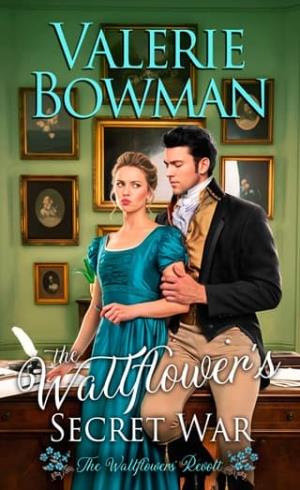
The Wallflower’s Secret War (The Wallflowers’ Revolt #2)
Chapter One
Lady Beatrix Winslow knew two things for certain.
One: the corner of Cheapside and Gutter Lane was no place for the daughter of a duke. And two: that was precisely why she had come.
Clutching the worn hem of her maid’s cloak and hunching her shoulders, Bea darted around the corner and pressed herself against the brick wall of a bakery, ignoring the smell of yeast and desperation wafting from within.
Her breath came fast. Not from exertion, but from the delightful, illicit thrill of anonymity.
No one recognized her. No one bowed. No one tried to foist a dance card or an eligible Tory suitor upon her.
It was glorious.
Her father’s coach would have been instantly identifiable, all gleaming black lacquer and gilt trim, utterly antithetical to stealth.
That’s why she’d paid for a hack today. That, and because the printshop’s apprentice had told her—somewhat nervously, as if fearing divine retribution—that a certain Bow Street Runner had inquired after B. Adroit’s latest submission.
They were sniffing.
Well, let them sniff.
Let them comb every ball, every club, every gentleman’s study for the elusive cartoonist. Let them scrutinize waistcoats for ink stains and examine gloves for charcoal smudges.
Let them look for a man.
Because everyone knew—positively knew—that B. Adroit must be a man. Only a man could have the insider knowledge. Only a man could wield such scathing wit and invent such devastating caricatures. Only a man would dare.
Bea smiled to herself as she slipped through the back door of the printing press.
The truth? B. Adroit was two and twenty, tall, blond, decidedly female, and hidden directly under all of their noses.
And when she wasn’t excoriating half of Parliament, she could be found standing dutifully beside her mama at the latest ton ball, nursing watered-down ratafia and refusing every dance with the determination of a nun guarding her virtue.
A wallflower.
By choice.
No one knew exactly why the proclaimed Diamond of every Season refused to take a husband. She was too particular, went the rumor. Outrageously so.
How deliciously wrong they all were.
Bea made her debut five Seasons ago, endured the tedium of required flirtation, and gamely danced with the endless queue of suitors her father paraded in front of her.
Then, somewhere between being partnered with the Honorable Harold Twitworth (who belched the entire length of the quadrille) and the Viscount Snodgrass (whose greatest conversational skill involved pheasants), her father, the esteemed Duke of Winston, made it clear that she was to marry his protégé, Lord Nicholas Archer, the Marquess of Vanover.
That was when Bea had promptly realized something: she would rather rot on the shelf forever than marry Nicholas Archer. A more pompous, full-of-himself, far-too-certain-he-was-always-right bag of wind did not exist.
Thankfully, Mama was reasonable. She had refused to allow her only daughter to be forced into a marriage she didn’t want.
And so, Bea had gone all these Seasons without a marriage.
She was infinitely proud of it. Oh, it would make any other girl an immediate wallflower.
Like her friend, Georgiana Chadwick, who, without a dowry, had been a wallflower all this time, until she quite literally was swept off her feet by the Earl of Pembroke earlier this Season while attempting to flee her own wedding to an entirely different man.
Then there was her other friend, poor Poppy Montford.
The only child of the scandal-ridden widow of the Viscount of Montague, the colorful Lady Viva.
While Georgie had been a wallflower because her debt-ridden father had spent her dowry, Poppy was a wallflower because of her mother’s scandalous reputation.
But Bea? Bea was something different altogether.
A wallflower by choice. Practically unheard of in the ton.
Which only made the rumors more pointed.
Particular, they called her. Selective was the word Mama liked to substitute.
It was laughable, really. But Bea didn’t give a whit.
They could call her whatever they wanted as long as she was able to continue to dodge the parson’s noose.
For if Nicholas Archer was her father’s choice, Bea would remain a wallflower indefinitely.
But her outing today was not merely about preserving her anonymity. It was about momentum.
The reform bill would be debated again in a fortnight, and every Tory in London seemed determined to crush it beneath polished boots and pompous speeches.
Restrictions on trade were the only way to protect the laborers whose backs bore the weight of the Empire, but men like her father and Nicholas Archer dismissed such concerns as “idealistic”—Bea’s least favorite word in the English language.
So she drew. Relentlessly. Strategically. Every cartoon she delivered was a stone thrown at the great, immovable wall of privilege. If she could make enough peers look foolish, if she could sway even a handful of votes, the bill might pass.
This wasn’t rebellion for amusement’s sake. This was her contribution to the only war she could fight.
Because she’d already decided long ago…she would write her own rules. If Society refused to hear her voice? She would draw it.
With ink.
With teeth.
And with a signature that made men in Parliament sweat through their cravats.
B. Adroit.
She even had a name for her little adventure.
The Wallflowers’ Revolt. Earlier this Season at the Willoughbys’ ball, Bea had encountered Georgie and Poppy in the retiring room, and the three of them had formed the Society For Resourceful Young Ladies Who’ve Had Quite Enough.
During their first official meeting, they’d renamed their little group.
The Wallflowers’ Revolt had a deliciously nonconforming ring to it.
Georgie’s escape from her elderly fiancé had been their first order of business. It’s true that there had been a bit of trouble when Lord Pembroke had inserted himself into the equation. But all’s well that ends well. Georgie and Pembroke were married now and quite madly in love with each other.
Of course, that’s not how Bea’s part of the revolt would end.
Far from it. She wasn’t looking for love.
She intended to be the first female politician in her family.
The only way she could be at least. With scathing drawings printed in the paper.
Only she had to make certain her parents never found out.
Or anyone else for that matter. Especially her most-used subjects like the detestable Nicholas Archer.
Focusing once again on the task at hand, Bea slipped the newest cartoon—tucked neatly into the pages of a dog-eared pamphlet—into the printer’s slot.
Her pulse fluttered with that delicious now-or-never anticipation.
Today’s piece was her boldest yet: a side-by-side comparison of her father and Lord Nicholas Archer rendered as puffed-up peacocks perched atop bags of gold and empty promises.
She’d given Archer an especially pointy beak. Honestly, that had been particularly satisfying.
She shut the slot firmly. The apprentice would find it in less than five minutes.
By then, she’d be long gone, lost in the morning crush of Covent Garden.
But even as she turned to leave, something pulled her back.
A flicker of unease, perhaps. Or...hope.
Because a small, triumphant part of her couldn’t wait for Nicholas Archer to see it. To read it. To recognize himself.
And possibly even wonder if she was the one who’d drawn him.
No. That was impossible. Nicholas Archer was just like her father. A pompous ass. Someone who expected everything he said to be immediately agreed with. Someone who would never guess a woman was his fiercest opponent.
She hated him. Of course she did. He was a Tory. Her father’s sycophant. And her designated future. Father had never been subtle about his intentions. Archer would be a duke one day. She was the daughter of a duke. It was a logical match. A powerful one.
It was also intolerable.
Because Nicholas bloody Archer might be brilliant and powerful—but he was also the very embodiment of everything she opposed.
Which just so happened to be everything her father stood for.
She knew Father’s speeches by heart. Knew the cadence of his parliamentary voice.
Knew how many times he’d voted against social reform, against suffrage, against anything remotely progressive.
Knew it—and loathed him for it. And she loathed Nicholas Archer for the same reason.
Oh, fine. The marquess was handsome. Devastatingly so.
Tall and broad-shouldered, with dark hair, darker eyes, and the sort of mouth a sensible woman tried very hard not to think about.
And sometimes, when she caught him watching her—really watching her—she wondered if he might find her attractive too, though she would never admit that aloud.
Sometimes…she wondered if he wanted her. Not as a pre-ordained wife. But as a man wants a woman.
Not that it mattered. She wouldn’t touch Nicholas Archer if he were the last man in London.
This was her life. Her choice. Her pencil. Her war.
And no man—no matter how irritatingly attractive—was going to stop her.