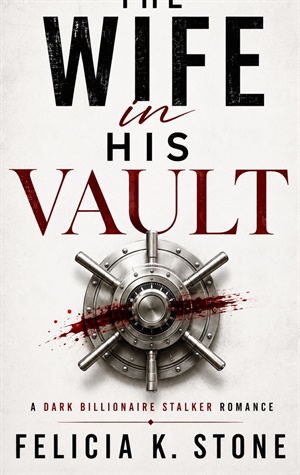
The Wife in His Vault
CHAPTER 1
SLOANE
At eleven forty-three on a Thursday night, the safest building in Virginia is lying to me.
The lie is three feet, eight inches wide.
I stand alone in a corridor on the forty-second floor of Rooke Systems, staring at a digital floor plan that insists the wall in front of me should be farther away.
The difference is small enough to survive a routine inspection and large enough to hide a room. Or a shaft.
Or the reason someone has been pulling restricted data through a network that supposedly cannot be breached.
Behind me, the building settles into its after-hours silence.
Air moves through concealed vents. Somewhere beyond the dark glass offices, an elevator descends toward the lobby with no passenger inside.
Its arrival tone sounds too cheerful for midnight.
I glance over my shoulder anyway. Nothing. That should help. It doesn’t.
Rooke Systems occupies the top nineteen floors of a black-glass tower overlooking the Potomac.
Its clients include federal agencies, private banks, defense contractors, and the kind of people whose names cause security officers to touch their earpieces.
The company designs biometric entry systems, predictive surveillance software, and physical protection networks that make ordinary alarms look like doorbells.
For the past seven hours, I have been testing whether any of that works.
So far, the answer is yes. Which is the problem.
The data leaving Rooke Systems is not moving like the work of an outsider.
There are no smashed locks, stolen credentials, or careless employees clicking links promising discount vacations.
The extraction is quiet, patient, and woven into ordinary system behavior.
Someone built a leak that looks like the building breathing.
I slide my tablet beneath my arm and remove my watch.
The metal clasp clicks softly in my palm.
A thin white scar curves along the base of my right thumb, the souvenir of a server plate that had been installed backward during my first consulting job.
My former supervisor told me to leave it alone.
I didn’t. The plate cut me. I fixed it anyway.
That has become an unfortunate summary of my professional life.
I set the watch on the carpet beside my laptop bag and press both palms to the wall.
The surface is cold, seamless, and slightly textured.
Decorative paneling over structural composite, according to the plans.
According to the measuring tool in my hand, it is almost four feet closer than it should be.
I step back and look toward the ceiling. No visible camera.
That doesn’t mean there isn’t one. In a building designed by Adrian Rooke, assuming a space is unwatched would qualify as optimism, and I have never been accused of that.
I reopen the floor plan. The corridor bends around a private executive conference room on one side and an equipment storage area on the other.
I have already inspected both. The interior measurements match the plans.
The exterior dimensions do not. The missing space belongs here.
I zoom in until the lines blur. There. A narrow interruption in the power map. Not enough to identify a separate circuit, but enough to show something is drawing current behind the wall. I touch the inside of my cheek with my tongue, a habit I only notice when Priya points it out.
“Stop trying to solve it with your face,” she usually says.
She is not here tonight. She left three hours ago after making me promise I would call before attempting anything that could get me arrested, fired, or buried in concrete. I made the promise. I did not define “attempting.” My phone buzzes inside my jacket.
PRIYA: Still alive?
I type with one thumb.
ME: Define alive.
The reply comes immediately.
PRIYA: Heartbeat. No criminal charges. Minimum one functional limb.
ME: Three out of three.
PRIYA: That was too fast. What did you find?
I look at the wall.
ME: Bad architecture.
PRIYA: You hate bad architecture more than most people hate betrayal.
ME: Bad architecture is betrayal.
The typing dots appear, disappear, then return.
PRIYA: Call me before you open anything.
I put the phone back into my pocket. The panel seam is nearly invisible.
I would have missed it if the thermal reading were not half a degree lower along the bottom edge.
I crouch, my knees protesting after hours in stiff black pants, and run a thin inspection card through the gap.
The card stops two inches in. Not a wall. A cover.
I retrieve a narrow tool from my bag and ease it beneath the seam.
The panel releases without resistance. That is worse than if it were locked.
A company like Rooke does not leave concealed panels unsecured.
Someone expects the concealment itself to be enough.
I pull the section toward me. It swings soundlessly on hidden hinges.
Behind it is a matte-black surface with no visible handle.
A door. My pulse shifts just enough for me to notice.
I check the corridor again. Still empty.
The temporary badge clipped to my jacket gives me access to all ordinary technical areas and none of the executive private spaces.
Adrian Rooke gave me broader permission than his legal department wanted, then disappeared to New York for a board dinner before I could ask why. I have met him twice.
The first time, he sat at the far end of a conference table while six executives explained that the leak was probably insignificant.
He did not interrupt them. He did not look at the presentation.
He looked at me. Not with interest. Not exactly.
With recognition. The second time, he gave me a folder containing access authorizations I had not yet requested.
“You’ll need these,” he said.
His voice was quieter than I expected from a man who built an empire around making threats visible.
I asked how he knew what I would need. He answered, “You were going to ask.” That should have irritated me more than it did.
The black door offers no response when I press my badge to it.
No rejection light. No sound. I try the badge again. Nothing.
My inspection light reveals a faint oval in the wall at eye level. A lens. I take one step to the side. The lens follows me.
“Of course you do,” I murmur.
I cover it with my palm. A soft tone sounds.
A line of white light appears around the lens and sweeps once across my fingers.
I remove my hand. The light disappears. Facial recognition, but not one of the company’s standard models.
There is no visible indicator, no keypad, no secondary identity check.
Either the security is hidden or whoever designed this believed one face would be enough. I test that theory.
First, I hold my temporary identification photograph in front of the lens.
Nothing. Then a photograph of Adrian from the company website.
Nothing. I search the executive directory and try Celia Rooke, his half sister and a board member.
Nothing. Calder Wynn, cofounder. Nothing.
Owen Reese, director of physical security.
Nothing. That eliminates the obvious faces and introduces several worse possibilities. I stand.
The lens is positioned slightly above my natural eye line. I lift my chin, and the pale light appears again. I step away before it can complete the scan. My phone buzzes.
PRIYA: Sloane.
She knows me too well. Unfortunately, she knows only the version of me that has been allowed to exist in front of her. I type:
ME: Calling in five.
PRIYA: That is not “before.”
ME: Time is subjective.
PRIYA: Prison visiting hours aren’t. Think of Ethan.
The message lands where she intended. For one ugly second, the corridor is replaced by a visitation room two hours away.
Scratched plastic. Bolted chairs. Ethan holding a phone to his ear and pretending the bruise near his jaw came from walking into a cabinet.
My brother has been in federal prison for eighteen months because evidence from Rooke Systems said he stole client data and sold access to a shell company.
He says the evidence was manufactured. I believe him.
Belief has not opened his cell. Facts might.
I look at the hidden door again. My contract requires me to report any concealed security environment before entering it.
It also gives me authority to test unauthorized data pathways.
The missing room is drawing power. The leak passes through this floor.
Waiting until morning gives someone eight more hours to erase whatever is behind it. I can call Owen. I can call Adrian.
I can call Priya and let her tell me that I am about to make an emotionally compromised decision involving the company that helped put my brother in prison.
All sensible options. I have always respected sensible options in theory.
I pick up my watch and slide it into my pocket rather than putting it back on.
Then I move in front of the lens. The scan begins at my forehead.
Cold white light travels over my face, pausing at my eyes, my nose, the line of my mouth.
I resist the urge to turn away. The system takes longer than any commercial biometric scanner should need.
It is not checking whether I am authorized.
It is examining me. The light reaches my chin.
For half a second, nothing happens. Then the wall exhales.
Locks retract one after another inside the frame, deeper than the width of an ordinary door. A vertical line appears in the black surface. Air touches my face, cooler than the corridor and faintly metallic. The door opens inward.
Beyond it is darkness.
A woman’s voice speaks from somewhere inside.
“Welcome, Sloane Mercer.”