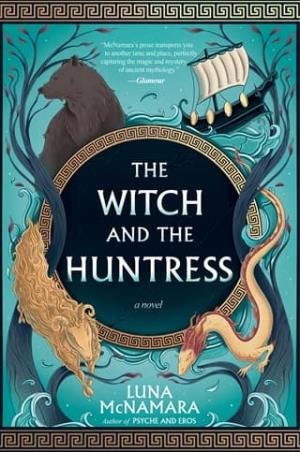
The Witch and the Huntress
Prologue
Atalanta
Sing to me, Muse, of the stories not told, of the events left out of the epics. Sing to me of the secrets known only to the
full moon and the voluptuous night.
Sing to me, Muse, though I’ve never been a singer of poems, only their subject. Music has never been my strong suit. For me
are the forests and fields, and the sunrises I once shared with her.
As I ride down the mountainside, I think of the stories of heroes and monsters, the turns of the tales as familiar as a heartbeat.
The rightful prince triumphs, and the evil king is vanquished. The witch works her spells, and the maiden warrior fights in
the field. A ship of fools sails across the wine-dark sea to steal a useless treasure.
But the story changes based on who is telling it. The victory of the fleeing deer is the tragedy of the lioness, who must
go without her supper. From the perspective of the Hydra, Heracles is the true monster. And only the end will show if the
story was worth telling in the first place.
I go now to seek an ending to the story left unfinished. My horse’s gait changes as she steps from soft earth to the packed
clay of the roads, marking our entrance into Corinth. The stink of the city rises around me, and eyes peer from dusty windows
and doors. I press onward, though my heart thrums in my ears and my hands grip the reins white-knuckled. What will be my reception,
and what beginnings might come from this ending?
And if Jason is there, I will face him too.
I find myself at a door, exactly as she described it: dark red with a blue-and-yellow geometric pattern around the edges.
I knock. After some time, she opens it.
And we find ourselves face-to-face for the first time in two decades.
She is older, yes, with graying hair and wider cheeks, but no less beautiful. Her eyes are still gold as an eagle’s, and right
now they are fixed on me in utter astonishment. Her mouth falls open, and she sags against the doorframe. I feel a momentary
amusement—witch she might be, but even she did not see me coming.
My heart twists at the sight of her. For so long I have avoided this, leaving the possibility of a reunion unrealized and
therefore perfect, like an apple too high to reach ripening in the sun. And now I am here, ready to drag the past into the
light of the present.
“Hello, Medea,” I say.
Emotions chase each other across her face, like fish flickering in the shallows. Why are you here? I can see her wondering. After all these years, why have you come here now?
Because I must finish this story, Medea. I must weave in the loose threads before time runs out. Draw the years back like
a bow, to our earliest days, and go to the beginning so that we might find an end to this.
Medea
I speak softly, my movements curtailed, lest I startle Atalanta into flight. We orbit each other like dancers, drawn together
but not daring to come closer.
Atalanta sits in the courtyard sipping a cup of water; an impossible creature come to visit my garden.
Surreptitiously, I study her profile as she sits among the blossoms, taking in her sharp cheekbones and piercing gray eyes, and hair whiter than mine.
Her skin is still bronzed from the sun, limbs strong and sinewy; age has dried her to a distillation of her essence, like fine wine.
Mothers in Corinth scold their daughters for spending too much time in the sun, but it has only made Atalanta more beautiful, more herself.
If I’d known she was coming, I would have dressed better—not that Atalanta ever cared about such things. I’d have swept the
dust from the corners of the house and moved the laundry in its baskets. Washed my hair with willow until it shone, summoned
back the spark into my eyes. Packed my sons off to one of their friends’ houses for the afternoon, certainly.
I fear her anger, I realize, at those of us who cannot do the things our hearts long for.
A man’s voice rings out across the courtyard. “Medea, where is—”
Jason appears at the door. He freezes when he sees Atalanta, and I notice her shoulders tense at his arrival. They are like
two cats sighting each other in an alley, tails bottlebrush. Tension crackles in the air.
Before I can say anything, Jason turns and goes back inside. Full of embarrassment, I am not quite sure whether I should apologize
to my husband or to Atalanta.
Atalanta is the one who speaks first. “What was your childhood like, Medea?” she inquires, nibbling the plate of fruit and
cheese brought out by the cook.
It is a bizarre thing to ask, but Atalanta could always be counted on to say bizarre things. I tilt my head, considering the
question.
“Lonely,” I reply. “And yours?”
“You already know.” She shrugs, not looking at me. “Full of bears, full of forests.”
I do know, recalling our talks from the Argo, nearly twenty years ago now.
Many things took place on that voyage that did not make it into the stories and songs.
Seasickness; the ache in the bones from sleeping on hard ground or the ship’s wooden deck; the blaze of the sun and the chill of the water.
And the affections that sprung up there, too fragile to persist after journey’s end but too compelling to be forgotten entirely.
I met my fate all those years ago, though not in the way the poets think. I made a choice between the love thrust upon me
and the love that grew unbidden. And I wonder, not for the first time, if it was the right one.
What is a hero who lives past her greatest adventure? Atalanta once told me that before you aim, you must first pull your
spear arm back as far as you can. So I draw my mind’s focus back to my earliest memories, to my childhood in the green hills
of Colchis. I think back to that day, thirty years before, when I took the first steps on the journey that would bring me
here.