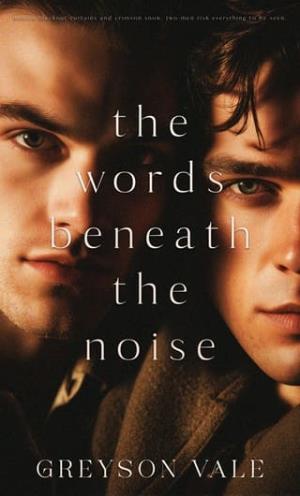
The Words Beneath the Noise
Chapter 1
ONE
ORDERS IN THE COLD
TOM
The train carriage smelled of wet wool and tobacco smoke, bodies pressed too close together, breath fogging the windows until the glass wept.
I kept my forehead against the cold pane and watched England blur past in shades of mud and grey, fields churned to soup by December rain, skeletal trees clawing at a sky that hung low enough to choke on.
Three days ago, I'd been in France.
Three days ago, I'd watched Corporal Eddie Shaw take a bullet through the eye socket while I lay in the rubble of what had once been a schoolhouse, scope pressed to my face, finger on the trigger.
The German sniper had been good. Patient.
He'd waited for Eddie to shift position, to reach for his canteen, and then he'd taken his shot with the kind of precision I recognised in my own hands.
I'd killed him four seconds later. Centre mass, because by then my hands were shaking too hard for anything cleaner.
Eddie had still been warm when I'd crawled to him.
Still had that surprised look on his face, like he couldn't quite believe the war had finally caught up with him after three years of near misses and close calls.
I'd closed his eyes with fingers that wouldn't stop trembling and stayed there in the dust and brick until someone dragged me out.
The train lurched over a rough patch of track, and I pressed my palm flat against my thigh to stop the phantom tremor. Steady now. Steady as stone. It didn't matter. The damage was done.
Light duty, they'd called it when they'd pulled me off the line. As if being sent away wasn't punishment enough. As if I didn't understand exactly what it meant when the medical officer had looked at me with those careful, clinical eyes and written something in my file that I wasn't allowed to see.
Sergeant Hale is physically recovered from his wounds but displays symptoms consistent with acute exhaustion. Recommend reassignment to non-combat duties pending further evaluation.
I'd heard them talking outside the hospital tent, voices low but not low enough.
Words like shell shock and not fit for duty and can't have him freezing up when it matters.
As if Eddie's death had been my fault. As if the shrapnel that had torn through my shoulder two weeks before that had somehow unmade me.
The woman across from me, wrapped in layers of darned wool, glanced at my uniform and then away.
I was used to that. People looked at soldiers differently now, four years into this bloody mess.
Not with the bright-eyed admiration of 1940, but with something warier.
Like they could see the war clinging to us, a film of mud and death that no amount of scrubbing would shift.
Smart of her. I didn't want to be seen either.
Outside, the rain thickened to sleet, then softened into snow.
Fat flakes drifted past the window, sticking to the glass before melting in slow tracks.
The landscape shifted as we moved north and west, industrial sprawl giving way to farmland, then woodland, then villages with church spires rising through the white like fingers pointing toward something I'd stopped believing in somewhere between Tobruk and Normandy.
I thought about the lads I'd left behind.
Hutchins with his bad jokes and worse singing.
Morris who wrote letters to his girl every night and read them aloud whether you wanted to hear or not.
Young Peters, barely nineteen, who'd looked at me like I had answers when all I had were bullets and a scope and the sick certainty that one day I'd be too slow.
They were still out there. Still freezing in foxholes, still waiting for dawn, still trusting that someone was watching over them from the high ground.
And here I was, rattling through the English countryside toward some desk job because I'd had the bad luck to get hit and the worse luck to show weakness afterward.
The anger was easier than the guilt, so I held onto it.
The station was barely more than a platform and a shed, the sign half-buried under snow.
I was the only one who stepped off, kit bag slung over my good shoulder, boots crunching on the frozen ground.
The cold hit like a slap, sharp and clean after the fog of the carriage, and I stood for a moment just breathing it in.
A guard huddled under the overhang, cigarette cupped in his palm. He looked me over with the quick assessment of someone used to sizing up strangers. “Hale?”
“That's right.”
“Truck's waiting.” He jerked his head toward the road beyond the fence. “Don't keep the captain waiting. He doesn't like it.”
I didn't ask questions. Questions had stopped doing me any good around the time I'd learned that knowing why didn't make the dying any easier.
The truck was a Bedford, canvas sides flapping in the wind, engine idling with that familiar rattle that meant it had seen better days. I climbed into the back and sat on the wooden bench, alone with my thoughts and the cold that seeped through my greatcoat.
We drove for what felt like hours but was probably twenty minutes, down lanes so narrow the branches scraped the canvas, through villages that were nothing more than a pub and a church and a handful of houses.
The snow fell steadily, muffling everything, turning the world into something soft and strange.
My mind went where I didn't want it to go. It always did.
The ridge outside Caen. Smoke so thick you could taste it, cordite and burning petrol and something sweeter underneath that I'd learned not to name. Danny Martinez had been spotting for me, calling out positions while I worked the bolt, and everything had been going fine until it wasn't.
The German had come out of nowhere. Or maybe he'd been there all along and I'd missed him, too focused on the officers in my crosshairs, too confident in my own accuracy.
He'd risen from a pile of rubble like something crawling out of a grave, rifle already tracking toward Danny, and I'd known, in that fraction of a second, that I wasn't going to be fast enough.
I'd hesitated. Just a heartbeat. Just long enough to see the kid's face through my scope, young, too young, barely old enough to shave, and in that heartbeat Danny had taken the round meant for me.
I'd killed the German. Clean shot through the throat I couldn't trust myself with anything finer. But Danny had still bled out in the mud with his hand reaching for mine, and all the shooting in the world couldn't bring him back.
The truck hit a rut, and I grabbed the side rail hard enough to hurt. Focused on that instead. Pain was simple. Pain made sense.
When I looked up again, we were passing through gates, tall iron things with guards and a checkpoint that looked serious enough to be protecting something that mattered.
Beyond them, the estate opened up like something from before the war, a manor house all gables and chimneys, lawns white with snow, a pond half-frozen at the bottom of a gentle slope.
And everywhere, scattered across the grounds like an afterthought, long wooden huts. Dozens of them. Smoke rising from chimneys, figures moving between buildings, the distant clatter of what might have been typewriters.
Beautiful, I thought, and then I saw the barbed wire.
It ran along sections of the fence, discrete but unmistakable. The blackout curtains in every window. The guards moving in pairs, rifles slung but ready. This wasn't a country retreat. This was a prison dressed up in snow.
The truck stopped outside the manor, and I climbed out, boots sinking into fresh powder.
A corporal materialised from somewhere, clipboard in hand, and led me up the steps without a word.
The door was heavy oak, the hallway beyond it all dark wood and floor polish and portraits of people who'd been dead long enough that no one remembered their names.
I felt like mud tracked across a clean carpet. Like something that didn't belong.
The corporal knocked on a door marked Security Office. A voice from inside, clipped and precise: “Enter.”
Captain Harold Finch sat behind his desk like a man who'd forgotten how to relax.
Ramrod straight, uniform immaculate, eyes the colour of a winter sky and just as cold.
He looked me over as I stood at attention, and I had the uncomfortable sense of being catalogued, every flaw and weakness noted and filed away.
“Sergeant Hale.” Not a question.
“Sir.”
“Sit.”
The chair was hard. Probably deliberate.
Finch opened a file on his desk, my file, and I watched him read through it with the kind of attention that made my skin crawl.
I knew what was in there. Enlistment records, training evaluations, deployment history.
The commendations. The kill count. And at the end, the medical notes that had brought me here instead of back to the line where I belonged.
“Impressive record,” he said finally. “North Africa. Sicily. Normandy.” His eyes flicked up to meet mine. “You've killed quite a few enemy combatants, Sergeant.”
I said nothing. What was there to say?
“Forty-seven confirmed.” He turned a page. “Likely more unconfirmed. Officers, mostly. Machine gun crews. Other snipers.” He closed the file with a soft snap. “You're very good at what you do.”
“Was, sir.”
His eyebrow lifted slightly. “Was?”
“I've been reassigned. Sir.”
“Yes.” He leaned back in his chair, fingers steepled. “You have. Do you know why?”
“Medical evaluation recommended non-combat duties.”
“That's what the paperwork says.” He studied me for a long moment, and I had the sense he was seeing more than I wanted him to.
“What it doesn't say is that you froze for six seconds under fire two weeks ago.
That you've been having difficulty sleeping.
That you flinch at loud noises and can't always control the tremor in your hands.”
I kept my face blank. Didn't let him see how the words landed like blows.