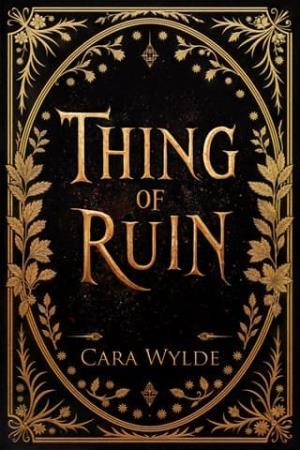
Thing of Ruin (Stitchborne: The Sacred and the Sewn #1)
Prologue
He’d miscalculated. The impulse to run sent a rippling shiver through his muscles, and he took a few steps back, bowing his head low under the hood of his tattered, rain-soaked cloak, hands going up in apology.
It was too late. The two watchmen who’d escorted him in crowded him, one clamping a set of iron cuffs around his wrists, the other pulling his hood off.
He squeezed his eyes shut and hunched his shoulders.
“No, please.”
“Bring him closer,” the sergeant ordered from behind his desk. “Here, in the candlelight.”
The men pushed him, and his feet shuffled on the muddied floor.
He could’ve easily overpowered them and made a run for it, but he didn’t.
Outside, it was raining. Thundering. It wasn’t what stopped him.
The vastness of the city, the open sky – those were things he couldn’t deal with.
They had cells here, somewhere in this building, and all he’d ever wanted was a small, cramped space where he could rest his tired bones.
He hadn’t expected them to want so much information before they locked him up.
He felt the heat of a burning candle held close to his face.
“Look at me, lump. What are you?”
He opened his eyes and was met with the sergeant’s widened gaze. Disgust flickered in the man’s dark irises.
“He did it,” one of the watchmen said.
They both tightened their grip on his shoulders, though he could feel their hands trembling.
“He murdered that woman,” the other one said. “Eviscerated her. Someone who looks like him? He did it.”
The sergeant’s jaw worked, but he didn’t say anything. After a minute, he shook his head and set the candle down. He dipped his quill in the ink pot.
“Name.”
That was the question that had tripped him the first time.
He’d hoped this would be easy: walk up to a watchman, say he had a confession to make, that he killed someone.
They took him to the watch house, where he described the murder scene, and the clerk wrote it all down at his desk in the far corner.
But then the sergeant asked him the impossible question.
He couldn’t say he didn’t know. Because who didn’t know their own name?
“Ru…” The sound came from deep in his throat.
“Tell me your name, lump.” The man avoided looking at him.
“You made your confession, I’ve sent men to find the body.
I want nothing more than to get you out of my sight.
” He unbuttoned his dark blue coat at the collar.
“Throw you in a cell, finish this blasted paperwork, and go home to a nice, hot dinner.”
Even with the iron stove glowing red against one of the lime-washed walls, the cave-like room was cold and damp. The air smelled of wet wool, old pipe smoke, and the sharp tang of cheap beer. Water dripped from the cloaks hanging on pegs by the entrance, forming small pools on the stone floor.
“Ru… ru… in…” he tried again.
He racked his brain, pushed as hard as he could, but his memories were shattered fragments, sharp at the edges and refusing to fit into any sort of coherence.
“Rune, you say?”
“What kind of name is that?” the clerk scoffed.
The sergeant shrugged and wrote it down. “Rune. Where are you from?”
“He-here.”
“Ingolstadt, then.”
The sergeant scribbled in the ledger before him, and the clerk did the same in his own ledger.
“Age?”
Rune stayed silent.
The sergeant threw a quick glance at him and dismissively declared, “Twenty.” He wrote it down.
Rune didn’t think he was twenty, but he didn’t have any better idea, so he didn’t make a sound. He didn’t think his name was Rune, either, but it was something as opposed to nothing. If someone ever asked him again, he’d have an answer.
“Check him thoroughly.”
He didn’t resist the watchmen when they tore the cloak off his shoulders and patted him down. He saw how they winced every time they touched him and felt his mangled body, the uneven skin, raised scars, and protruding sutures.
“Six kreuzer,” one of them said and slammed the coins on the table.
“A graphite pencil and a scrap of paper.” The other one squinted at the words written, but it was obvious he couldn’t read.
“No weapons.”
The sergeant noted everything down, then dropped Rune’s meager belongings into a wooden box that sat at the foot of his desk. He raised an eyebrow at what was written on the paper but didn’t ask questions.
“All right, take him.”
They pushed him through a back door, out into the pouring rain and across a mud-flooded courtyard.
The watch house sat at the corner of two streets, squat with small windows.
It was part of a large, fortified building spreading back in a square shape with an inner courtyard devoid of any vegetation aside from two spindly trees now threatening to crack and fall under the vicious wind.
Rune looked back and saw the gatehouse he’d walked through earlier, a stone archway with iron-banded doors.
Two guards stood under the overhang, out of the rain, muskets propped against the wall.
There was no going back now, and he didn’t regret it.
Crossing the yard under the wideness of the sky was torture enough.
His corded muscles relaxed only when the men opened a heavy door and pushed him through it, and he felt the constriction of a narrow corridor.
The walls were bare stone, spotted and damp. The floor sloped downward, uneven where the stones had settled over time. It smelled of mildew and old straw, with something sour underneath – unwashed bodies and buckets that weren’t emptied often enough.
They passed an open door, and a man in a stained leather vest looked up from a wooden table.
Keys hung on a ring at his belt. With a sigh, he pushed his chair back and took a lamp from its hook on the wall.
He didn’t speak, just jerked his head toward the end of the corridor and walked ahead of them, keys jangling with each step.
He stopped in front of an empty cell and held the iron-barred door open.
Rune was pushed in more abruptly than was necessary, then one of the watchmen unlocked his cuffs.
“Wait,” the turnkey said. “His boots.”
Rune didn’t understand at first. The watchman motioned at him to take them off.
“Come on, give them here.”
He didn’t protest. When the cell door banged shut and the key turned into the heavy lock, he was left in his shirt and pants, feet bare, drenched to the bone.
The cell was barely wider than a man could stretch his arms. Stone walls, stone floor, a single wooden bench against the far wall.
A thin layer of straw covered part of the floor, pushed into one corner.
A bucket sat near the door – tin with a wooden handle.
One square window, barred, showing no more than a sliver of gray sky.
Safe, at last. His lungs fully expanded for the first time in weeks, and he breathed in the foul air, not minding the stench at all.
To make sure, he walked around the cell, running his hands over the walls, meticulously checking every scratch and dip in the stone, his fingers studying, memorizing, discovering carvings previous prisoners had left behind.
Names, dates, a crude drawing of a woman’s face.
He traced the mortar between the stones and pressed his palms flat against the cold surface.
Cramped. Contained. Perfect.
He sat down on the straw, tipping his head back against the wall, hands on his knees. His fingers started tapping a rhythm that came from deep within him, from the unknowns of his being, from where the name Rune had emerged when desperately needed.
Until today, he’d only known himself as Twelve. Construct-Twelve had been written on a plaque on his cell door, so they’d called him Twelve. But he knew that was just a number, and people’s names weren’t numbers.
“Rune,” he repeated, and was startled by how low and deep his voice sounded, rough with unuse. “Rune.”
A name as good as any.
Rune who rotted in a rat hole.