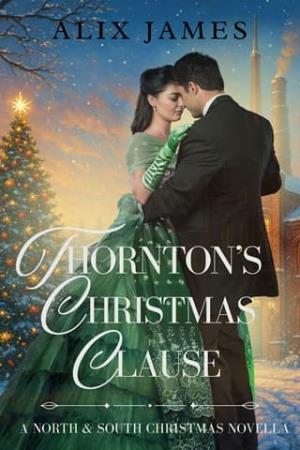
Thornton’s Christmas Clause (North & South Christmas Novella)
Chapter 1
The ledger snapped shut beneath his hands.
For a long moment, Thornton only stared at it, the stiff leather pressing into his palms as though the weight of the entire mill sat bound between its covers.
Marlborough Mills had been his pride—its looms the loud, steady pulse by which he measured his worth.
But now the quiet of his office seemed accusatory.
The machines downstairs were running, but not vigorously.
Not confidently. Not like the steady thunder they had once been.
The numbers did not lie. He had always trusted numbers.
He exhaled slowly, the sound scraping in his throat.
Profits that should have sailed them into the new year were thinning like gruel.
And the causes were brutally plain: months of uncertainty, the strike, the men he had been forced to protect, the costs of breaking up riots his competitors had simply…
avoided. He had done his duty. He had done what was right.
And somehow, that had made him the fool.
His rivals whispered that Thornton would weather the storm because Thornton always weathered storms. He had heard Slickson say as much at the last Master’s Meeting— “Thornton? Oh, he will come through. He always does. The stricter he grows with his men, the fatter his profits seem to run.”
Hamper had been overheard outside the Exchange only a week ago to declare, “Mark my words, he’ll land on his feet. Thornton’s the one fellow in Milton who don’t feel the pinch. Built of iron, that one.”
Even Bartley had murmured within Thornton’s hearing, “If any of us can weather this cursed slump, it is Thornton. His accounts are always in the black. Too prudent by half, that man.”
They all said it—every name on the Board of Trade, every man who had watched Marlborough Mills rise from nothing under Thornton’s unrelenting hand.
They had folded him neatly into the myth of “Thornton the Unshakeable,”
the man too disciplined to fail, too stern to falter, too proud to come undone.
None of them knew how close he stood to the edge.
He leaned back in his chair and pressed two fingers to the space between his eyes.
No one except his mother had caught even a glimpse of how tight the margins had become.
And even she only suspected. He could not bring himself to voice the full truth aloud: that if the winter was hard, if orders continued to lag, if credit tightened just one degree more… he would have to do the unthinkable.
Retrench.
Dismiss workers.
Shrink the mill he had built from nothing.
Failure.
Even the word turned his stomach.
A soft rap sounded at the door. “Post for you, sir,” the boy announced, edging inside with a bundle of envelopes tied in twine.
Thornton pushed back from his desk, rubbing his thumb along his brow. “Set them there, Tom.”
“Yes, sir.” The lad placed the stack carefully near the ledger, cast a quick glance toward the looming machinery yard through the window, and slipped out again.
Thornton stared at the bundle a moment before tugging it toward him.
Too many of the letters these days bore the same hungry look—creditors inquiring, suppliers pressing for confirmation, banks hinting at reassessments of terms. He went through them methodically, breaking seals with the grim resignation of a man counting blows.
The first was from the dyers—payment “requested at earliest convenience.”
The second from a broker—prices falling further.
The third—he breathed in sharply—another demand for settlement by month’s end.
He set that one aside with a hard growl.
Halfway through the stack, his thumb paused on an envelope heavier than the rest. Cream paper, thick, with a dark red seal stamped cleanly on the flap. No handwriting to catch his eye—only the impression of a professional seal: HENEAGE he never did. It felt almost sacrilegious to disturb something so intimately touched by her hand.
Margaret Hale. She was as unreachable as the stars to him. Gone from Milton—no doubt happily!—and gone from him forever.
And now Bell gone too. The final thread to those sweet, terrible months cut.
He closed his eyes. A man could grow soft with such thoughts. Weak.
Thornton slammed the book, too sharply, and dropped it back in his drawer. He would not indulge in fantasies. Not when the mill stood on the edge of ruin and he must consider how many families depended on him for survival.
But the solicitor’s letter lay there, stark upon his desk. Bell’s affairs. The property was to change hands.
A new landlord taking stock before the year was out.
Thornton dragged a hand across his jaw.
As if the winter were not already cruel enough, he must now prepare to answer to a fresh master—one who would know nothing of Milton’s trials, nor of the years it had taken Thornton to build Marlborough Mills into a concern worth trusting.
Bell had been patient, willing to weather fluctuations in the trade…
but who could say what manner of man would follow him?
He looked again at the drawer. At the book. At the faint edge of ivory ribbon peeking from its place. He shut the drawer carefully, as if the slightest sound might disturb the fragile thing inside.
Enough. There was work to be done.
Thornton stood, squared his shoulders, and reached for his coat. The mill awaited him—its debts, its doubts, its weary men—and he would meet them all head-on.
Whatever upheavals London might hold, it surely had nothing to do with him.
One Month Later
The letter had been lying on her desk for nearly an hour before Margaret found the will to break the seal.
Sholto’s shrill demands for his wooden soldiers had very nearly drowned out Edith’s gentle urging that she “ought really to sit down and read her correspondence,” but Margaret had managed at last to slip into her room, draw a breath, and unfold the thick sheet of cream paper.
The solicitor’s hand was crisp and businesslike:
“Madam,
You are requested to attend our offices on the twenty-third instant at half past eleven, that we may conclude certain matters pertaining to the late Mr. Bell’s estate…”
She read no further.
So, it was to be done. A formality, nothing more.
She already knew the substance of the will—had known it for nearly a month, ever since the first shock had faded into the dull ache of comprehension. Mr. Bell had left her everything. His Oxford rooms, his modest investments, and, impossibly, Marlborough Mills.
A mill she did not want. A legacy she did not understand. A responsibility she had no idea how to bear.
She folded the letter carefully, set it atop her writing case, and pressed a hand to her forehead. She had scarcely risen when Edith burst through the half-open door, cheeks pink from exertion and indignation in equal measure, Sholto at her heels bellowing something about mislaid artillery.
“Margaret!” Edith swept into the room in a rustle of silk and agitation, Sholto scampering behind her with a wooden horse held aloft like a banner of war.
“Mrs. Willoughby has altered the time of her Christmas tea! It is to be held on Wednesday instead of Christmas Eve. Truly, I think she does it only to torment me. And if we arrive even five minutes past the hour, she will assume the most dreadful slights. Entire friendships have cooled on less — I promise you they have!”
Margaret blinked. “Wednesday… the twenty-third?”
“Yes! Can you imagine?” Edith thrust the calling card into her hand as if the date itself were an insult.
“I had thought we might spend the morning in Bond Street, and then perhaps take Sholto to the Serpentine. But now everything must be rearranged. Do you still have your ice skates? Oh, dear,, who shall escort us? I wish the captain had not promised to join his friend at boxing that day, for surely—”
“Edith,” Margaret said gently, “I am afraid I shall not be able to attend.”
Her cousin stopped, eyes widening. “Not attend? Margaret, whatever do you mean? Mrs. Willoughby will think you have taken mortal offense at her change of plans.”
Margaret held out the solicitor’s letter. “I have been summoned to settle matters of Mr. Bell’s estate. The appointment is for the twenty-third at half past eleven.”
Edith gasped. “On the very morning of the tea? The solicitor must be made to change it at once! You cannot possibly go alone—and certainly not when Mrs. Willoughby is expecting us.”
Sholto hurled himself at Margaret’s skirts. “Aunt Margaret, my soldiers are lost!”
Margaret stooped to help him disentangle himself. “Are they indeed? Perhaps Dixon put them away after luncheon.”
“No, no, Margaret, listen—” Edith tried to press the invitation upon her again.
“Besides the Willoughbys, the Montagues will be there, and Lady Treves, and oh—Mrs. Armitage asked after you particularly, though why she should, I cannot guess, since she never speaks above a whisper and trembles at everything from drafty windows to over-boiled tea—”
“Edith,” Margaret said gently, “Truly, I cannot go with you.”
“How can you say that, Margaret? I say, the solicitor can very well wait for you on another day. Mrs. Willoughby will think you quite out of sorts, missing two gatherings in a row. You know how she was put out when you did not come to dinner last week. It gives entirely the wrong impression.”
“I am afraid the appointment cannot be changed.” Margaret laid the solicitor’s letter atop the invitation in Edith’s hands.
Edith scanned the letter with widening eyes. Sholto attempted to climb Margaret’s knee; she steadied him absently.
“Two days hence?” Edith gasped. “But that ruins everything! I was only just thinking before I came up that perhaps we might go to Gowing’s for ribbons after tea, and Henry had promised—well, he thought he might manage—to escort you to the Harrowes’ second Christmas luncheon in the afternoon, and…”
Margaret only smiled a little wearily.
“But Margaret, dearest, you cannot possibly go to a solicitor’s office alone. What a notion! What if they try to confuse you? What if they press you to sign things you ought not? Mr. Bell’s affairs were dreadfully tangled, I am sure of it. Henry must go with you.”
“Henry need not trouble himself,” Margaret replied, gathering Sholto and passing him carefully to a waiting nursemaid at the door. “I know what must be done. The will is clear enough. The appointment is merely to settle the last particulars.”
“But you must have a gentleman with you!” Edith cried. “Why, Henry said only last week that if you required any legal advice—”
“I do not.”
Margaret’s voice was soft, but its firmness halted Edith. “Henry has business of his own to manage, and Christmas plans with you and Captain Lennox besides. I shall not pull him away for something I can very well manage myself.”
Edith stared at her for a long moment, her eyes brightening with something between admiration and bewildered concern. “At least allow me to send the carriage with you. And Dixon shall accompany you upstairs. Only think how improper—”
Margaret reached out and squeezed her cousin’s hand. “Thank you, Edith. Truly. But I shall be perfectly safe.”