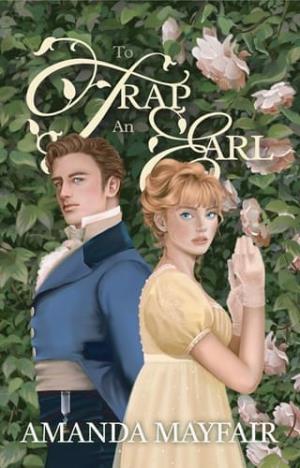
To Trap An Earl (Sutton Family #1)
Chapter One
Your eyes are as round as circles,
And your lips as plump as the sun,
From the moment I first saw you,
I knew you were the one.”
Frances Plimpton smiled encouragingly at the young man reciting poetry in their drawing room, while Daisy, her younger sister and the subject of said poem, stared longingly out the window. Mr. Brooks was the second son of a baron, and Mama was holding out for a title.
For Daisy, that is.
With Frances already in her fifth season, everyone had mostly given up on her finding anything other than an elderly gentleman looking for a nursemaid.
Mama swooped in before anyone could embarrass the man by falling asleep. “Frances, why don’t you go ask for some tea? Mr. Brooks must be in need of refreshment after such a long and spirited oration.”
“Of course, Mama.”
“There are two verses left.” Mr. Brooks looked up from his pages.
“I am sure Daisy will be happy to recount whatever Frances misses.”
Mr. Brooks looked more upset by the interruption than losing an audience member, so he resumed his recital while Frances made her way to the kitchen. In all honesty, she preferred it down there, with the smell of constant baking keeping it warm and cozy.
“Poetry or juggling this time?” Mrs. Brown asked when she walked in, adding the finishing touches to a tray of biscuits.
“Poetry.” Frances sighed and took her usual stool at the counter. “He’s no Shakespeare, but I do think he wrote it specifically for Daisy, which is rather sweet.”
“If he has any sense, he’ll come back tomorrow and ask for the right daughter,” Mrs. Brown said under her breath, with a loud sigh.
“He won’t.” Frances took a biscuit from the tray, making an effort to smile so Mrs. Brown would know she was fine.
Mrs. Brown looked apologetic. “It wasn’t my place, love. You go on, I’ll be up in a minute with the tea.”
Mr. Brooks was finishing his poem just as Frances returned to the drawing room. She was the only one who clapped, which surprised Mr. Brooks and woke Daisy.
“That was beautiful.” Frances smiled at him before taking a seat beside her mother, who gave her a stern look for speaking out of turn.
“Yes, quite lovely,” Daisy agreed as the tea service was brought in. “Oh, Mama, look at the time.”
“Oh dear, Mr. Brooks, I’m afraid we won’t have time for tea if we wish to appear at the Sampson Ball,” Mama lamented. “I do hope you’ll be attending.”
“I will indeed. I hope Miss Daisy will save me a dance?” He looked hopefully at her.
“Perhaps. Come find me once I have my dance card.” Daisy nodded her head coyly before Mr. Brooks was escorted to the front door.
“You could just say you have no interest in him,” Frances suggested once they were alone.
“What if he’s my only suitor?” Daisy argued.
“He won’t be.” Their mother didn’t lift her eyes from the tea she was stirring. “But it never hurts to have options. A man wanting you will let others know how desirable you are.”
“Shouldn’t they know it from how much they desire me?” Daisy fanned herself in a seductive manner.
“Being humble is a virtue,” Mama reminded her.
“Perhaps in the future, we can leave the poets to Frances while I keep the tokens.”
“What would they write about?” Mrs. Plimpton asked as if the very idea was ridiculous.
Frances didn’t think Mama meant to hurt her feelings, but she felt a pang, even if Mama was right.
Her hair was strawberry blond – not a gold like the sun, or a red that could be compared to fire.
Her eyes were a blue so pale they were nearly grey.
Nothing worth writing poetry about.
“Frances has eyes, lips, and hair. Mr. Brooks could even rhyme ‘Frances’ with ‘dances’, which is markedly better than ‘Daisy’ and ‘lazy’.”
“I’m so sorry I missed that part.” Frances met her sister’s eye and was grateful when she giggled.
The girls had never been close, and Daisy had on occasion been somewhat mean to Frances, but most of the rude comments had stopped now they were the last sisters remaining at home, and Frances was hopeful they might become friends.
“You jest, but it is my job as your mother to ensure you are married off as well as can be, to respectable gentlemen who will take care of you.”
Daisy rolled her eyes and reached for a biscuit, but Mama quickly slapped it out of her hand.
“Is my blue dress ready?” Daisy sighed.
“It arrived this morning.” Mama smiled. “The green one fell through,” she told Frances, “but I’ve laid out one of my old dresses for you.”
“Thank you, Mama.” Frances put on a smile as Daisy went upstairs to try on her new gown.
She knew her parents didn’t have money for new dresses, and that Daisy, being newly out, deserved every opportunity to secure the perfect match, but she had three new gowns in as many months, while Frances couldn’t remember the last time she wore something new.
“You both have your strengths and talent. Daisy’s beauty will serve her well, but beauty fades. You are hardworking, obedient. The man who marries you won’t be concerned with the frock you’re wearing.”
“Yes, Mama.”
“Make sure your hair is styled appropriately.”
Frances brought her hand to her right temple and realized the burgundy patch of skin that went from the tip of her eyebrow into her hairline was no longer covered by her hair.
It was hardly noticeable in low candlelight, but it made certain people uncomfortable, so she kept it hidden, even inside the house.
“Of course, Mama. I’ll go get ready.”
“And remind your father we need the good carriage tonight. If we are seen arriving in the other one…” Mama shuddered.
“Papa?” Frances called, knocking on the door to her father’s study.
“What is it?” he asked without looking up, sounding as if he’d also had to sit through an hour of amateur poetry.
“Mama asked me to remind you she needs the good carriage tonight.”
He sighed. “I don’t have time for this nonsense. I need the carriage to visit White’s once I finish these accounts, which may well be midnight. Remind your mother that not everyone has a carriage, let alone two, so she can easily walk if ours doesn’t meet her standards.”
He cursed as he dipped his quill with too much aggression, resulting in a large blotch of ink in the middle of his ledger.
“Perhaps if I helped with the accounts, you might finish faster?”
He finally looked up at Frances, relief on his face, before awkwardly turning away. “Yes, I’ll go to White’s while you finish up here, and perhaps I’ll be back in time for your mother to have the carriage.” He hurried out the room, leaving Frances to the accounts.
The Plimpton girls had never gone to school, but their governess taught them all they needed to know to run a household, and Frances had made it a point to excel.
Her looks were rather plain, and she perhaps wasn’t as accomplished in the arts as she should be, but she could balance accounts flawlessly, even when her father tended to spend–and gamble–more than the small income his elder brother allowed them.
Someday, she would run her husband’s household, take care of his tedious paperwork, and make sure he never regretted marrying someone like her.
“Keep them coming,” Nathaniel told the barman after downing the bourbon he’d been served.
It seemed everyone he’d gone to Oxford with was either getting married or having children. Nathaniel was happy for them, of course, but after rounds of celebratory drinks, everyone else went home while he drank alone, unable to fill the void in his chest.
A rowdy group walked into White’s, and Nathaniel recognized another of his friends from school.
The only thing worse than drinking alone was pretending to be happy drinking with others, so he didn’t even wait to see what the celebration was about.
He downed another glass and slipped out onto St. James Street before they noticed him.
He wasn’t ready to go home, especially not in this state, and the Fergus residence was right around the corner.
It was only seven, which meant it would be hours until Lydia’s husband got home.
While Nathaniel avoided married women, Lady Fergus and her husband had an arrangement where–after four healthy sons–Jack didn’t care who she slept with while he spent copious amounts of time with an old ‘friend’.
Hell, Jack was the one to introduce Nathaniel to Lydia, basically giving them his blessing.
“Lord Lark,” Lydia greeted him once he was shown to her private sitting room. “I would ask what brings you, but—"
“You know what brings me.”
Lydia understood wanting something you could never have, settling for a version of it, and pretending your heart wasn’t breaking. And she never took him to task for it. It was one of the many reasons he came back to her whenever his latest conquest became too attached.
“We have thirty minutes,” she decided.
“Challenge accepted.” Nathaniel abandoned pretences and bridged the distance between them, pressing her body to his as his mouth claimed hers.
“You can’t rip the dress,” she warned when his hands discovered the complex fastenings that held it in place. “I need to get back into it, and I’ve already sent my lady’s maid to bed with a megrim.”
“So all these buttons…”
“You’ll need to do them up.” She smiled and bit her lip as he kissed her neck.
“That would take hours,” he said after tearing himself from her skin long enough to properly examine the back of her dress.
“More like twenty minutes, accounting for the fact that your fingers are much clumsier than hers.”
“Clumsy, are they?” Nathaniel asked, running his hand down the length of her thigh, hooking behind her knee so he could wrap her leg around his waist, letting his fingers continue their exploration beneath her skirts.
“You know what I mean,” Lydia said, breathless as his fingertips caressed her inner thigh.
“Luckily, I don’t need to remove your dress and waste our precious time, but I can assure you, my fingers have ample experience with buttons.”
“Bloody Mrs. Sampson.” Lydia sighed, her fingers now gripping his hair.
“I beg your pardon?”
“Don’t look so shocked; we both know I’m no lady,” she defended her choice of words.
“Nor am I Mrs. Sampson.”
“I wish you were. Her ball would be infinitely more enjoyable if it included this.”
“The Sampson ball is tonight?” Nathaniel froze as his right hand cupped her left buttock.
“Since when do you care about society? Or anything fun?” she asked before the look on his face stopped her. “Ah, is Rebecca attending?”
“My grandmother is taking her,” he admitted.
“I’m sure she’ll have a wonderful time.”
“Indeed,” he agreed, but the guilt eating at him prompted Lydia to gently push off his lap, so she could sit beside him on the couch instead.
“I can be late, if you want to talk.”
“I don’t.” He sighed.
“Do you want to accompany her?”
“My grandmother is far better suited, which Rebecca understands. I would just… I can’t.”
“Of course.”
“You’re judging,” he reproached, but there was no heat to his voice.
“I’m agreeing.”
“But you don’t.”
“Do you?”
“I haven’t been to one of these things in six years. I avoid them like the plague, for good reason.”
“I know.”
Her look told him she also knew how much he loved his cousin, who would be fine under his grandmother’s care, but he might not be, given the regret he already felt for letting her down. Were he still alive, his father would never have missed Rebecca’s debut.
Nathaniel sighed. “I have to leave.”
“Shall I assume I’ll see you at Sampson House?”
“If you do, please tell horrible tales of me seducing opera singers and—”
“I will tell such lies as to scare off anyone who sets their sights on you,” she assured him.
“Who says they’re lies?” He raised an eyebrow and gave her a smile that would have made her weak in the knees a decade ago, before he’d let her look beneath the surface and she became an expert at seeing the pain he hid behind his green eyes.
“You’re not as charming as you think,” she warned.
“I have half a mind to never return if this is how you treat your guests,” he teased, shaking his head at her.
“Of course not. I’m only this honest with my friends.” She gave him a sad smile. “I’ll see you at the ball, Nathaniel.”
“Always a pleasure.”
He kissed her hand before making his way to Wiltshire Manor.