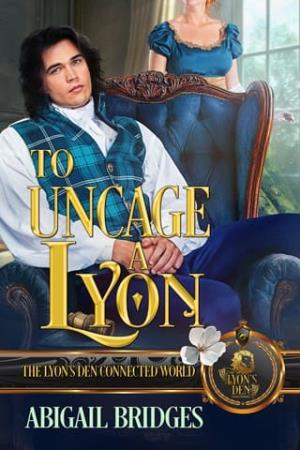
To Uncage a Lyon (The Lyon’s Den Connected World)
Prologue
Inmarsh House, Berkeley Square, London
Two in the afternoon
“No! Tell me it’s not true! He cannot be dead!”
Lady Elspeth Westridge rushed into the drawing room of her parents’ town home and stomped her foot, her voice clogged with grief, her muslin pinafore clinging to her stockinged legs, crumbs of dirt bouncing off her slippers. “Please! It is not true! Miss Garner said he was murdered. Murdered!”
Her father, William, Third Earl Inmarsh, sat in his favorite wingback by the fire, his feet on an ottoman, his body hidden behind his beloved newspaper. Bending one page down from the corner, he peered at his daughter. “Good heavens, child, you are covered in mud. Where have you been?”
“The conservatory! With Miss Garner!” She could not believe her father seemed more concerned with a bit of dirt when she was inquiring about the death of a magnificent man. “Father! Is it true?”
“Of whom are we speaking?”
“James!”
“And why would your governess tell you this James had been murdered?”
“I do not know! Please! Tell me! Is it true?”
The earl looked from Elspeth to his wife, who sat at a nearby table, leafing through one of her favorite books of exotic plants from the Americas. “Anna, do you know a James? One who was murdered. I have seen nothing in the newspaper about it.”
Anna removed her gold-rimmed spectacles and laid them on the book. “I do not.” She looked at Elspeth, whose tears streamed warm down her cheeks. “El, darling, you must be more specific when asking such a question. Who is this James?”
Elspeth clinched her fists, beating them on her thighs, her exasperation with her parents almost overwhelming her. How could they not know! Her teeth ground together. “The captain.” As her parents exchanged puzzled looks, she released a long, frustrated sigh. “Captain Cook!”
Her father snorted and disappeared behind his newspaper.
Her mother motioned for her to come closer.
Reluctantly, Elspeth went to her, acquiescing as her mother pulled her onto her lap, smoothing red curls away from wet cheeks.
She plucked a lace-trimmed handkerchief from somewhere and began to clean the dirt from Elspeth’s face and hands.
“El, darling, I’m afraid Captain Cook died some time back.
Before you were born. And, yes, he was killed by some of the people on an island he discovered in his travels. ”
“But I was going to marry him!” Elspeth sobbed, leaning her head against her mother’s shoulder.
Anna tucked the handkerchief into her sleeve, then put both arms around Elspeth, tugging her closer. “My darling, Captain Cook was already married. A rather remarkable woman named Elizabeth Batts, if I remember correctly. And you are but nine years old. He would have been far too old for you.”
Elspeth raised her head. “That would not have mattered. Old people get married all the time. And wives die. I see it in the newspapers. A lot!”
Another snort from her father was followed by a muttered, “I told you not to let her read the newspapers.”
Elspeth crossed her arms. “How else am I to know what is going on at the Royal Society?”
“You could ask your mother.”
“Liam.”
Elspeth sniffed, amazed as usual at how her mother could make one word sound like a warning from the good Lord above. Her father flicked his newspaper and turned the page but did not respond.
Anna shifted, adjusting Elspeth on her lap. Between her mother’s gentle hug and the warmth of the cozy room, Elspeth began to relax, and she sighed. “But I love him.”
Anna smoothed Elspeth’s skirt, picking at a particularly stubborn spot of mud.
“My darling, had Captain Cook still been alive, he would have been two and sixty when you were born and almost eighty by the time you could have married him. When the time does come for you to wed, your father and I will help you decide on one of the many young men who will come to our door, hoping to court you. Because I know you will be an incomparable, a diamond of the first water. A debutante of no equal. And you will have a much in-demand dowry. In fact, we have already had inquiries in that regard. Gentlemen will be clamoring for your hand, and you can pick whomever you want from amongst them.”
“Only if she stops reading the newspaper.”
Her mother cast a withering glance at Elspeth’s father, then went on. “You will find as you grow up that you will want a household of your own, with a bright young man who can give you a position and children.”
Elspeth scowled, thinking of the three children upstairs, her two sisters and a brother. “No, I will not. I must marry an explorer. No other man would do.”
“Why not?”
“Because only an explorer will see that our future lies in science. The advancement that comes about because of discoveries.”
Her father coughed. “Newspapers . . .”
“Hush, Liam. El, I know there are other men who will understand.”
“But if they are noble, they will want children. I will never want children. I want to explore. To travel. Children are noisy and unruly. They never listen. And they do not read.”
“They will learn, just as you did.”
“Not soon enough. And I do not want just any man. I want an explorer. I want someone who understands.” Her lower lip protruded. “I want the captain.”
“Do not pout. It is not ladylike. Anyway, you have many years to spend learning and doing your own exploring before you can marry. Almost ten years. And exploration of our world is not limited to your dear captain. There are many others. There will be many others. We still have a great deal to learn about this astonishing planet of ours. Expeditions are launching almost every week.”
“Do women ever go on these expeditions?”
The earl coughed.
Her mother stroked Elspeth’s hair. “No, darling. Not usually. It is considered too dangerous for women.”
“Is that why you have never gone on an expedition?”
Anna paused, glanced at Elspeth’s father, then cleared her throat. “Yes. It is.”
“Why is it too dangerous for the women but not the men?”
“Too many newspapers.”
“Liam.” Anna frowned, then plucked a leaf from the back of Elspeth’s hair, smoothing it on the table.
“Darling, I will have to explain that to you when you are older. It is more complicated than it seems.” She shifted them both in her chair, turning toward her book and reaching for her spectacles.
“For now, let me show you the flower I have been reading about. Most exotic and beautiful.”
Elspeth peered at a full-page illustration of a brilliant blue, spiky flower with a dark center. The disk-shaped bloom looked as if it were about to take flight.
Anna pointed at the description on the opposite page. “It is called the Passiflora caerulea, or blue passionflower. It was first discovered in Peru but was brought to Europe in the 1600s. Now it grows all over. Parts of it are edible, and it has been used in medicines. Look at those colors!”
Elspeth ran her fingers over the drawing, her mind captivated by her mother’s love of all things botany.
As her grief dissipated, Elspeth moved to a chair beside her mother, kneeling on the seat and leaning over the table.
They examined several of the plants illustrated in the book, and Anna’s passion for the flora of their world enveloped Elspeth in a warm cocoon of knowledge and love.
Elspeth cherished these moments, holding them close in her mind and heart.
They seemed to spark her own adoration of plants—and explorers, those gallant men who searched the world over for new discoveries.
Later that night, as Elspeth lay in her bedchamber on the fourth floor of the house, she sent up a quick prayer that—woman or not—she would be allowed to explore the world in her own way.
In the room next door, her sisters burst into squeals of delight, followed by raucous giggles.
Hopefully, Elspeth added to her prayer, without children in tow.