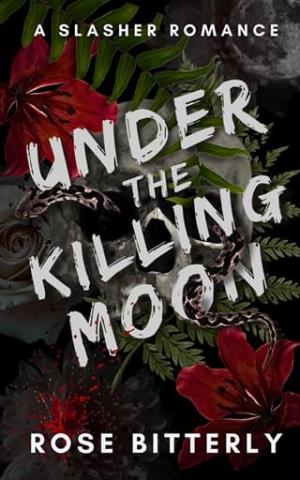
Under the Killing Moon (Hunter’s Heart #5)
Prologue
THEO
SIXTY YEARS EARLIER
The first thing I taste is dirt, dark and gritty and metallic.
The weight of the earth presses down on me, threatening to crush the air out of my lungs, and the dirt pours into my mouth.
But my body reacts as if it knows what to do, and I can feel myself surging upward, clawing desperately through the black loamy soil toward the surface.
I thought I was dead. I remember dying. I remember the hot spark against my temple when I hit the edge of the pier and the sharp, terrible crack that I thought was wood and then realized, a second before I sank into the inky darkness of Hanging Lake, was actually my skull.
But I’m not dead, because I erupt out of the ground, sputtering dirt and breathing in the sweet, cedar-scented air of the mountains. I cough and choke, wiping the dirt away from my tongue, and then I slap my hand against my head, feeling for the wound. It’s not there.
I cry out, although words don’t come. They never have for me, and it seems whatever happened in the lake hasn’t changed that.
So I heave myself up, dirt cascading over my body. I’m wearing the stiff grey suit that Mom said belonged to my father. I don’t understand why. I wasn’t wearing it when I—
When I died.
I roll sideways until I’m lying on my back, and I blink up at the tangled net of tree branches overhead.
They’re sparse and spindly, just starting to bloom out.
I’m not sure how I can see that, exactly, since it’s nighttime.
The forest is dark and filled with the usual night sounds—the hooting of owls, the soft hum of crickets.
And the moon is full behind the trees, bright enough to cast silvery light over everything.
I take deep breaths, filling my lungs. I’m alive.
I’m wearing the suit, the one Mom insists I put on for church services at Christmas and Easter, the only time we go.
I can feel my body working beneath my skin: my blood pumping, my lungs filling.
It had stopped, though. I remember that.
I sank into the lake, and for a moment, I saw my blood ribboning past me, and then there was a terrible flooding feeling in my chest, and then everything stopped.
Because of Kenny Hickman. Everything stopped because of Kenny Hickman.
Rage slams through me, out of nowhere. A hot, violent, all-consuming rage.
He shoved me.
I sit up, moving faster than I expect. My skin is hot and itchy. My fingers clench. The moon bears down overhead.
It wasn’t just Kenny Hickman, though. It was all of them. Jack Cooley. Fred Parrish. Maggie Stone.
The rage swells through me again, and this time I jump to my feet, my muscles moving with some grace I’ve never had before. When I land on the soft, mulchy ground, my chest heaves, and all I can do is remember.
Kenny pushed me, but Maggie was the reason I was there at all. She cornered me while I was at the grocer’s, her expression guileless.
Some of us are having a party, Theo. Wanna come?
Her big cheerleader’s smile. Her glossy ponytail, curled at the ends. Her big pink bow.
Her loud, braying laughter as I toppled sideways over the pier, as my skull shattered, as the lake swallowed me whole.
I stumble forward and slam my shin against something, a bright burst of pain that, just for a moment, calms the rage. It’s a rock, silver in the moonlight.
No. Not a rock. It’s too carefully placed, jutting up out of the ground like a tooth.
A tooth among dozens of teeth. I’m in a graveyard.
My rage is swallowed up by something else. Fear. Because somehow I know what I’m going to see on that gravestone as I crouch down, and still it’s a shock to find my name emblazoned in the moonlight, carved out in a jagged, unsteady hand:
Theodore Shorn
And beneath it:
1943 - 1960
For a long time, all I can do is stare at those dates.
Then I lift my gaze, blinking at the rest of the graveyard.
I know it, I realize. This is the little graveyard near my house, where the graves are marked with stones from the ravine nearby, and where Mom likes to come and pick wildflowers in the spring.
Mom.
I take off in a sprint, tearing into the woods. The air is damp and cool on my skin, and there’s not much growth to hold me back. Spring. It’s spring now.
Did Mom pick flowers off my grave?
The moon follows me home, a lantern lighting the way. When I see the familiar, sagging front porch of our old cabin, I feel something like relief. But only for a second.
Because the cabin is dark. Abandoned. There are leaves on the porch, which Mom never allows. She sweeps them off every morning, the swish swish always waking me up. The grass in the yard is wild and overgrown. Dead vines crawl along the old sideboards.
I shout for her, but like always, any words lodge in my throat. It’s always been easier for me to speak with my hands.
I bolt forward, bound up the porch steps, and slam my shoulder against the door. It’s unlocked and swings open easily.
Inside is worse than out. Everything looks like it should—the same yellow couch, the same radio in the corner, the same homemade rug on the rough wooden floors. But it’s all covered in a thick layer of dust, and there are leaves on the floor, and a sense that the forest has come inside somehow.
I keen softly, although I know I’m not going to find Mom, not here.
I’m not going to be able to tell her I’m okay, that I’m not dead after all.
That it was all a mistake. I stumble forward through the living room, heading toward the kitchen.
She was always in the kitchen: fixing dinner, washing dishes, sitting at our rickety metal table with her yellow notepad, making her chore list for the day.
And to my horror, she’s in the kitchen now.
I stop in the doorway, a terrible emptiness gnawing into my chest. My mother, but it’s not my mother.
It’s a corpse. A skeleton draped in my mother’s favorite floral dress, dangling from the light fixture by a rope.
The moon shines through the window above the sink, casting her in a soft, hazy light.
The rage comes roaring back, swelling my body with violence. Like my father, even though I never knew him. Your father has a violent soul, Mom told me once. Maybe you’ll have it, too. Or maybe you won’t.
I have it. I feel it, that violence, pumping through me like blood.
I stumble forward and wrap my arms around her hips, the bones clacking together inside her skirt. It reminds me that she’s not alive, that I can’t hoist the pressure of the rope off her throat.
Tears prickle in my vision as I push myself up on the nearby chair.
The corpse does nothing, only stares at me with empty eyes and strips of dried-out, leathery skin.
She’s been dead a long time, I think numbly, and I don’t know what to do with that information.
I don’t know what it means that she’s dead, and I am not.
I pluck at the rope until it unravels, and then I catch her before she falls. The clacking fills my ears, and I choke back a sob as I carry her into the bedroom. She would hate to be laid out on the kitchen table.
Her room is as neat and tidy as always, although the forest has crept in here, too.
Vines push through the window above her bed.
Leaves scatter across the patchwork quilt her mother made her long before I was born.
I settle her down on top of it and then sweep the leaves away, my body trembling with fury.
It’s then that I notice the envelope, propped up on the pillow. My name is written across the front in my mother’s perfect, looping handwriting.
My hands shake as I pick it up. The paper feels brittle and warped. Exposed to the elements.
I rip it open, and inside is a letter on her favorite stationery, the one she always used to write thank-you notes after Christmas.
My dearest Theo,
If you are reading this, then it means I was wrong, and I am sorry.
But I simply can not live with this grief.
Every moment in this house reminds me of you, my sweet boy, and if you did come back to me—you won’t be my sweet boy any longer.
You’ll be like your father, and I don’t know if I can live with that pain, either.
So I’m sorry to abandon you like this. It is my prayer that you will never wake up and that I will see you in Heaven.
But I know there is an equal chance that you are reading this letter, and I owe you an explanation.
The paper trembles in my hand. My stomach flips around. You’ll be like him. My mother never liked to talk about my father. She said he was dangerous and that he was gone, and that’s all I needed to know.
I force myself to keep reading.
Your father’s name is Cecil Ashbury. He is a murderer.
However, he was very kind to me, and I think he loved me, in his way.
He told me, when you were born, the odds were even that you would turn out like him.
That you would be a murderer, too. He said he would come back if that was the case and teach you his ways.
But if you aren’t like him, if you’re like me, he didn’t want to taint you with his evil.
He said the only way to be sure is for you to die. If you come back, you’re like him. If you stay dead, as I will, then you’re like me.
My mouth feels dry and sickly. The stationery crumples in my fingers, my mother’s words swirling around like the dead leaves on the ground.
My darling, if you’re reading this, please seek him out. I believe he is living in Ohio. If you ask enough people about him, he’ll come to you. He will not harm you. And please, please, please forgive me. I could not live with the sorrow of your death or of your sins.
With all my love,
Mom
The letter drops out of my hands and floats down the bed.
I stare at the corpse that used to be my mother, blood pounding in my ears.
My rage spikes, cruel and hot, although it’s not rage at Mom.
I can feel her grief on the air, like a ghost, and I understand that she did this terrible thing to herself because I died.
Because Kenny and Maggie and all the rest killed me. And when they did, they killed her, too.
My vision tunnels down until all I can see is her corpse, illuminated by a bright shard of moonlight that cuts in through a clean patch on the grimy window. I breathe deep, my body aching with some urge I can’t quite identify.
I lift my hand and fold it in the shapes she taught me when I was a little boy, when I didn’t learn to speak the way the other children did. “I love you,” I say with my fingers, my eyes hot with tears.
Then I wrench away from her, stalking back into the kitchen. The rope is coiled on the floor like a snake, and I kick it with a wordless scream, sending it flying into the ice box. Then I slam open the drawer where Mom kept her knives.
They still look sharp.
I select the cleaver she used whenever she would slaughter a chicken for our holiday meals.
I like how it feels in my hand. As a boy, she didn’t want me to watch her kill the chickens, and I wonder now if it’s because she was worried that I was like my father.
But I used to watch anyway, peering through the window.
She always thanked them first, right before she swung this cleaver down and separated their little heads from their bodies.
I liked the blood, crimson and glistening in the sunlight like rubies.
I shove the drawer shut and stalk back out to the woods. The moon watches me through the trees with a bright, urging intensity as I pick my way down to our little dock on the lake. Our boat is still there, not that it matters. I would have swum across if I needed to.
The waters of Hanging Lake lap softly against the rocky shore, as quiet and steady as a heartbeat. And on the other side, the lights of Veritas shine in the dark. That’s where they live, in Veritas. My murderers. Her murderers.
I squeeze the cleaver tightly. I think about the bright, rubied blood of the chickens.
And I wonder if human blood will be just as beautiful.