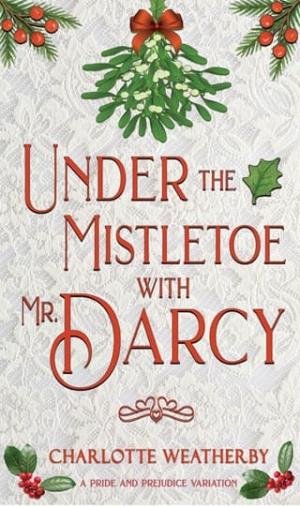
Under the Mistletoe with Mr. Darcy (Sweet Mr. Darcy Pride and Prejudice Variations)
Chapter 1
THE INVITATION
When all the men, Jem, John, and Joe,
Cry, “What good luck has sent ye?”
And kiss beneath the mistletoe
The girl not turn’d of twenty.
— Samuel Arnold, Two to One: A Comic Opera (1784)
Mrs. Bennet's voice carried through the breakfast room with the force of a cannon salute.
“And did you see the way Mr. Bingley smiled at our Jane? Four times! I counted four distinct smiles, each one more particular than the last!”
Elizabeth lifted her teacup to hide her expression.
The morning after the Netherfield ball had dawned crisp and bright, but inside Longbourn, the atmosphere crackled with her mother's relentless enthusiasm.
Lydia and Kitty had already rehashed every dance, every partner, every ribbon worn by every lady present.
Mary had pronounced three separate opinions on the moral perils of late-night entertainments.
Though, if pressed, she admitted to enjoying the music.
And Jane sat with her hands folded and her cheeks the color of summer roses.
“I believe Mr. Bingley smiled at everyone, Mama,” Jane murmured. “He has such an agreeable nature.”
“Agreeable!” Mrs. Bennet waved her fork like a scepter. “He is besotted. Mark my words, we shall have a proposal before Twelfth Night.”
From behind his newspaper, Mr. Bennet spoke with the measured calm of a man long accustomed to domestic storms. “If Mr. Bingley proposes before Twelfth Night, Mrs. Bennet, I shall eat my hat. The good one. With the buckle.”
“You mock me, Mr. Bennet, but I am never wrong about these things.”
Elizabeth caught her father's eye over the edge of the paper. He gave her the barest hint of a wink.
She smiled into her tea. The ball had been lovely, truly. She had danced every set, laughed with Charlotte Lucas, and watched Jane glow under Mr. Bingley's open admiration.
And Elizabeth had danced with Mr. Darcy.
The thought arrived uninvited. She shoved it aside. There was nothing remarkable about a dance. People danced at balls. It was the entire point of the exercise.
Still, she could not quite shake the memory of his dark eyes, the way he had studied her as though she were a riddle he could not solve. His hand at her waist, formal and correct, yet somehow—
“Lizzy, you are woolgathering.”
Elizabeth startled. Jane watched her with a knowing look Elizabeth did not care for at all.
“I was merely contemplating the excellence of Cook's scones,” Elizabeth said. “They are particularly fluffy this morning.”
“Mmm.” Jane's smile was serene and entirely unconvinced.
That afternoon, in the drawing room, Hill stepped through the doorway, a folded note in her hand.
Mrs. Bennet sat bolt upright. Her cap tilted dangerously. “A letter! Is it from Netherfield? I am sure it must be from Netherfield. Give it here at once, Hill!”
The housekeeper surrendered the missive with the resignation of long practice.
Elizabeth exchanged a glance with Jane, half amusement, half dread. The pale blue wax seal gleamed like a small coin of fate.
Mrs. Bennet broke the seal with trembling fingers. Her eyes raced across the elegant script. “A tea! Tomorrow afternoon! The invitation is addressed to all my girls. Well, to Jane and Lizzy especially—oh, my sweetest Jane!”
Kitty snatched the letter from her mother's grasp and read aloud, stumbling over Miss Bingley's elaborate flourishes. Lydia hung over her shoulder, squealing at every other word.
“We are to take tea with the Bingleys!” Lydia crowed. “La, what shall I wear? My pink muslin, do you think, or the sprigged cotton?”
Mary cleared her throat with the gravity of a minister mounting a pulpit. “A tea is harmless enough, I suppose, though I should hope young ladies will conduct themselves with dignity rather than frivolity.”
Lydia dissolved into giggles. “Oh, Mary, you speak as though tea were a mortal sin! Shall we tumble into ruin over a biscuit?”
“Rudeness,” Mary pronounced, “is the hallmark of an undisciplined mind.”
“And pompousness,” Lydia shot back, “is the hallmark of a dull one.”
Elizabeth bit the inside of her cheek to keep from laughing. Her stomach, however, had begun an uncomfortable waltz of its own.
A tea at Netherfield meant Mr. Bingley's continued devotion to Jane.
It also meant Mr. Darcy.
Jane leaned close, touched Elizabeth's arm, and in a whisper said, “You seem troubled. Are you well?”
“Of course.” Elizabeth kept her voice light. “Though I confess I anticipate the company with mixed sentiments.”
Jane's brow furrowed. “You speak of Mr. Darcy.”
“I speak of Miss Bingley's insistence upon discussing the fashions of town and the deficiencies of country society. But yes, him as well.”
“He was not so disagreeable at the ball, Lizzy.” Jane's tone was gentle, reproachful. “He danced with you. And I think he would have danced with you again and again, had propriety allowed.”
“Hardly that! Mr. Darcy danced with all the enthusiasm of a man submitting to the surgeon's blade.” Elizabeth set down her teacup with more force than necessary. “I believe the effort nearly killed him. His face bore the expression of a condemned prisoner throughout.”
“Perhaps he is merely shy.”
“Shy?” Elizabeth laughed. “Jane, the man looks upon every person in the room as though calculating the precise degree to which they disappoint him. That is not shyness. That is pride in a well-starched cravat.”
“I think,” Jane said carefully, “that you judge him harshly.”
“And I think you see the good in everyone, even when they offer precious little evidence of it.”
Before Jane could reply, Kitty interjected, “I think Jane has some right of it. Mr. Darcy kept staring at you whenever he thought no one was looking. I saw him.”
“He was not staring, he was—” Elizabeth stopped. What had he been doing? Scowling, certainly. Brooding, absolutely. But staring?
Her pulse gave an irritating skip.
“You are both being ridiculous,” she said firmly. “Mr. Darcy considers me tolerable at best. He said so himself at the assembly.”
“People change their minds.” Kitty wiggled her eyebrows. “Especially when confronted with pretty eyes and a sharp tongue.”
“My tongue,” Elizabeth said with dignity, “is none of Mr. Darcy's concern.”
Mrs. Bennet, who had been conferring urgently with Hill about refreshments and carriage arrangements, whirled round at the mention of Mr. Darcy's name.
“Mr. Darcy!” She pressed a hand to her bosom. “Oh, imagine it! Lizzy, you could turn his head yet. What a fine thing that would be—Mrs. Darcy of Pemberley!”
Elizabeth set down her teacup with exaggerated care. “Mama, I assure you, no one in this house, myself included, has ever wished for that outcome.”
“Ten thousand a year, Lizzy!” Mrs. Bennet's eyes had gone misty with visions of carriages and silks. “And such a handsome face—though somewhat gloomy, I grant you. But gloom can be fixed with a cheerful wife!”
“If you believe I am capable of curing Mr. Darcy of gloom, Mama, you vastly overestimate my abilities.”
“Nonsense! You have the liveliest wit in Hertfordshire. He cannot help but be charmed.”
“He is not charmed. He is affronted. There is a significant difference.”
Mr. Bennet lowered his newspaper at last. “My dear Mrs. Bennet, if Lizzy manages to capture Mr. Darcy, I shall be forced to revise my entire understanding of human nature. The man appears allergic to enjoyment.”
“You are no help at all, Mr. Bennet.”
“I am an excellent help. I help by staying out of the way and making unhelpful observations.” He turned a page. “Lizzy, you have my permission to refuse Mr. Darcy when he inevitably proposes in a fit of besotted confusion.”
“He is not going to propose, Papa.”
“Of course not. That would require him to form a facial expression other than disapproval, and we cannot have that.”
Elizabeth laughed despite herself. The sound came out too loud, too bright. She pressed her lips together.
Mrs. Bennet huffed. “You are both impossible. Mark my words—by Christmas, I shall have two daughters engaged. Two!” She raised two fingers for emphasis. “And then we shall see who is laughing.”
“Almost certainly still me,” Mr. Bennet declared.
Elizabeth escaped to the hallway the moment propriety allowed.
The letter lay on the side table where Kitty had abandoned it. Elizabeth traced the edge of the paper with her fingertip.
A tea at Netherfield.
She should be pleased. She was pleased. Jane deserved every happiness, and the invitation confirmed what Elizabeth had observed at the ball: his affection was genuine, his intentions honorable.
And yet.
She leaned against the wall and closed her eyes.
Mr. Darcy's face rose unbidden in her mind. Dark eyes, sharp jaw, that peculiar intensity he carried like a second coat. He had been insufferable at the assembly: proud, dismissive, and far too aware of his own consequence. She had disliked him on principle.
But at the ball...
There, he had been different. Not charming. But his gaze had followed her across the room with an attention she could not quite explain. When they danced, his hand had been steady, his conversation stilted but not unkind. He had looked at her as though she intrigued him.
As though he could not decide whether to flee or to stay.
Elizabeth pressed her hands to her cheeks. They burned.
“This is absurd,” she whispered. “He is proud and disagreeable and thinks himself above everyone in the county. I do not care what he thinks of me.”
Her pulse, inconveniently, disagreed.
She remembered the way he had held himself during their set. Cautious. As though she were a flame and he could not decide whether to warm his hands or step back from the fire.
She remembered his voice, low and measured, asking whether she enjoyed country dances. And when she had returned with a jest, had he smiled? Almost.
Her own heart had beaten faster at that expression, quite against her will.
“He is nothing to me,” she told the empty hallway. “A proud, silent, difficult man who happens to be Mr. Bingley's friend. Nothing more.”
The words rang hollow even to her own ears.
She straightened her shoulders. Tomorrow she would go to Netherfield. She would support Jane, endure Miss Bingley, and treat Mr. Darcy with cool, distant civility. She would give him no reason to stare, no cause for further attention. She would be perfectly composed.
She would not think about his dark eyes or his almost-smile or the way his hand had rested at the small of her back.
Not at all.
She picked up the invitation and read it once more. The words swam before her eyes.
“This tea,” Elizabeth said to no one in particular, “is going to be very inconvenient indeed.”