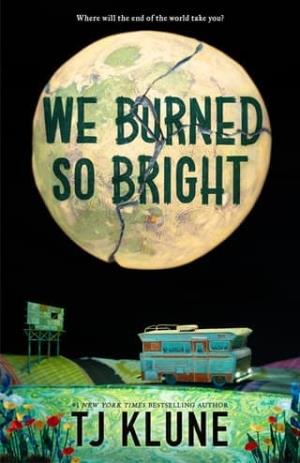
We Burned So Bright
Chapter 1
Don switched off the television. He’d spent the morning in the garden, those pesky weeds returning with a vengeance. All that spring rain, he thought. And for what?
His husband, Rodney, sat in a recliner a few feet away. At seventy-eight, Rodney was a gruff and quiet man, his bushy eyebrows doing most of the talking for him. Forty years together, and Don could tell what he was thinking without a word between them.
“I know,” Don said. “It’s time.”
Rodney grunted in response, leaning forward in his chair, hands on his knees. His back was bothering him, though he wouldn’t say as much. But Don knew. Of course he did. He knew everything about Rodney. Rodney, who looked over at Don, expression softening. “You all right?”
“No, I don’t think I am.”
Rodney nodded and stood from the recliner, groaning as he did so, knees popping. “Stay right there,” he said.
Don did, staring off into nothing. He didn’t know how to feel. Frightened? Oh yes. Angry? Perhaps; a little spark that whispered how is this fair?
But mostly, Don felt relieved, and oddly so. Not over the fact that the entire world would be gone in thirty days, give or take. No, he wasn’t the type to revel in the misfortune of others. His relief came in knowing how it would end.
Getting older meant he was running down the clock as it was, thoughts sometimes straying to darker corners:
Would it be the colon?
The heart?
A little pop in a blood vessel of the brain that caused one to drop dead?
The human body was a miracle that was not meant to last. He felt it in the stiffening of his joints. Stretch wrong in the morning? That was a week’s worth of discomfort. Get a blood test? Ooh, what could be found in that?
Now, though. Now, it was different. Now, the mystery of death—when, how, why—was solved for everyone.
Rodney returned. Don didn’t know how long he’d been gone. He carried a small box with him—oak polished within an inch of its life, a brass keyhole in the front. Roughly the size of a jewelry box, it wasn’t large nor was it heavy, but Rodney was careful with it.
He said, “If we’re going to do this, we have to do it now.”
Don lowered his head. “I know. It’s … You always think there’s going to be more time.”
“We have enough,” Rodney said. “That’s what counts.”
Don looked out the window. Clouds in the sky, wispy clouds that stretched above a green forest. The sun, shining.
Birds singing. And if the people who knew about these things were right, all of it would be gone in a month.
Either the planet would be cracked apart, chunks of rock being pulled toward infinity, or it would be stretched and stretched and stretched until the entire world was a thin, straight line, unable to support life.
The cause? A rogue black hole. A one-in-a-trillion chance, they’d been told breathlessly. There was a one-in-a-trillion chance a black hole would find its way to our little corner of the universe. Astronomical odds, and yet, now a reality.
Which meant chaos, of course. Military vehicles in the streets of most cities and towns.
Looting, rioting, the burning of cars and buildings and people, all of it had already happened.
They’d known about the black hole for close to a year, and in those early days, more things were aflame than not.
When backed into a corner, an animal could be dangerous.
Humans were animals, and deadly ones at that.
Over the last year, they’d proven themselves as such.
In Arizona, a group of people had doused themselves in gasoline.
As a horrified crowd looked on, someone flicked a lighter, and up they went in fire and smoke, all in the name of leaving the world behind on their own terms. In Nebraska, thirty-four people attempted to take the capitol, but ten of them were shot before they could get inside.
Six died from their injuries. In Paris, massive crowds filled the streets, storefront windows shattered as people looted everything that wasn’t bolted down.
In Cape Town, hundreds of people walked into the ocean and drowned.
Some held children. Others assisted the elderly.
In Chengdu, dozens of people leapt from the tops of skyscrapers while others looked on with blank expressions, waiting their turn.
In Denmark, a self-proclaimed prophet said that before the planet was destroyed, Heaven would open up for the chosen, and they would rise into Eternal Glory.
He amassed crowds in the thousands, his voice carrying over a packed field.
During one of his pulpit sessions, he was stabbed to death by a woman who cried as she raised and lowered the knife again and again.
No one tried to stop her until it was already too late.
The prophet died choking on his own blood.
The woman—older, shouting and screaming—did not resist when the crowd descended upon her.
“We’ll be careful,” Don said, gaze going back to the chest in Rodney’s arms. “Take the back roads. Avoid major freeways.”
“When?” Rodney asked.
“Tomorrow.”
And so it was decided.
When they’d retired ten years ago, it’d been unexpected.
Both had planned to work a few more years, but then life happened, and both were pulled away in a direction they hadn’t expected.
Rodney had worked for the state in a thankless role, filling out endless reports for any little thing the government could think of.
Don had managed the office for a physical therapist, doing so for damn near fifteen years.
And then … well. An ending, of sorts, one they had both expected and dreaded in equal measure.
Cut off, like a limb had been removed without discussion.
Seven months in, Rodney had bought an RV.
Don had not been pleased.
Their friends—all older—had been excited.
RV life was a different breed, they said.
Why, buying their own RVs had been one of the best decisions they had ever made for themselves.
A hotel on wheels! Sure, you had to find a place to park for the night—avoid Walmarts if you could—but there were so many places made for RVs.
Hell, there were thousands upon thousands of retirees who’d done the same and hadn’t regretted it.
Yes, it would be grand, except the RV was an ugly thing: old, with dented siding and rust around the wheel wells.
White, with a fat dirt-brown line down the sides.
Not one of the overpriced RVs that looked and traveled like a bus.
No, this one was more akin to a camper slapped onto an old truck.
But its worst sin was a set of hideous brown-and-pink knitted blinds that hung in the small bedroom. Don was not a fan of those blinds.
Small wonders, the RV ran, belching out thick black exhaust from the tailpipe.
Registered, passed inspection (barely), and guzzled gas like it was an endless pit.
But Rodney was charmed by it, saying he thought they could get on the road, taking in sights and people they’d never had the time to see before.
Don had never really considered himself an RV person, but he could picture it in his mind: long summer days with nothing but the open road, the sun setting in the distance, making the sky pink and red and orange.
An audiobook on the radio, one he’d always meant to get to, but hadn’t had the time.
He often thought about that: time. How interminable it could be, and then in a blink of an eye, years have gone by.
Oh, the places they’d gone: To Montana and water so clear, the deep lakebeds looked within arm’s reach.
To Arizona, standing before the Grand Canyon, the rock burnt red, the air sizzling hot.
To the Appalachian Trail, hiking a good eight miles before calling it quits.
To Wyoming, the Grand Tetons rising in all their majesty.
To Utah, the petrified forest, rocks in impossible hues.
To Tennessee and the Great Smoky Mountains, trying to reach the top of Mount Le Conte.
Years of travel, years of doing what needed to be done. And now, at last, the trip they’d been putting off because that made the distance real, something they’d long avoided. They had no other choice.
Don was seventy-two years old.
It took them longer than expected to pack up the RV.
An entire lifetime of trinkets and memories to leave behind, all contained within the walls of a home Don had thought would be their last. Thirty-odd years ago, they’d seen it for the first time, their Realtor chattering away about the curb appeal, the original wood floors, the updated bathrooms. They’d thought on it for a few days—seen some other houses, too—but kept coming back to it.
The wood siding, the brick base. The apple tree in the backyard.
The trees surrounding them, the nearest neighbor half a mile away.
Eventually, it was theirs, and they’d made a home out of it, filled with friends and hope and fights and tears and laughter.
Rodney and Don stood in front of the house, hands clasped between them.
A lovely man, Don thought to himself, even as he shivered and wiped a stray tear from his cheek.
This was harder than he’d thought it’d be.
He wondered how many other people were doing the same thing they were, right at this very moment.
Saying goodbye to their homes for one last adventure before it was all over.
“It’s not all bad,” Rodney said abruptly, in that way he did when his emotions were too big.
“It isn’t?”
“No.”
“How do you figure?”
“I don’t know,” he admitted. “But we still have the chance to…” He trailed off.
Don knew what he was trying to say, even if he couldn’t finish. “To apologize. To be there for him.”
Rodney didn’t look at him. “Yeah. Yes. That.”
Friends came to see them off on a drizzly spring day.
Tears were shed. They told each other that it wasn’t goodbye, it wasn’t the end, but rather, it was so long, see you later, alligator.
These were lies, of course; though they didn’t say as much, everyone knew this would be the last time they’d be together like this.
Tina and her husband, Craig, brought them muffins in a plastic container. She said they were lemon poppyseed. They looked half-baked, gritty.
Jim—their elderly neighbor who often complained about everything to anyone who would listen—told them they were foolish. Going on the road was a death sentence. Dumbasses, he called them, before waving and going back to his house.
Ernest and June, an attractive couple in their midfifties, stopped by shortly before they left. June was crying quietly, a tissue balled up in her hands. She spoke only briefly, saying, “Tell him … tell him we said hello. And goodbye.” And then she buried her face in her hands.
“You sure about this?” Ernest asked Rodney. “Heard some crazy things are going on out there. I know how important this is, but…”
“We’re sure,” Rodney said simply.
But Ernest wasn’t finished. “Two older men on the road. You need to be careful, Rodney. There are people out there who will try and take advantage of you.”
Rodney snorted. “I’d like to see them try.”
They hugged and made promises that they could not keep. Standing side by side on the walkway leading up to their house, they watched as their friends and neighbors returned to their homes.
Eventually, Rodney said, “We’re wasting time.”
“Yes,” Don whispered.
They sat in the RV, staring at the house. Behind them, tucked neatly away on a shelf, the wooden box. Don waited for Rodney to start the RV. He didn’t.
Instead, his hands shook.
Don said, “When we first saw this house, I told myself, isn’t that nice? I could picture it, you know. Even then. Our life. Together. Here, in this place. It’d be a good life, I thought. For all of us. Christmases. Birthdays.”
“It was,” Rodney said, gripping the steering wheel so tightly his knuckles turned white. “A good life. The best life.”
Well, no. It wasn’t, it couldn’t be. But if Rodney needed that white lie to push himself forward, Don wasn’t going to take it from him. Not now. Not yet.
“It was, wasn’t it,” Don said. “Even with everything.”
“Even with everything,” Rodney agreed.
When they’d bought the house, the flower beds had been mostly barren aside from a few scraggly hedges that hadn’t been trimmed in who knew how long. Don’d spent years getting it right.
First, he rebuilt the flower beds on his own.
Dug out all the dirt, the plastic sheeting, the miles and miles of roots.
Brought in fresh, nutrient-rich soil. Planted flowers in every color he could think of.
Out in the back, he’d sectioned off an area along the fence to the right.
Tore up that part of the yard. Put in small trees and strawberries and blueberries and carrots and vines that grew and grew and grew until they crawled up the fence.
Rodney helped, sometimes, but Don loved doing it on his own. It was his thing, something he hadn’t been very good at to start, but had learned along the way. It took time, Don said, gardening did. Patience. A willingness to be wrong and have to start all over again.
Plants were, in his estimation, as finicky as people could be, and just as dramatic. Prune a plant the wrong way, and it’d die just to prove a point.
“What will you miss?” he asked his husband.
Rodney’s hands relaxed on the steering wheel.
“Mornings,” he finally said. “When it’s cool outside.
Dew on the grass, looking like diamonds when the morning sunlight shines upon them.
A low fog that’ll burn off by nine. It’s quiet, then.
So very quiet. People don’t appreciate mornings, and for good reason.
We have to get up to go to school. To work.
To meetings and appointments. I spent my whole life not seeing what a morning looks like.
After retirement, it was like I was seeing it again for the first time.
” He paused. Then, “It’s going to hurt.”
Don closed his eyes. “I know. But we made a promise to ourselves. To be there for him. And besides, how much more can it hurt? We’ve already been through the worst. In all honesty, it…
” He paused, then forced himself through the rest. “I think we need to go and say what needs to be said. Both of us.”
Rodney didn’t respond. A moment later, the RV grumbled to life, and they left their home behind for the last time.