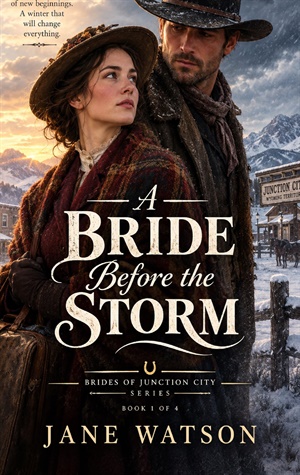
A Bride Before the Storm (Brides of Junction City #1)
CHAPTER ONE
Margaret Colston had read the advertisement so many times she could recite it in her sleep, and some nights, she did.
Wanted: A young woman of good character, willing to relocate to Wyoming Territory, to correspond with and consider marriage to a respectable rancher of means. Must be capable, sensible, and not afraid of hard work.
It was the word sensible that had caught her, three months ago, folded into a copy of the Boston Transcript she'd been using to wrap her mother's good china for the movers.
Not pretty. Not accomplished, though she supposed she was that too, in the narrow ways Boston measured such things—needlework, a passable hand at the pianoforte, enough French to be polite and not enough to be threatening.
But sensible. As if somewhere out past the Mississippi, a man had sat down and decided that what he wanted, above all else, was a woman who would not faint at hard news.
She folded the letter now—not the advertisement, but Mr. Draycott's third and final letter, the one that had come with the train ticket tucked inside it—and set it on top of the trunk that held everything she owned that mattered.
Three dresses let out at the seams twice already.
Her mother's sewing box. A tin of her father's watch parts, the only thing left of the shop after the creditors had finished with it.
"You don't have to go." Her sister Louisa stood in the doorway of the room they'd shared for nineteen years, arms crossed against the October chill, though Margaret suspected the cold had little to do with it.
"Someone has to," Margaret said, and did not look up from the trunk. It was easier to fold than to argue, and she had done a great deal of both this autumn. "Papa's debts don't forgive themselves because we wish they would."
"You could stay. Take the position at the Whitmore school. Miss Ainsley said—"
"Miss Ainsley says a great many things." Margaret closed the trunk and sat on it, testing whether the latch would hold for two thousand miles of rail.
"Teaching wages for one more mouth in this house, or one less mouth and a husband besides.
I've done the arithmetic, Lou. I do it rather well, in case you hadn't noticed. "
It came out sharper than she intended, and she saw Louisa flinch, and hated herself a little for it.
She reached over and took her sister's hand instead, the old gesture from childhood, when the arithmetic of their lives had been simpler—who got the last of the cocoa, whose turn it was for the good hair ribbon.
"I don't say it to be cruel," Margaret said, more gently. "I say it because it's true, and because someone in this family has to look at true things without flinching. I've had practice."
"You always did." Louisa came and sat beside her on the trunk, and for a moment neither of them said anything at all, the way they hadn't needed to as girls, when a shared look across the supper table could carry an entire conversation their parents weren't meant to hear.
"Do you remember when Papa first started keeping the ledger locked? "
"I remember picking the lock." Margaret allowed herself a small, unwilling smile. "You were meant to keep watch and instead you ate an entire jar of Mrs. Hanley's preserves and fell asleep on the stairs."
"I was eleven. And you were the one who understood what the numbers meant, not me. I only knew they were bad." Louisa's voice caught. "You've been doing arithmetic for this family since you were fifteen years old, Maggie. I don't think anyone's ever once asked what sum you wanted for yourself."
Margaret's hands stilled over the trunk's latch.
It was, she thought, precisely the sort of thing her sister would say—soft-hearted, sharper than she let on, and completely unhelpful to a woman trying to leave without weeping.
"I want the sum where this family isn't drowning," she said. "That's arithmetic enough for me."
"That's not an answer."
"It's the only one I have time for." She stood, smoothing her skirts, putting the moment firmly back in its place before it could unmake her resolve. "Help me with the trunk strap. The Whitfields' boy is coming at nine to take it to the station, and I won't have him waiting on us."
She had, at that. Two years now since her father's shop had failed—quietly at first, then all at once, the way these things did, like a dam that held and held and then simply didn't. Two years of watching her mother's hands shake over the household ledger, of learning to read a column of debts the way other girls her age were learning to read music, of understanding before anyone said it aloud that someone would have to go.
She remembered the exact evening she'd understood it fully—not the slow months of whispered worry beforehand, but one particular October night, curtains drawn, her father's account books spread across the dining table like a body laid out for burial.
He hadn't meant for her to see. She had come down for water and found him instead, head in his hands, the columns in front of him refusing, no matter how many times he added them, to come out any way but ruinous.
She hadn't said anything. She had simply sat down across from him, pulled the nearest ledger toward herself, and begun checking his figures, because it was easier to be useful than to watch him grieve.
He had wept, a little, that he'd let his eldest daughter see him broken. She had told him, quite truthfully, that she would rather see the truth than be protected from it, and that if he wanted her help, she meant to give it fully or not at all.
She was the eldest. It had never really been a question of if, only how.
The advertisement, when she'd found it, had seemed almost like an answer arriving before she'd finished asking the question.
She had written back that same evening, before she could talk herself out of it, and Mr. Caleb Draycott of Junction City, Wyoming Territory, had written back within the month—a short letter, plainly worded, the hand of a man more accustomed to a branding iron than a pen.
He owned cattle. His father was unwell. He required a wife who could keep a household and did not require, he'd written with what she thought might have been dry humor, a woman given to fainting spells, as we have not the leisure for them out here.
She had liked that line best of anything in his letters. It suggested a man who valued the same plain, unsentimental competence she'd spent two years teaching herself.
What his letters had not said—what she would only learn later, and at some cost—was anything at all about the size of his herd, or the state of the range that fed it, or the certain arithmetic of Wyoming winters, which was a kind of mathematics she had not yet learned to read.
? ? ?
The train station was a chaos of steam and shouted departures, porters calling out platform numbers, a boy hawking newspapers with a headline about silver prices that no one seemed to be reading.
Margaret's mother wept openly at the platform in a way that made Margaret's own eyes sting despite her best efforts, and even her father, who prided himself on a certain New England reserve, had gone glassy about the eyes as the final boarding call was announced.
He pressed an envelope into her hand—money he could not spare, she knew, which was precisely why she knew she must take it, because refusing it would have cost him more than the money itself.
"For the journey," he said. "And after, if you need it.
Don't let pride stop you writing, Margaret.
I don't care what it costs the family to send more.
I'll not have you stranded out there for want of a stamp. "
"I won't be stranded, Papa." She closed her hand around the envelope and did not open it, not wanting to know yet how much he'd given her, or what he'd gone without to do it. "I'm going to a respectable household, not off the edge of the map."
"Wyoming Territory is rather close to the edge of the map," Louisa said, trying for lightness, and failing only a little.
"Wyoming," her mother said, as though testing the word for poison. "You'll write."
"Every week. Longer letters than I've ever managed for you before, I expect, since I understand there is a great deal of empty time on a cattle ranch once the household is running properly."
"You'll be careful of the sort of men out there.
Rough men. Not—" Her mother's eyes went to the letter still visible at the top of Margaret's traveling bag, and her voice softened, torn between fear and the desperate hope of a woman who wanted, more than anything, to believe her daughter was walking toward safety rather than away from it.
"Not like your Mr. Draycott, I'm sure, but the sort of men who go out to those territories.
You've read the same dime novels I have, whatever you claim otherwise. "
"He's not my Mr. Draycott yet," Margaret said, and tried to smile, because the alternative was to cry in the middle of the platform and she had promised herself she would not. "He's a stranger I've exchanged four letters with, Mama. Let's not romance it more than it is."
The conductor called the final boarding, and there was a flurry of embraces—her mother's grip almost fierce, her father's hand lingering a moment too long on her shoulder, Louisa pressing something small and hard wrapped in a handkerchief into her palm that Margaret didn't examine until the train was already moving: a little brass button from their father's old shop apron, kept, she realized, as a private keepsake of exactly the kind of sentiment neither of them ever spoke aloud.
But she thought, as the train pulled from the station and Boston began its long unspooling into farmland and then forest and then a flatness she had no name for yet, that she had romanced it, a little, despite herself.
Not the man—she knew better than to build a castle out of four short letters—but the idea of him.
A ranch prosperous enough to advertise for a bride rather than simply marrying the nearest available widow, as she understood most men out there did.
A father established enough to want grandchildren to carry on his name.
A future with enough solid ground under it that a sensible woman might build something on it, brick by careful brick, the way she'd once helped her father build columns of figures that added up to security.
She had left Boston believing she was traveling toward stability.
She unwrapped Louisa's handkerchief and turned the small brass button over in her fingers, worn smooth from years on their father's apron, and found she could not, after all, keep from crying a little, quietly, with her face turned toward the window so no other passenger would remark on it.
She let herself do it for exactly as long as it took the city to disappear behind her—chimneys, then church spires, then the last visible edge of Boston harbor—and then she wiped her eyes, folded the handkerchief around the button, and tucked it into the same pocket where she kept Mr. Draycott's letters, as though the two keepsakes might keep each other company on the long way west.
She took out his most recent letter and read it once more, not because she'd forgotten a word of it, but because rereading it steadied her the way checking a column of figures a second time steadied her—not to find a different answer, but to confirm the one she already had.
We have not the leisure for fainting spells out here.
She liked, too, the plainness of his hand, no flourishes, no attempt to impress her with sentiment he likely didn't feel yet for a woman he'd never met.
It suggested honesty. It suggested a man who wrote what was true and left the rest unsaid because it wasn't yet worth saying.
She did not yet know that Caleb Draycott's father had built his fortune on grass that grew only so far, and cattle that multiplied only so much before the land could no longer hold them—and that the two of them, six hundred miles apart and unknown to each other, had spent this same autumn doing very different kinds of arithmetic.
Hers had taught her to face hard truths without flinching, to sit across the table from her father's ruin and add the columns herself rather than look away.
His had taught him, very carefully, how not to look at one at all.
The window glass was cold under her gloved fingers, and beyond it Massachusetts had already given way to a countryside she didn't recognize, stone walls and stubbled autumn fields sliding past in the fading light.
Somewhere ahead, past days of rail she could not yet imagine, Wyoming Territory was waiting—and winter, though she did not know it yet, was already gathering itself somewhere far to the north, patient as a debt come due, waiting for an arithmetic of its own that no amount of careful bookkeeping would balance.