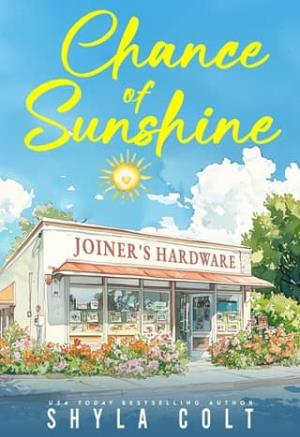
A Chance of Sunshine
Chapter 1
Chapter One
Everyone hates Mondays. But it’s the second day of the week I dread, because it consistently delivers soul-crushing news on the regular.
Tuesday curse. Behind the counter, I stare out the large glass window, peering at the shuttered shop fronts.
Joiner’s is scrawled across the center in black cursive lettering.
At eight thirty, the town is still slowly waking.
Shop owners amble in, and lights illuminate the other stores.
The scent of lemon furniture polish and the unmistakable scent of metal fill the air.
The aroma used to remind me of home, now it’s the mark of a prison.
The curse started with news of the company buyout that led to my layoff. Then, mere weeks later another blow to my kidneys—served up on the day named after the Germanic god of war and law—came with ten words: Dad had a stroke. I need you to come home.
One message halted everything else in my life. The job hunt ended abruptly, which meant canceling my interview for a lucrative position as a project manager meant to put me back on top. While the company understood my situation, they couldn’t hold the position open.
So, duty led me back to the tiny town stuck in the early 2000s that I thought I had put behind me. With Dad’s recovery process, leaving to head back to the city wasn’t an option. As the only child and a dutiful daughter, this is where I belong now.
The recovery process for a stroke can last up to two years, and I’ll be damned if I rush him.
Even if that means putting on a fake smile and kissing my dreams goodbye.
Replanting the roots I’d painstakingly ripped up years prior, I took over Joiner’s Hardware for the foreseeable future. We have to protect the family legacy.
Maybe the town legends of the keeper’s curse are true.
The myth says that one of the founding families must remain to tend their business so that Chance Falls can prosper.
There are about six of the founding lines still hanging on in various positions around town.
As a cocky youth, I thought it was a horror story meant to spook the locals into staying close to home.
But I can’t deny the town declines a little more every time a founding family relocates, or dies out.
Of course, things slowed down as people had fewer children and others left the town for bigger cities.
With no one to work, family legacies would come to a natural conclusion.
Shabby, faded signs, empty storefronts, and décor that seems dated rather than classic or timeless have become the norm. It’s disheartening.
This town is losing the magic that made it special.
I saw this coming, but I take no joy in being proven right.
When I suggested changes or updates over twenty years ago, town members mocked my ideas as too grand for Chance Falls.
Because I understood the need for growth, I pushed for modern amenities, and offer different items in the store. It hadn’t gone over well.
My brain has always been a few steps ahead. For me, dreaming of what’s coming next is natural. Forward thinking makes me a futuristic personality, and there’s nothing wrong with me.
That outlook, coupled with the town’s elder members’ resistance to change and reliance on upholding rigid traditions, made me feel stifled and dismissed. If it’s not broke, why fix it? I loathed that statement.
Perched on a stool, I survey the castle made of glass, wood, and my ancestors’ sweat.
Rows of wooden shelves are neatly stocked with hardware essentials.
The wooden floor shines thanks to regular polishes.
It’s quaint, but I can’t enjoy it. How in the hell did I wind up trapped here?
After spending my late twenties and early thirties creating a career in project management for construction companies, this is humiliating.
A lump forms in my throat, and my eyes get itchy.
I’m chronically single with no job prospects in my career field, or definitive plans for a previously imagined future.
The rows of tools, plumbing, and fasteners blur.
Grabbing the black travel mug off the worn counter, I bring it to my lips and swallow, washing down the bitterness.
Tears won’t help. Inevitably, news of a breakdown would reach my parents.
The extra stress won’t help them. We’re just now getting Dad’s blood pressure under control. I won’t put that in jeopardy.
The door swings open, rattling the same gold bell I remember from my childhood.
Dar walks in with an oversized Tupperware container in her hand, straight from work, judging by the navy-blue double-breasted skirt suit with a gold name tag and shiny brass buttons. Sensible navy flats round out the outfit.
“Morning Phil. I come bearing gifts.” Her cheeks are rosy from the cool morning, and her hazel-colored eyes sparkle with morning merriment.
Golden streaks thread through her dark brown hair.
Long, dark lashes frame her almond-shaped eyes.
Honey-kissed skin glows with health that was hard fought for.
“Almost forty years of friendship, and I still can’t handle your perkiness this early in the morning, Dar.”
Her cupid’s bow lips form a circle. “Early? It’s already nine in the morning.”
“Not all of us are on innkeeper time, lovely. You’re up at what, six?” I turn my nose up at the abhorrent thought.
“4:30 on days I open,” she corrects me cheerfully.
“Yuck.” I gag. “Sounds gross.”
Laughing, she sets the container on the counter. “I have samples of new pastries Rosie is thinking of using for fall.” The older matriarch has ruled the Fallen Star Pastries with an iron fist and a heavy wooden rolling pin for years.
“Why didn’t you say so? I’m happy to help judge flavors.” Rallying at the thought of sugar, I give her a genuine smile. Pushing up the sleeves of the black hoodie meant to ward off the morning chill, I stand from the stool behind the counter.
She removes the lid. The scent of sugar and flaky pastry drifts up toward me.
The airy croissants with chocolate cream in the center are delicate works of art that make my mouth water.
Square-shaped, bready pieces with rich red centers have glazed raspberries.
Sweets have been scarce in our house post-stroke.
“Mabel still bakes like an angel.” The sugar bakers’ matriarch runs the shop with a firm hand but a whimsical soul she pours into every creation they sell.
“That’s true.” I pick up a raspberry concoction and take a huge bite to stop myself from stating the list of things I can’t get in this town. I speak around a mouthful. “Is it your day off?”
Dar shakes her head, placing a dainty hand in front of her mouth as she finishes chewing.
“It’s my run errands around town and show my face to the local vendors day.
So much here is seasonal, and menus and activities constantly have to be updated.
Which is a good thing. It gives repeat guests a fresh experience each season.
” The happiness in her voice warms my heart. It’s obvious she loves what she does.
Since before either of us was born, the Murphy clan has run the Falling Water Inn. The two-story building is a staple in the town and the only place to stay for out-of-town visitors.
“Is the inn doing well?”
“Oh yeah. It’s been one of our best years, actually. Word’s been getting around now that Mom is letting me do more modern promotions.” Pride makes her stand a little taller, shoulders back, and chin up.
After attending college for business and marketing, she spent years trying to convince her folks that change can be a good thing. Seeing her win almost pulls me out of my bad mood—almost.
All of her family stayed in town. Proof that the founding family rule has merit.
The inn has been immune to the economic downturn.
Not that I begrudge Dar or her family their success.
My shy best friend is finally being seen as the force of nature she is, rather than for her disability.
The shorter, quieter member of a set of twins, with congenital hearing loss, they automatically branded her as the quiet one.
Lost in her twin brother Bridger’s shadow, she was handled with kid gloves by the family until she showed everyone she was made of sterner stuff.
“How are things here?” Dar glances around the store. Tall, handcrafted wooden shelves line the aisles. The chunky signs with black trim and corresponding labels painted in my great-great-great-grandfather’s handwriting haven’t changed.
“Exactly the same as always.” Which is part of the problem. A business has to grow with its customers. “But we’re the only hardware store in town, so it’s not like there’s steep competition.” We’re just locked into the same boring routines with limited services and no innovation.
Dar’s smile falters. “You’re absolutely miserable, aren’t you?”
“It’s been a rough few months.” A twinge of heartache over disappointments tightens my chest. I stomp the weakness down. “And this isn’t where I saw myself at thirty-nine.”
“I know.” Reaching out, Dar covers my hand with hers.
She’d been with me every step of the way during my father’s medical crisis and recovery process.
From the whirlwind that was relocating my entire life to the culture shock of moving from Raleigh, North Carolina, back to the small mountain town in the Midwest. Selling my two-bedroom white ranch style home with the oak tree in front broke my heart.
We needed the cash to keep the store afloat with the reduced hours.
I don’t regret supporting my family when I need to. It’s being trapped that angers me.
“You won’t feel better until you let yourself heal.”
“I’m working on it.” We both know I’m lying. I’m like a detective with a case they can’t shake, trying to figure out how everything went wrong.
“Have you heard from Brie recently?” I changed the subject to the third member of our trio.