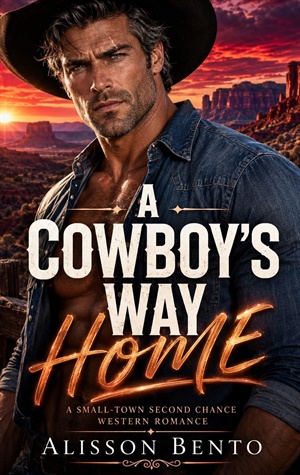
A Cowboy's Way Home (The Wild Sky Legacy #18)
CHAPTER 1
Beck
◆
The county line came up the way it always had, sudden and without ceremony, just a green sign gone to bird-shot and the road dropping into the valley like a held breath let go.
Beck Calhoun took his foot off the gas without deciding to.
Ten years, and the truck still knew the grade before he did, still leaned into the long curve above the river bottom the way water knows the low place and finds it without being shown.
He didn't want it to know. That was the trouble with coming back. The body remembered what the man had spent a decade trying to forget.
Red dust hung in the slant of late afternoon, kicked up by the tires and caught in the low gold light so the rearview mirror filled with it, a haze the color of dried blood that glowed and turned and did not settle, piling up behind him.
Behind him was where he kept things. He'd gotten good, these ten years, at leaving a long red smear on the world and never once looking forward through the windshield at where he was going.
The arena taught a man that. You didn't look at the dirt. You looked at the chute and you waited for the gate and then for eight seconds you held on to an animal that wanted you dead, and when it was over you got carried out one way or the other and somebody hosed the dirt down for the next fool.
The cattle guard at the Red Mesa turnoff came up on his right.
A quarter mile out it showed itself, the way the dirt lane peeled off the county road and ran up under the cottonwoods toward the home place, and his whole chest drew up tight as fence wire stretched one turn past true.
The pipe rails of the guard sat in their concrete cradle, rust-orange, the gap beneath them a black slot you could break a calf's leg in.
Beyond it the lane climbed and bent and vanished.
Up there, somewhere past the bend, was the house his mother had died in and the porch where her roses grew and the old man who'd told another man, plain as weather, that his eldest son broke everything he touched.
Beck's thumb came off the wheel and found the split through his right eyebrow. He dragged it across the old scar, slow, the way another man might cross himself.
Just driving through, he told himself. Just seeing it. Just laying eyes and turning around and going on to wherever a man goes who's got no place to be.
He did not turn in.
The truck rolled across the mouth of the lane at fifty and the cattle guard flashed past on his right and the red dust boiled up behind, thick now, swirling in the tail-lights as he passed so that for a second the whole rearview was full of it, that hanging rust-colored haze hung over the turn he hadn't taken, settling slow over it the way a thing you've done settles and can't be undone.
Then the road carried him on and the dust thinned and Red Mesa Ranch was behind him again, the way it had been since the night he left, and he hated how easy his hands had made it look.
He'd gotten good at arriving places that weren't home. This was the one that was, and he still couldn't make the turn.
---
Cedar Gulch hadn't changed and that was its own kind of cruelty.
He came in off the county road past the grain elevator and the old depot and there was Main, two blocks of false-front brick baking in the last of the sun, angle parking, a single blinking light at the cross street the way there'd always been.
The Spur sat on the corner with its chrome and its red vinyl glowing through the glass, and Beck slowed without meaning to and looked at it and looked away.
Diane Cross would be in there behind the counter with the pot in her hand. Diane Cross, who'd buried her husband two years gone, on a midnight calving call, while Beck was four states away winning a buckle he'd never wear and not coming home. He kept his eyes on the road.
The feed store had a new front but the same name painted small in the corner of the window, and that meant Wyatt was in there, or had been, propped on his cane behind the register, grinning at somebody, because Wyatt Mercer grinned at everybody, even the man who'd cost him his leg.
Especially him. Beck's foot eased off the gas and then pushed back down.
He couldn't look at the feed store either.
There was a whole list of things in this town he couldn't look at, and that list was the reason he'd stayed gone a decade, and it kept getting longer the slower he drove.
What had changed was small and bad. A storefront papered over with newspaper, FOR LEASE in a hand that had given up halfway through.
The hardware store gone dark. A rancher's truck at the curb with a hay-hauling rig that had seen better decades, and the rancher himself coming out of the bank with his hat in his hand and his shoulders set like a man walking away from a coffin.
Beck knew that walk. Hell, he'd written the book on that walk.
Ranch country had the look it got when the rain wouldn't come and the prices wouldn't hold and the bank wouldn't bend, the look of good people doing everything right and losing anyway, and the valley wore it now like a coat two sizes too small.
A woman crossing at the blinking light turned and watched him pass.
He didn't know her and she knew him, and he could read the whole thing happen on her face in the half-second it took, the squint and then the widening, the name landing.
Calhoun. The one that left. There was no meanness in it.
People here didn't hate him. They just knew exactly what he was, the way you know which dog will bolt the gate, and the knowing followed him down Main like the dust.
He pulled into the angle parking in front of The Broke Spoke because it was the one place on the street he could stand to walk into, a bar being a thing without memory, or at least without the wrong ones.
He cut the engine. The quiet rang. In the console, face-down where he'd kept it for three years, the championship buckle slid an inch and stopped, a slab of engraved silver and gold worth more than the truck and worth nothing at all, the proof he'd spent a decade gathering that the old man was wrong about him. Beck looked at it for a second.
Then he put his thumb to the St. Christopher medal through his shirt, his mother's medal, warm from his own skin, the little worn saint that was supposed to look after travelers, and he thought, not for the first time, that he was the one kind of traveler the saint had no use for.
The kind who could go anywhere and never once arrive.
He left the buckle face-down and went inside.
---
The Broke Spoke was dark and beer-cool and near empty, sawdust and stale hops, a ball game on the set with the sound off, two old boys at the far end who didn't turn around.
The bartender did. He was a heavy man going bald, with forearms like fence posts, and he looked up from the glass he was drying and his face did the thing Beck was already tired of, recognition coming on like a slow light.
“I'll be damned,” the bartender said. “Beck Calhoun.”
“In the flesh.” Beck took a stool. “Whatever's coldest. Just one.”
The man drew it and set it down and didn't take his eyes off him. “Ten years.”
“About that.”
“We watched you on the TV out here. Vegas. That ride on the brindle bull, the one nobody'd covered all season.” The bartender shook his head, half admiration and half something else. “Whole bar stood up.”
“Bull won the rematch,” Beck said, and tapped the scar through his eyebrow with one knuckle, dry. “Got me right here on the way down. So we're even.”
The man almost smiled. Then he set the towel down and leaned a forearm on the bar and his voice dropped into the register men used in this town when they were about to hand you something heavy and pretend they hadn't. “Your daddy know you're back?”
And there it was. Beck turned the glass a slow quarter-turn on the wood. “Just passing through.”
“Huh.” The bartender straightened. “Things are tight up at Red Mesa, way I hear it.
Tucker's been carrying a load. Whole valley's tight, but.” He shrugged, the shrug a man gives when he's already said one word more than was his to say.
“Hard to keep a place like that running on one set of hands, is all. Even Calhoun hands.”
Beck drank. The beer was cold and it was the first true thing that had happened to him all day.
Tucker's been carrying a load. He had a sudden picture of his brother at the books, jaw set, sandy hair gone darker with sweat, doing the work Beck had been born first to do and walked out on, and the picture sat in his gut like a stone.
He'd sent money, the first years. Tucker had sent it back.
After that Beck had stopped asking and Tucker had stopped answering and they'd built ten years of silence one returned envelope at a time.
“He always could outwork me,” Beck said. “Outwork three of me. Old man liked to say so.”
The bartender didn't touch that. Smart man. He went back to his glass.
Beck had one drink. That was the deal he'd made with himself somewhere around the Utah line, the way a man caught in open country under a building sky makes deals with God: one drink, lay eyes on the valley, and then get gone before the gravity of the place got hold of him, because he knew that gravity, he'd felt it pull at him for ten years from a thousand miles off, the slow constant tug of the one piece of ground that had ever had a claim on him.
One drink and out. He was good at out. It was the only thing besides riding he'd ever done well.
He was lifting the glass for the last of it when his phone went off against the bar.
The screen said Charlie.