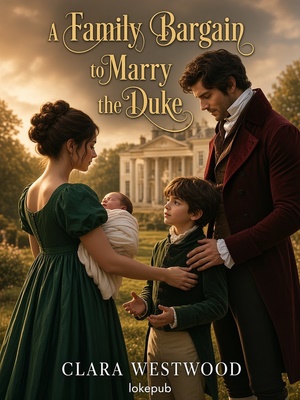
A Family Bargain to Marry the Duke
Chapter 1
“You cannot keep her, Louisa.”
Robert Everly, the Earl of Henswick, stood near the cold hearth, hands clasped behind his back in the posture he used for estate business and, apparently, for this.
Louisa stood across from him with Eleanor asleep against her shoulder, one small fist curled against the collar of her gown.
“I made a promise, Father,” she said.
“Promises made to a dying woman do not have to be kept.”
“Mine do.”
Her father’s jaw tightened. He was a patient man, ordinarily.
He had endured her opinions at every dinner party since she turned sixteen, had weathered her refusals of four separate suitors without once raising his voice.
But there was something in his face now that she had not seen before, something closer to fear than anger.
“Louisa.” He said her name the way he used to when she was small and had climbed somewhere she should not have. “Think for once, before you answer me. How do you intend to raise a child alone? Unmarried? What will you tell people when they ask whose baby you carry about on your hip?”
“I will tell them the truth. That her mother died and I gave my word.”
“Society does not care for the truth. Society cares for appearances, and a young unmarried woman raising another woman’s bastard will not be forgiven her sentiment, however noble you believe it to be.
” He exhaled, dragging a hand down his face.
“I am not without heart, Louisa. I grieve for Nell as you do. But you must think of your own future. What man will offer for you with an infant already in your arms?”
Louisa opened her mouth, but nothing came out.
She had an answer for everything. She always had.
It was the thing people complained about most—her sharp tongue, her readiness to argue a point until her opponent surrendered from sheer exhaustion.
But she stood there now with her father’s question hanging in the air, and for the first time in her life, she found herself at a loss for words.
She looked down at Eleanor instead. The baby slept on, oblivious, one cheek pressed to the muslin of Louisa’s sleeve, utterly unaware that the whole shape of her small life was being decided above her head by adults who loved her and did not know what to do with her.
Something in Louisa’s chest cracked.
She did not let it reach her face. She had spent twenty-five years learning to keep her face still when everything underneath it was not, and she called on that practice now, holding her chin level, refusing to let her father see what his question had done to her.
But her mother saw.
Lady Henswick rose from her chair by the window, where she had sat through the entire exchange with her hands folded in her lap and her eyes flicking between her husband and her daughter, watching a storm gather over water she could not calm.
She crossed the room and laid a hand on Louisa’s arm, over Eleanor’s small back.
“We will find a way,” she promised.
It was such a small thing to say. It solved nothing. It answered none of her father’s questions, offered no name, no husband, no respectable explanation for the child in her arms. But Louisa felt her mother’s hand steady against her arm, and something in her chest, cracked as it was, held.
“Anne.” Her father’s voice had grown tired. “You cannot promise her that when neither of us knows what way there is to find.”
“Then we will find one together, and quickly,” Lady Henswick said, “because our daughter has already decided, and I would rather help her succeed than watch her fail alone.”
Lord Henswick looked at his wife for a long moment. Then at his daughter. Then, briefly, at the sleeping child neither of them had asked for and both of them, Louisa suspected, already loved a little.
“I have business in the study,” he said finally, which was what he always said when he had run out of argument, and pride would not permit him to admit it. He crossed the room, paused at the door, and looked back at her. “I only want you settled, Louisa. Safe. Is that so great a crime?”
“No,” Louisa muttered. “It is not.”
He nodded once, as though that settled something, and left. The door clicked shut behind him with a softness that somehow felt louder than if he had slammed it.
Louisa stood very still in the silence that followed.
“He does not mean to be cruel,” Lady Henswick said.
“I know.” Louisa’s voice came out smaller than she had intended.
She looked down at Eleanor again, at the small round face gone slack and peaceful in sleep, lashes dark against her cheeks, utterly untroubled by the argument that had just been fought over her future.
“He only asks the question I cannot answer.”
“Which question is that?”
“How.” Louisa’s arms tightened around the baby.
“How I mean to do this. He is right that I have no husband. No income of my own beyond what he gives me. No answer for what I will tell people, or what they will call her, or what will happen to her the first time some spiteful woman at a ball decides to make an example of us both.” She swallowed.
“I have never in my life not known what to say, Mother. And I have no idea what I am going to do.”
Lady Henswick reached out and smoothed a strand of hair back from Louisa’s forehead, the way she had done since Louisa was small enough to require it.
“You made a promise to a dying woman,” she said, “and you have not once wavered from it, not for a single day. That is not nothing, Louisa. That is the beginning of an answer, even if you cannot see the rest of it yet.”
“It does not solve anything.”
“No,” she agreed. “But you solved nothing yesterday either, and yesterday you still managed to keep her fed, warm, and loved. I imagine you will manage the same tomorrow. The rest,” she said, with the calm certainty that had steadied Louisa’s whole life, “tends to arrive when it is needed and not a moment before. It always has for you.”
Louisa looked down at Eleanor’s sleeping face and did not entirely believe her mother. But she wanted to, badly enough that she let herself pretend for a moment.
“Go and sit with her in the nursery,” Lady Henswick urged. “I will speak to your father. He will come around. He always does, given time and enough of your stubbornness pressed against his.”
Louisa managed something close to a laugh, thin as it was. “That is not a compliment.”
“It was not meant as one.” Her mother’s mouth curved, gentle. “It was meant as the truth.”
Louisa carried Eleanor up the stairs, past the portraits of ancestors who had never once had to answer for a promise like hers, and into the small nursery that had been hastily assembled from what had once been a sewing room.
She laid the baby down in the borrowed cradle, tucked the blanket beneath her small chin, and stood over her for a long while, watching her breathe.
What am I going to do?
The question would not leave her, no matter how she turned it over.
She had no husband. No fortune of her own.
No answer for the whispers that would follow her the moment Society learned that an unmarried woman of good family had taken in a servant’s orphaned child and meant to raise her as her own.
She had made the promise easily, in the moment, with Nell’s cold hand in hers and the girl’s dying eyes fixed on her face.
“Promise me she will never be alone. Promise me she will be loved.”
Louisa had given her word without a single thought for how she would keep it, because in that moment, there had been nothing else to give.
Now the moment had passed, and the promise remained, and Louisa stood alone in the nursery with no earthly idea how a woman with no husband and no fortune of her own was meant to raise a child and keep her safe from a world that punished women for exactly this kind of loyalty.
She had never, in twenty-five years, been without an answer.
Eleanor stirred faintly in her sleep, one tiny hand opening and closing around nothing, and Louisa reached down and let the small fingers close around one of her own instead. The grip was absurdly strong for something so small.
“I do not know how yet,” Louisa whispered, so quietly it barely disturbed the air. “But I will find it. I promise you that as well.”
She closed her eyes for a moment.
Oh, Grandmama…
Edith would have known what to do. She had never once needed a voice to speak, and yet she had always managed to say the truest things Louisa had ever heard, straight from the heart and past every polite pretense standing in the way of it.
She would have taken one look at the argument, one look at Louisa’s stricken face, and her hands would have moved with absolute certainty, cutting through every fear Louisa could not yet find words for.
“I wish you were here,” Louisa murmured, brushing her thumb gently over Eleanor’s small curled fist. “You would have known exactly what to say to me tonight. You always did.”