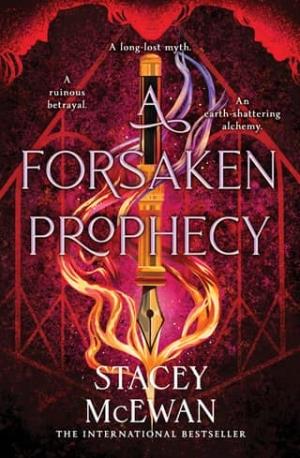
A Forsaken Prophecy (The Artisan Trilogy #2)
Prologue Nina
Ma and I were the only ones in church with the coming of winter. I hated her for it.
The walk was slushy, the building jarringly cold, the pews merciless. I wriggled my backside against it and whined to holy hell.
“I want to leave.”
“I know you do.” My mother’s voice was distant. She looked to the altar as though she saw something else entirely. She only ever wore her best clothes here; a white dress turned yellow at the armpits and hem, a woolen hat low over her ears, earrings her own mother had given her on her wedding day.
There was no one in the parish more religious than my mother, it seemed.
Not even the pastor rose on Sundays while snow was falling.
No one but her and I to light the candles and converse with Idia, or pretend to.
In Scurry, there was not much religion to be had at all.
I knew for a fact that Pastor David liked to take God’s name in vain.
I heard it through the walls of our apartment when he visited Mrs. Flamshank in the night.
The other children of Scurry were not freezing on hard wood benches every week. They were under blankets in their beds, staving off the morning chill. They wouldn’t be back in church until the snow had melted and the Scurry ground was full of widow’s lace and wildflower.
“It’s cold.”
“Just a little longer.” She scooted me closer to her, so I was tucked under her arm. I went reluctantly, wanting to reproach her, but gravitating toward the warmth. “It’s important we come, even when we don’t want to.”
“But why?”
“Because it takes sufferin’ to have your wishes answered,” she said. “That’s what God wants. He wants to know we’ve earned it.”
“Is that why the seats hurt so bloody much?”
“Yeah. Don’t swear.”
I frowned at the little statue on the altar. Shorter than me, hollow-eyed, bone-white. Idia, frozen in her suffering. How much had she had to endure before God was finally satisfied?
“What do you wish for?” I asked Ma now. Whatever it was, she wanted it badly. Badly enough to wake me at dawn every week. Badly enough that tears filmed her eyes when she prayed to that ugly statue.
Her smile was as weak as they came. “When God grants it, I’ll tell you.” She kissed my curls, the same as her own: golden in sunlight, dull there in the nave.
“Pastor David says that God loves us all, even if we don’t come to church.”
“Well, Pastor David is a pig.”
We sat in silence for a moment. Me fidgeting, Ma reveling in whatever evangelical reassurance she found in a place that smelled of tobacco and damp wood.
“Wishes ain’t real,” I said eventually, and only because I wanted to poke a hole in her peace. The bones of my backside pulverized further.
“I wished for you, and here you are. What say you to that?”
“All the women have babies, even the ones that don’t want ’em. That ain’t a real wish.”
She scoffed. “And if you could wish for anythin’, Nina, what would you wish for?”
What a question to lob at an eight-year-old.
I wanted for more things than I knew how to voice.
All that wanting had become an unrelenting ache in my fingers.
Sometimes it was hard to tell exactly what it was I longed for.
Desserts? Toys? A big house with twelve rooms?
Or was it tied more closely to the things I was afraid of?
Vacant eyes. The tremor in Dad’s fingers.
The shake of Ma’s frame when she lay aside me in bed.
“I’d wish for magic,” I said. It seemed the only answer to encompass the whole lot.
She nodded, looked back to that sorry statue. “Me own Ma used to tell me a story about wishes. Do you want to hear it?”
I nodded.
She licked her cracked lips in readiness. “Let’s see now. God bestowed three daughters to Earth—”
“God only had one daughter,” I interrupted haughtily. “Idia.”
“But in this story, there’re three,” she winked at me.
“Idia, Joan, and Dione. The three daughters were sent to Earth with powerful gifts. In their blood was a magic no man or woman had ever seen. They could bend rivers, plunder the earth, levitate any matter they set their mind to. They held the world in the palm of their hands, and the humans, those greedy blighters, they wanted that power for themselves, didn’t they? ”
I leaned closer, captivated despite myself.
“Soon, people from foreign lands learned of their magic and came to take it from them. But the three daughters had grown and worked on this land, and their neighbors had come to love them. They vowed to protect the daughters—to hide them. These men and women called themselves ‘the Stewards.’ ”
My ears pricked. A word I’d heard before. The ramblings of a street corner preacher on Pewter Lane who spoke of Stewards. There was a song they sang in the schoolyard:
Hide, hide the witch,
The stewards, they hid three.
Two in the parish,
One by the sea.
Catch, catch the witch,
Never let her flee.
Put her to the post, The devil’s slave, is she.
Ma continued. “But the enemy were relentless, and so of course, eventually the daughters were found, and their magic was stolen.”
I saw it in my mind, those daughters holding their magic against their chests, kicking the shins of those who wanted to take it.
“Why didn’t God help ’em?” I asked. But if my mother had an answer, it was stuck between her lips. She pressed them together tightly.
“Perhaps it was their turn to suffer,” she said.
I looked to my shoelaces and pondered a God that would give his daughters magic, then punish them for it.
“They say if you visit their graves and make a wish, the three daughters will grant it,” Ma said now, bumping her shoulder against mine.
“Have you seen ’em?” I frowned. “Their graves.”
Ma looked to the ceiling. “No. But one day we both will.”
“And we’ll make a wish?”
“We’ll make as many wishes as we can manage,” she said.
Warmth gathered in. I mashed my nose into the sides of her ribs. “And Dad as well?”
She sighed, all the breath in her lungs escaping. “No, darlin’. That’s a trip meant for you and me.”
And she turned enough that I could see the bruise shadowing the left side of her face, creeping in from her hairline, swelling her eye near closed, and I thought it was just as well that we left him behind.
Those three daughters had seen enough suffering. Hadn’t they?