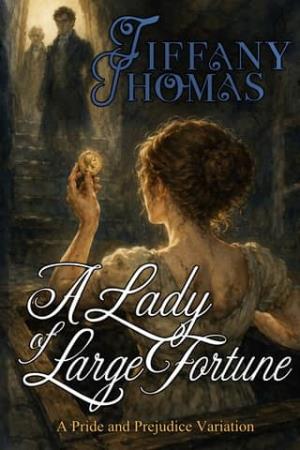
A Lady of Large Fortune (Pride & Prejudice variation)
Prologue
The rain had not ceased in three days.
It drummed steadily upon the tiled roofs of Londinium and ran in muddy rivulets through the once-proud streets of the city. Water gathered in the cracks of broken stone and pooled beneath the arches of abandoned forums where weeds now grew between the paving slabs.
Lucius Cassianus Varro stood motionless beneath the portico of his townhouse and stared toward the wall.
Even through the curtain of rain, he could see where repairs had recently been made. Fresh stone patches marred the older Roman work, desperate attempts to preserve what remained of imperial authority in Britannia.
It would not hold.
Everyone knew it.
The Saxons had grown bolder with every passing season. Raiders descended upon the eastern coast like wolves, while the northern tribes pressed farther south each year. The legions that once protected Britannia were gone, recalled decades before to defend a dying empire across the sea.
Rome no longer guarded Britain.
Rome scarcely guarded Rome.
Behind Lucius, the house stood silent.
Too silent.
Once, laughter had echoed through the atrium.
His wife’s soft voice had mingled with the patter of little feet across the mosaic floor.
Servants had hurried through the halls carrying trays of figs, wine, and lamp oil while clients waited patiently each morning for audience with the wealthy merchant whose ships carried wool, tin, and imported luxuries between Britannia and Gaul.
Now there remained only emptiness.
His wife had died over the winter before from a fever that swept through the city. His son—
Lucius closed his eyes.
His son had survived her only briefly.
Marcus had been sixteen when the coughing sickness came. The physician had called it a corruption of the lungs. Blood stained the boy’s lips within days. By the end, Marcus had been too weak even to lift his own hand.
Lucius still heard the sound of that terrible breathing in the night.
The gods had taken everything.
A sharp knock sounded at the outer gate.
Lucius turned as his steward entered the courtyard, soaked through despite his heavy cloak.
“They have begun leaving already,” Gaius said without preamble. “More wagons departed through Ludgate before dawn. The magistrate’s household among them.”
Lucius gave a bitter laugh.
“The magistrates abandoned their duties long ago. Why should they not abandon the city as well?”
Gaius hesitated. “My lord... we should depart tonight.”
Lucius looked once more toward the wall.
Beyond it lay chaos.
Beyond it lay Saxons.
He had heard the stories from the eastern settlements. Villas burned. Temples desecrated. Roman families slaughtered or driven into the countryside like beggars.
He would not allow generations of wealth to fall into barbarian hands.
“Bring the chests,” he ordered quietly.
Gaius froze. “All of them?”
“All.”
The steward stared at him in alarm. “My lord, there are too many. We cannot possibly transport such weight safely to the coast.”
“We are not taking them.”
Understanding dawned slowly across the older man’s face.
“You mean to bury them.”
Lucius said nothing.
Rainwater dripped steadily from the edge of the roof as the two men stood in silence.
Finally, Gaius bowed his head. “Very well.”
The work began after nightfall.
Servants dismissed weeks earlier could not be trusted, and so only Lucius and Gaius labored in the flickering light of oil lamps.
Beneath the rear chamber of the townhouse—a room overlooking the road that led eastward from the bridge across the Tamesis—they pried loose the mosaic floor one piece at a time.
The earth beneath was damp and cold.
Into the pit went the first chest.
Gold solidi stamped with the faces of emperors long dead gleamed in the lamplight. Garnets from the east. Emeralds from Egypt. Silver plate engraved with hunting scenes. Ivory carvings. Necklaces that had adorned Roman noblewomen before Constantine himself had ruled.
The accumulated wealth of generations disappeared slowly into the darkness below the floor.
Lucius descended into the pit one final time and knelt beside the treasure.
For a long moment, he simply rested his hand atop one of the chests.
This was madness.
If he never returned, all of it would vanish into the earth forever.
Yet what choice remained?
Outside, the storm winds moaned through the dying city.
At last, Lucius lifted his eyes toward the ceiling above him.
“Mercurius,” he whispered hoarsely, invoking the guardian of merchants and prosperity, “keeper of fortune and protector of travelers... preserve what is mine until I return.”
His voice faltered.
“And if I do not return... let civilized hands one day uncover it again. Let Rome not vanish utterly from this place.”
The lamp flame trembled.
Somewhere in the distance, beyond the walls of Londinium, a horn sounded through the rain, signaling another group’s departure.
“We must depart soon, my lord, else we will be left behind. The last group leaves tomorrow.”
Lucius nodded, then climbed the ladder up out of the pit one last time. He looked down on the treasure, then lifted the shovel and began to cover it with dirt.
Hours later, he carefully laid the wooden planks on top of the now-packed soil.
He picked up his satchel and left the house, closing the door behind him.
Turning his back on the building that once housed his family but failed to protect them, Lucius mounted his horse and urged him into a trot.
A cold, gray mist clung to the streets as he closed the door behind him.
As he and Gaius passed beneath the city gate, the iron-bound wheels of his wagon rattled over broken paving stones, echoing unnaturally through the silent streets.
No merchants cried their wares.
No senators rode in litters.
No soldiers stood watch.
Only emptiness remained.
Lucius rode at the front beside Gaius, his heavy cloak drawn tightly against the damp chill rising from the Tamesis.
Behind them came six servants, two wagons, and a pair of elderly slaves too frail to abandon.
What little they carried now consisted only of necessities—food, blankets, tools, and a handful of silver hidden amongst sacks of grain.
Once across the bridge, Lucius turned in his saddle and looked back.
The great walls still stood, though sections sagged where age and neglect had weakened the stone.
Roofs had begun collapsing inward throughout the city.
Entire districts near the old basilica had been abandoned years before.
Grass grew between the paving stones of streets that had once bustled with traders from every corner of the empire.
The temples were empty now.
The forum silent.
Rome in Britannia was dying.
Lucius stared at the city for a long moment.
His shoulders sagged.
He had spoken of returning for Gaius’s sake more than his own.
In truth, he knew he would never see Londinium again.
“Master?” Gaius asked quietly.
Lucius swallowed hard and turned away.
“Go on.”
The wagons creaked forward along the muddy road.
By midday, rain began again.
The countryside beyond Londinium bore the scars of years of unrest. Villas stood blackened and abandoned. Fields once carefully cultivated had gone wild. More than once they passed the remnants of shrines smashed apart by raiders or desperate peasants scavenging stone for their own shelters.
Toward evening, they reached a stretch of wooded road.
Gaius’s horse suddenly snorted and stamped nervously.
Lucius frowned.
The forest had become too quiet.
Then came the whistle.
An arrow struck the servant riding behind them clean through the throat.
Chaos erupted.
Men burst from the trees with savage cries.
Saxons.
Tall, broad-shouldered warriors with tangled fair hair and painted shields descended upon the road like wolves upon wounded prey. Spears and axes flashed through the rain.
One of the wagon drivers screamed as a spear pierced his chest.
Another fell beneath an axe blow so violent that blood sprayed across the side of the wagon.
“Horses!” Gaius shouted. “Ride!”
But there was nowhere to ride.
More Saxons emerged from the woods ahead, cutting off escape.
Lucius drew the short spatha at his side, though he had not wielded it in earnest since his youth. His horse reared violently as another arrow flew past his face.
A servant stumbled toward him, blood pouring from his arm.
“They found us!” the man cried.
A Saxon axe buried itself in the servant’s back before Lucius could answer.
The man collapsed into the mud.
Gaius fought beside him desperately, striking one attacker from his horse before another dragged him down. Lucius heard the old steward cry out as spearpoints descended.
“Gaius!”
Lucius kicked his horse forward, slashing wildly at the nearest attacker. His blade glanced uselessly from a shield.
A heavy blow struck his side.
Pain exploded through his ribs as he tumbled from the saddle into the mud.
The world spun.
Rain pounded against his face.
Dimly, he saw shapes moving through the storm. Heard screams cut short one by one.
The Saxons tore through the wagons, overturning sacks and chests in search of plunder.
One warrior seized Lucius by the cloak and rolled him onto his back.
The barbarian barked something in a harsh tongue, clearly demanding to know where his wealth was hidden.
Lucius stared upward through the rain.
And smiled.
The Saxon’s face darkened in fury.
The axe descended.
By the following dawn, nothing remained upon the road but corpses, broken wagons, and blood washing slowly into the mud beneath the rain.
And far away, beneath the floor of a silent house beside the road leading from the bridge across the Tamesis, the treasure of Lucius Cassianus Varro remained hidden in darkness while centuries passed above it.