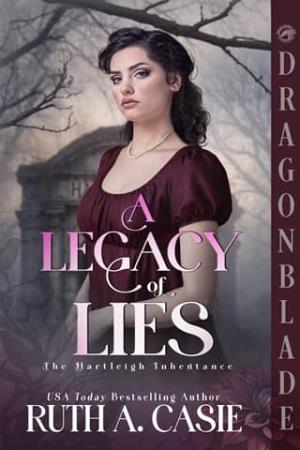
A Legacy of Lies (The Hartleigh Inheritance #1)
Chapter One
Some mornings, the sky wakes promising a color palette of rose, gold, and lavender. But not today. Today, the world woke draped in fog, stripped of color, the dawn crawling from its grave, gray and chilled, reluctant to rise.
The faint rustle of silk and the steady, controlled tap of her cane against the stone floor announced Lady Eleanor’s arrival.
Her veil caught the damp air like breath made visible.
Her features were fine-boned, her cool gray eyes shadowed by too many farewells.
Her hair, a dignified gray, was swept up neatly beneath it.
Beneath the severity of mourning lay the quiet majesty of a woman born to command herself before others.
She lifted her chin. Her gaze, drawn by memory to the opposite wall, fell upon the plaque that had broken her heart. It took her back two years, the last time she came to this place.
Adrian, Marquess of Thornhaven.
Born May 22, 1804. Died November 14, 1835.
Husband of Eliza Somerton Hartleigh.
Son of the Duke and Duchess of Hartleigh
Loved in life, remembered in peace.
It was just the two of them in the years since Adrian’s passing.
Eliza had sent a messenger from Thornhaven explaining the situation.
They left immediately and made the three-day journey in less than two.
She and Charles swept into his room. For a tall, broad-shouldered young man, Adrian looked suddenly small, sweating and shivering at once, a child trapped in a failing body.
“Mama,” his voice a whisper.
Eliza emptied the room, giving her and Charles time alone with him.
She forced the memory back. The rasp of Adrian’s breath, the mirror of it in Charles only days ago. Memory had become an illness of its own, one she endured without a cure.
She pulled her gaze from the plaque, unwilling to look at what lay behind it.
Instead, her eyes flickered downward, past the edge of the vault, to the mosaic set into the stone floor.
The bare tree waited there, its roots spreading like veins through the marble, the same emblem that had watched over every Hartleigh passing.
Eleanor steadied her breath before turning her attention to the vicar.
He was saying what a fine, fair, and honest man Charles had been.
True enough. Yet truth never seemed large enough to contain him.
What the vicar left out was the way Charles could make her laugh at the smallest absurdity, how there had always been a touch of the rogue in him even after forty-one years of marriage.
A smile touched her lips. All it took was his lean against the doorway, one eyebrow raised, that devil’s smirk that could undo her composure in an instant.
Retired from the House of Lords, they had chosen to retreat to Hartleigh Hall in Northumberland.
She sighed. Fate, ever unkind, had other plans.
Oh, my dearest Charles, if I could see you one more time, to tell you the things left unsaid, to share the quiet mornings, and survive the stormy nights once more.
The murmur of the mourners broke her reverie.
She was not alone. Clara Whitmore, her companion, remained a few paces behind.
Barely past girlhood, she was slight and straight-backed, soft brown hair pinned in modest coils that caught the crypt’s faint light.
Her watchfulness lent her more stature than height.
Edith Greaves, her housekeeper, and her husband, Percival, the Hartleigh butler, took their places around the casket. Thomas Grey, the gardener, and three footmen waited in respectful silence.
The vicar quietly closed his hymnal and looked toward Eleanor. She came forward and bent over the coffin.
“You were my rogue, Charles Hartleigh,” she whispered. “And my peace. Wait for me, love. But not too close. I’ve still work to do in this world.”
She stepped back and gave a single nod to Thomas and the footman.
The men came forward and guided the coffin into the sarcophagus, where it would rest beside generations of the family line.
“We return him to the earth,” the vicar began, “trusting in God’s mercy and the memory of those who love him. Let peace rest upon him, and light eternal shine before him.”
Thomas sealed the vault, and the vicar led the way up from the gloom.
Clara stepped forward and gently touched Eleanor’s arm.
Together they followed the vicar. Next came the staff.
Percival was silent, Edith tight-lipped, and the footmen solemn.
Thomas closed and locked the crypt door and handed Lady Eleanor the key.
“I am truly sorry for your loss,” the vicar said, taking her hand. “My lady, Lord Charles will be sorely missed.”
Unable to say anything, she nodded.
“Miss Clara,” he continued softly, “take good care of her.” He left without another word as a weak sun broke through the clouds.
“Would you like to walk, my lady?” Clara asked. “Or go directly to the Hall?”
“A short walk. Through the garden, perhaps. I’ve neglected the late roses.” They walked a short distance in silence.
*
While Eleanor tended to the roses, Clara sat on the bench, hands folded in her lap, her thoughts adrift.
There was a quiet dignity about Lady Eleanor, burying her husband and perhaps, in some silent way, her son once more.
Clara had seen the way her ladyship’s gaze lingered on the plaque.
That small, private moment when grief bent her head before she straightened again.
Clara knew loss. Hers hadn’t come through illness but had been slower, deliberate.
It was the steady collapse of a family into debt, madness, and the drink that blurred remembrance.
She shook herself. Self-pity served nothing. She had met others with similar stories, though not all had done as well. At least her mother had secured her a position with Lady Eleanor before death claimed her.
She shuddered at the memory, or was it only the crypt’s chill still clinging to her skin?
If she were truthful, she could not leave that place quickly enough.
The air bore down against her ribs like judgment itself.
There were moments she swore the stones were breathing, heavy and patient, judging the living.
“Clara, would you like to sit out here longer?” Lady Eleanor stood before her, fussing with a basket of roses in her hand. “Or are you coming in? You seem to be far off someplace.”
Clara glanced at the basket, then up at Lady Eleanor.
“Thomas. He saw me at the roses and brought me a basket and shears.” Eleanor studied her closely, then set the basket on the bench and bent down. “Are you feeling well?”
“I am well, my lady.” She rose. “If you’re ready?”
They walked on together, their steps slow across the damp path.
“He should be here any day now,” Eleanor shared.
“Who, my lady?” she asked casually.
“Charles’s successor.”
Clara turned to her. With no direct heir, she, as the staff alike, had wondered who the 8th Duke of Hartleigh would be.
“Don’t look so surprised. He is a good man, a solicitor. He will see to the estate.”
Lady Eleanor walked ahead into the arbor with its leaves painted in every shade of dying summer.
Before she exited, Clara paused, turning at the sound of a soft footfall. No one stood there, only the leaves trembling as if someone unseen had brushed past. Her breath caught. Surely only her mind, overwrought by grief and sleeplessness, was playing tricks. The day had all been so stressful.
Lady Eleanor climbed the terrace steps as the church bell tolled, its echo lingering like a benediction.
Clara came beside her and turned away to give her ladyship privacy.
In the tall window by the terrace, her reflection hovered as a shadowed figure, hair pinned too tightly, cool gray eyes a touch too wide.
She looked like a woman who might vanish in the space between one breath and the next. Perhaps that’s why she belonged.
They entered the Hall, where Percival and Edith were preparing the drawing room for refreshments.
Edith set the teacups down hard enough that the saucers trembled.
“Mark my words,” she muttered, “this house knows.”
Percival, arranging a linen napkin, cleared his throat, the sound brisk and deliberate. “Houses do not speak, Edith.”
“This one does,” she said under her breath.
“Excuse me, my lady.”
Eleanor turned. “Yes, Mr. Carter.”
The footman stepped forward, a silver tray balanced in his hands, a folded note resting upon it. He bowed and presented it to Lady Eleanor.
She took the note and broke the seal with practiced calm, the paper’s crack loud in the quiet room. Her gaze flicked across the page, a faint lift of her brow the only sign of what she read.
“Thank you, Mr. Carter. That will be all.”
Eleanor studied the letter for a long moment before she folded it with the care of someone smoothing their grief. She slipped it into her pocket with fingers that did not tremble.
“Nathaniel Draycott, who now holds the Hartleigh title, is expected tomorrow,” she said at last, her voice even.
Even his name seemed to stir the air, its cadence clipped and foreign, shaped by distance itself.
“The duke’s will confirms him as heir presumptive.
He is to serve until such time as the rightful inheritor is revealed. ”
Something in the stillness of the room leaned closer, as though the Hall itself paused to listen.
She turned toward the tray. “Clara, are you having tea?”
“Yes, my lady.” Clara’s voice sounded steadier than her breath felt. She stepped forward, ready to pour.
Behind her, a quiet footfall. Carter, composed and silent, appeared at her shoulder with the silver salver. A second envelope rested atop it.
“For you, miss,” he said, and that was all.
The young man withdrew as quietly as he had entered.
Clara’s eyes locked on the paper. Time narrowed to a single breath. The handwriting curled across it like smoke from a dying fire, slanted, theatrical, unmistakable.
Miss Clara Whitmore
Hartleigh Hall
No town. No county. Her father had never needed directions to find her.
Her fingers closed around the note before anyone else could look too closely. It was heavier than it should have been, as though the past itself had laid a hand at her throat.
She smiled the practiced smile her mother had taught her. “Thank you,” she said, and tucked it into her pocket.
The paper brushed the silk at her hip, its edge sharp as a blade.
She did not open it. Not here. Not while Eleanor lifted the teapot, not while Percival smoothed the cloth, not while the windows blinked in silence.
But all through tea, the letter pulsed against her side, a second heartbeat that would not be still.
Before she read a single word, her past had already found her. And it had no intention of letting go.