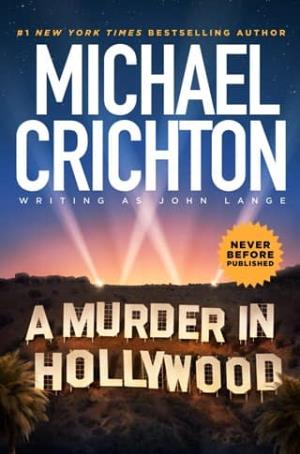
A Murder in Hollywood
Foreword
It is such an honor and pleasure to see the John Lange books freshly and newly published by Blackstone, to reintroduce these books to fans and also present them to a whole new generation of readers.
My husband, Michael Crichton, put himself through Harvard Medical School in the sixties by writing pulp fiction novels. He wrote them as John Lange and Jeffery Hudson before he was published under his own name with The Andromeda Strain.
The John Lange books are adventure stories, and you can start to see in them the genius that would, only a few years later, become so apparent. While later in his career Michael made a point of separating his identity from these novels, I suspect he had a lot more affection for them than he showed.
The books are set in the late sixties and seventies and were his tribute to Ian Fleming’s James Bond novels and to one of his favorite Alfred Hitchcock films, To Catch a Thief; the books are about secret treasures, heists, archaeology, unlikely heroes, seductive and at times treacherous lovers, classic villains, and much more.
I look at these John Lange novels with great affection as I picture Michael studying medicine day and night and writing these fun books over school breaks and holidays.
Becoming an author was his dream—not being a doctor—and the John Lange novels truly are a testament to his exotic imagination, places he dreamed of visiting, and above all, they show the birth of Michael as an author.
In an interview from December 2000, Michael shared details of the beginning of his career in the sixties. His comments reveal how he went from John Lange to Michael Crichton:
I was one of those kids who seemed to know very early what I wanted to do. I was driven to writing. I did a lot of it starting around the third grade, when I wrote this enormously long puppet show that had to be typed up by my father with carbon copies so that all the kids could have their parts.
At that time most of the third graders were writing a page, and I had written this very long thing. But I just wanted to do it. I don’t know how to explain it any differently.
When I was thirteen or fourteen, I had visited a place in Arizona called Sunset Crater Volcano National Monument; I thought it was extremely interesting and relatively unknown.
I complained that people didn’t have more knowledge about this place, and my mother and father told me, “Well, why don’t you write an article?
” I said, “I can’t do that.” And they said, “No, no, the New York Times accepts articles in their Travel section from all kinds of people.” So I wrote an article and they published it.
I’d read that only two hundred people in the United States were able to support themselves full time writing books.
I thought to be one of two hundred people in the entire country seemed a very difficult group to join.
And six thousand doctors graduated every year.
That seemed much more doable. But while I was in medical school, I began to write to pay the term bills.
I wrote under a pseudonym because the grades you got in those days were very dependent on the evaluation of your teachers, and I was quite convinced that if they knew I was running off to write books, they would think less of me.
The names I chose were John Lange and Jeffery Hudson.
John Lange, I drew from my own first name, which is John, and I thought of these books as James Bond thrillers, fairy tales for adults.
I associated the books to Andrew Lang, who was an author of Victorian fairy tales, and Jeffery Hudson, who was a little person from the court of Charles I of England and a great adventurer.
I thought it would be very entertaining for me to have the name of a little person since I am six nine.
The book I wrote under the name Jeffery Hudson, A Case of Need, was optioned for a movie and eventually made by Blake Edwards.
It made my life very strange because I was sometimes going to California to talk to the screenwriter, then I’d come back and put on my whites to be in the hospital.
There’s a bizarre difference between being an impoverished student and then having these periods where I got into limousines and drove around Hollywood.
It made me a little crazy. Yet, even when A Case of Need won the Edgar Award for Best Mystery and I had to go down to New York to accept the award, no one in the medical school ever found out, which was odd.
It showed me how self-centered the institution of medicine really was.
Eventually, I was going to write a nonfiction book, which ultimately was published as Five Patients, and I had to go to the dean to get permission to skip certain classes to do this book.
He said, “Well, writing a book is very difficult. Do you realize how difficult it is? Have you ever done anything like that?” And at that point I finally thought it was okay, and I said, “Yes, actually, I’ve written several books. ”
My next novel to be published was The Andromeda Strain; I wrote it in secret, and when [director] Robert Wise bought it to make it as a film, it got publicized that there was this kid in medical school who had sold a book to the movies for a lot of money.
My picture was on the wire services. The story was officially out. Everybody knew. But looking back on it, it was a very free time.