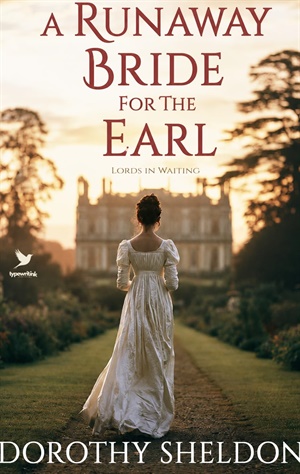
A Runaway Bride for the Earl (Lords in Waiting 4)
Chapter One
“My aunt is terribly ill,” Molly Granger lied to the mail-coach driver, who had asked her absolutely nothing.
“Consumption, I believe. Or a fever upon the lungs. The physician’s letter was most alarming, which is precisely the sort of circumstance that demands an immediate journey at midnight, in the rain, alone. You understand.”
The driver, a broad man weathered into patience by years of bad roads and worse passengers, looked her over.
She was soaked through, her hair escaping its pins in copper-dark rivulets that clung to her neck and jaw.
One ankle was plainly swollen beneath the muddied hem of her gown.
She clutched a travelling-bag against her chest as though it contained something far more precious than what appeared, from the split seam, to be the heel of a pale blue shoe that matched nothing she wore.
She was also, despite looking like something a river had lately spat out, smiling at him with such determined cheer that he almost believed her.
Almost.
“Where’s this aunt, then?” he asked.
“West.” Molly said this with tremendous confidence, because west was the only direction she had actually planned. Everything before west had been panic, and everything beyond it remained, as yet, a void. “Quite far west. As far west as you are going, really.”
“Bath.”
“Bath! Yes. My aunt lives in Bath. My terribly ill aunt. In Bath. Where she is ill. Terribly.”
She was a catastrophic liar. Other women could construct elegant falsehoods with serene composure; Molly built hers out of wet sand and sheer volume. Her father had once told her she possessed her mother’s gift for filling a room, and her complete inability to deceive a single soul in it.
Her father.
She pushed the thought away, and it came back as it always did, patient and unhurried.
“You running from something, miss?”
“Certainly not. I am visiting my aunt.”
“Right.” The driver glanced again at the travelling-bag, at the absurd shoe heel, at the way her eyes kept darting towards the dark road from which she had emerged, searching for something she was desperate to outrun.
He had daughters, perhaps. Or sisters. Or some woman in his life who had taught him to recognise that particular species of terror which dressed itself in cheerfulness and hoped no one would look too closely.
“Coach leaves in ten minutes,” he said. “Ride up top if you can manage the rain.”
“I adore rain,” Molly said wistfully, climbing onto the box before he could change his mind.
Within thirty seconds of the full force of an April night bearing down upon her already-ruined hair, she regretted every word.
She gripped the edge of the seat and pressed her mother’s locket against her collarbone beneath her soaked gown.
The locket was the one thing she had packed deliberately.
Everything else in the travelling-bag was evidence of panic: two dresses snatched from the nearest hooks, a hairbrush, a novel she had read twice, and a single evening shoe in pale blue silk, which served no practical function whatsoever but had been the first thing her hand had closed around in the dark.
It had taken her nearly three miles to discover she had forgotten money. By then, she had been standing at a crossroads in the pitch-black night, her ankle throbbing, her palms stinging from thorn-scratches, her entire worldly strategy consisting of the word west.
And going back was no longer an option.
Going back meant the dress hanging in her wardrobe, and the morning that came with it.
It meant Lord Vyne.
The coach lurched forward into the darkness. Molly let her breath out in a rush, tipped her head back against the luggage rack, and watched the stars reel overhead between the clouds.
I have done the most reckless thing I shall ever do in my life, she thought. I am either brave or catastrophically stupid, and there is truly very little way of knowing which until morning.
The memory found her before she was ready for it. They always did, the bad ones, waiting for a quiet moment, a gap in the noise, before sliding in like water through a crack.
Three weeks ago. Lord Vyne had sat in her father’s drawing room.
He was one-and-sixty, silver-haired, impeccably dressed, and possessed of the sort of authority that made servants step backwards when he entered.
He had arrived with his solicitor, his valet, and the air of a man inspecting a purchase.
He had smiled at Sir Gerald Granger, complimented the claret, and then turned his attention to Molly.
His eyes were pale. That had been her first impression—how pale they were, how flat, how patient.
They had travelled over her face, her throat, her hands folded in her lap, with the slow deliberation of a man examining a horse at market.
He had studied her while speaking to her father, as if she were a painting being discussed in a gallery rather than a living woman sitting three feet away.
“A spirited girl,” he had said. “I admire spirit in a wife. I look forward to settling her.”
Settling.
He had said the word as one might say taming, or breaking, or corking a bottle of something that had been left to breathe too long.
Her father had smiled, nodded, poured more claret.
And Molly had sat there in her best afternoon dress, her fingernails pressed into her palms, the ground falling away beneath her with a clarity that left no room for misunderstanding what she was being sold into.
Reasoning had not worked. Papa, the man is forty years my elder.
Tears had not worked either—real ones, loud ones, the sort that left her red-faced and gasping, and should have moved a stone.
Bargaining had failed as well. Give me one Season. Only one. I will find someone suitable, someone young, someone who does not make me feel like a mouse in a trap.
Sir Gerald had listened to all of it. He had held her hands. He had met her with those kind, helpless eyes she had loved all her life.
“This is the only way, Molly. The estate. The tenants. Your mother’s grave is on that land.”
Then he had left her room.
Molly had lain in bed for two hours afterwards, staring at the wedding dress hanging from the wardrobe door like a white ghost, all silk and seed pearls and someone else’s idea of her future. And an eerie calm had come over her, soft and cold as snowfall.
I shall simply die in that house if I marry him.
The thought was melodramatic. Of course it was.
But she had seen what lived in Vyne’s eyes when he said settling, and it was the same thing the housekeeper had whispered about Lady Catherine, Lord Vyne’s first wife, who had died at four-and-twenty of a fall, officially, and of something else entirely if one listened to the kitchen talk that ceased whenever Molly entered the room.
She did listen.
People assumed that because she talked so much, she heard very little. The opposite was nearer the truth. Molly talked because she heard everything: every undercurrent, every hesitation, every silence that said more than the words surrounding it.
And the silence around Lady Catherine’s name had been deafening.
So, she had packed, badly and in the dark.
She had climbed out the window because the front door creaked and the servants would hear, dropped into the garden, landed squarely in the rose bush, and bitten her own hand to keep from screaming as thorns raked her palms and her ankle turned beneath her at an angle that was, medically speaking, inadvisable.
Then she had limped down the lane in the dark, hitched a ride on a passing cart as far as the coaching inn, and now she was sitting atop a mail coach in the rain, bound for Bath.
Free.
Or near enough to it, once she discovered what came next.
The driver, apparently under the impression that silence was an option in Molly’s company, attempted it and failed.
“The novel in my bag,” Molly said, raising her voice above the rain and the rattle of the wheels, “is about a woman who escapes a Turkish prison by disguising herself as a merchant. She steals a horse, rides to Constantinople, and falls in love with a diplomat, who proves to be the very man who imprisoned her in the first place—which is, I must say, a most questionable foundation for romance, though the horsemanship is excellent.”
“Is that so?”
“It is. I have read it twice. The first time I thought the escape unrealistic, but now, having climbed out of a window and fallen into a rose bush, I think the author may have underestimated how willing a person becomes to tolerate physical pain when the alternative is spending the rest of one’s life trapped. ”
The driver glanced sideways at her.
Molly noticed, belatedly, that she had abandoned the aunt fiction entirely, and pressed on regardless, because pressing on regardless was, she was beginning to suspect, the defining philosophy of her life.
“My mother used to say that the secret to a good life was knowing which things not to apologise for. She said everyone apologises for being too loud, but hardly anyone apologises for being too quiet when it matters.”
“Your mother sounds like she was a sensible woman.”
“She was extraordinary.” Molly’s voice softened, and for a moment the rain seemed louder, filling the space between them.
“She died when I was fourteen. She could walk into a room full of strangers and have every one of them laughing within five minutes. My father says I inherited her talent for filling a silence, and none of her talent for reading one.”
“I believe him.”
“That was unkind,” she said, shooting him a playful glare.
“Miss,” he sighed, “you’ve been talking since we left the inn. I know your views on French novelists, the name of your childhood pony, and the fact that your ankle is worse than you are admitting.”
“Buttercup,” Molly supplied. “She was a very good pony.”
“I don’t doubt it.”
Molly fell quiet.
It lasted an uncomfortable number of seconds, which she counted, and was, she suspected, a personal record.