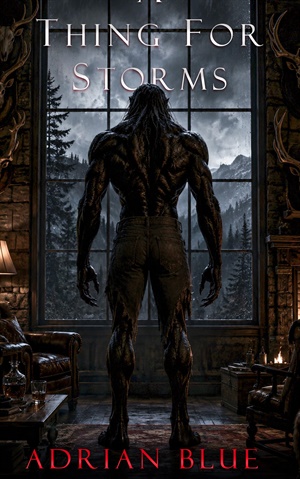
A Thing for Storms (Creatures of the Night #5)
Chapter One
The cove has gone the color of steel, and the gulls have quit working the shallows and gone to ground in the rocks, which means the weather report Wyatt read me at six o’clock is going to be right for once.
I stand at the end of the dock with my hands shoved into my parka, and my hood cinched tight, and watch the wind drag white off the tops of the chop.
The air tastes like cold pennies and salt. Somewhere under it is the green rot smell of low tide, and under that the first thin edge of snow that won’t fall for another month but is already up there thinking about it.
Ten forty-eight. The man is late, or the plane is, which is the same thing out here.
Then the droning comes around the point, and there’s Jimmy’s plane dropping out of the gray sky, red and white and ugly as ever, banking on one wing like a gull that’s spotted something dead.
He sets it down hard. He always sets it down hard.
I’ve told him for fifteen years that he lands like a man throwing a drunk friend out of a truck, and for fifteen years he has told me to mind my own dock, and so I mind my own dock.
I catch the brace strut as the float swings in, walk the plane down to the bumpers, hold it there with my boots braced on the boards and my whole weight against the pull of the current.
Jimmy lifts a hand at me through the windshield. I nod back. The passenger door pops open.
The man who steps out onto the float is too big for the plane and too big for the dock and, my first thought, too big for the cabin I’ve put him in. Six foot five, easy. Shoulders that fill the plane’s doorway and then keep going.
He’s wearing a wool topcoat the color of charcoal that probably cost what I clear in a slow week, and city boots that will be ruined by Thursday. A duffel over one shoulder. A flat leather case in his free hand.
He doesn’t wobble on the float the way they all wobble.
He steps down onto my dock like he’s stepping off a curb.
As soon as his weight is clear, I shove the strut away.
The plane drifts off, and Jimmy lifts his hand one more time and guns it.
The droning thins and thins and is gone, and it’s just the wind and the water and the two of us.
He’s looking at me.
I’m used to being looked at out here. It’s mostly men who come to Eagle’s Ridge, and a woman alone running the place is a novelty they like to turn over in their hands. I’ve got a face for it. Pleasant, closed, the innkeeper’s face, the one that says welcome and also no.
I put the face on and look back at him, and the face nearly slips.
Because the trouble with August Vale, I think, in the half second before either of us says anything, is that he is the kind of handsome you don’t get out here.
Not the rough, weathered handsome of the guides or the cheerful, soft around the middle of the fishermen.
Something colder and better made. A strong jaw with a day of dark stubble on it.
A wide mouth. Intense eyes set under straight black brows, gray like the sky an hour before snow.
They have settled on me, and they are not in any hurry to settle anywhere else.
Well, I think. Hell.
“You’d be Ashley.” His voice is low and a little rough, like he hasn’t used it much today.
“That’s me. Welcome to Eagle’s Ridge.”
“August Vale. It’s a pleasure.”
He puts out his hand, and I take it. His hand is colder than mine, and I’ve had mine out in this wind.
I’ve shaken a thousand hands on this dock, and most of them come off the plane warm from the cabin heater.
His feels like he’s been gripping the pontoon the whole flight.
I’m still doing the math on that when his thumb slides across my knuckles, once, deliberate, and the math goes clean out of my head.
It’s nothing. It’s a man holding a handshake a beat too long, a thing married men do on this dock all summer, and a thing I am very good at not noticing. I notice it. I feel it low in my belly.
I take my hand back.
“You picked a hell of a weekend to visit,” I say. “Storm’s coming in tonight.”
“So your young man told me on the phone. Wyatt, was it.”
“That’s right.”
“He suggested I rebook.”
“You should’ve listened to him.”
“And miss this?” The corner of his mouth goes up, and I have the brief, unprofessional thought that he is not talking about the scenery.
“Path’s up this way,” I say. “Watch your footing. It’s slick.”
I reach for the duffel, and he takes it away from me, easy. “I’ve got it.”
So I lead, and he follows me up the gravel trail that switchbacks through the cedars. And the whole climb I am aware of him at my back the way you’re aware of weather coming. The crunch of his boots. The size of him eating up the space behind me.
The lodge comes up around the last bend with its windows already lit, gold against the dark trees, and the sight of it settles something in my chest. We thump up the stairs, and I hold the front door for him.
“After you.”
He goes past me into the warm lodge, close enough that I get the wet wool of his coat and something underneath it, something faintly sweet that I half know and can’t place, gone before I can chase it. Cologne, I tell myself. Some expensive thing from wherever he flew in from.
He stops in the middle of my great room and turns a slow circle, taking it in. The river-rock chimney. The long table. The two leather chairs gone soft and dark by the fire. His eyes go up the stairs to my rooms and come back down without stopping.
“It smells wonderful in here.”
“Bread. I’m making chowder for dinner. Your cabin’s out back. I’ll walk you down.”
Cabin Two is the closest one. Thirty yards down the boardwalk, a one-bedroom, one-bathroom with a stove, a bed, and a window looking at the water.
I turned the heat on early, so it’s warm when I let him in.
He sets the duffel on the bed, the leather case on the desk, and turns to face me.
The room seems to suddenly have less air in it.
I look away. “Wood’s in the box, lighter’s on the shelf. Lanterns are in that cupboard if the power goes, which it might.” I gesture as I speak, unable to stop myself. “Bell’s on the porch post if you need me. Dinner’s at six.”
“This is exactly what I wanted.”
He says it, looking at me, not the room, and I let that go because chasing it would be a mistake, and I am not in the business of making mistakes.
I shove my hands in my pockets. The day’s already dropped to dusk in here, the window small and facing east. August’s pupils have tripled in size in the low light. I reach for the door.
“Six o’clock. Main lodge.”
“I’ll be there,” he assures me.
I leave and head back up the boardwalk with my hood up, and the rain finds me halfway, hard and cold and blowing sideways. By the time I’m up the lodge steps, the front of my parka is soaked.
I leave it hanging in the entryway and get to work in the kitchen. Potatoes, onions, leeks. The white fish I pulled out of the water yesterday morning. Outside, the wind is starting to push on the cedars. I set out a second placemat across from mine.
I dice the vegetables and think about him, because there’s no one here to catch me doing it.
The thumb. The eyes that didn’t hurry. I sigh.
You are thirty-five years old, I tell the onions, and you run a lodge, and you are not going to lose your mind over a paying guest with a good face and good coat. The onions don’t have an opinion.
At twelve thirty there’s a soft knock at the back door. I open it, and there he is. His hair is wet from the rain, but he doesn’t seem to notice. His eyes don’t leave my face.
“I’m sorry to intrude. Would it be all right if I read by your fire? The cabin’s lovely; it’s just very quiet down there.”
He’s holding a paperback.
It’s not a strange ask. Solo guests do it in the off-season, drawn up to the warmth and the company the way anything is. I had a retired professor in October who read three days running in that chair and said maybe forty words the whole time, and I liked him fine.
“Come on in. Coffee’s on the stove.”
He sheds his coat and hangs it beside mine. I try not to stare. He’s changed into a flannel shirt and jeans that fit him far too well. He turns his head to look at me, and I jerk my gaze away. He follows silently behind me as I return to the kitchen.
He pours himself a cup of coffee, picks a chair by the fire, and opens his book. I get back to work. He turns a page. The hallway clock ticks.
A while later, I look over to ask if he wants a warm-up on the coffee, and his eyes are already on me.
I forget about the coffee.
It is a heavy stare. Not polite curiosity, but something that makes my mouth go dry and other places wet. I swallow hard, briefly pressing my thighs together.
“Sorry,” he says. He doesn’t sound sorry in the slightest. “I was admiring the view.”
“There isn’t one,” I say, rougher than I intend. “Windows face the wrong way for the channel.”
“There’s a view.”
He says it without taking his eyes off me. The back of my neck goes hot, and I turn around and attend to the leeks, because if I keep looking at him I am going to do something stupid. I cut the leeks. He turns a page I’d bet money he doesn’t read.
He doesn’t go back to his cabin after I bring him a sandwich at one.
He stays in the chair the whole long gray afternoon, and every time I glance over, he’s already watching, and he never once looks away like a man caught staring.
By the time the light’s fading to evening, the back of my neck has been warm for hours, and I have stopped pretending I don’t like it.
I light the candles for supper because the wind’s loud enough now that I want a backup if the power quits.
The wine is a sauvignon blanc that I’ve been saving since spring, and the cork comes out with a small dry pop.
I think, don’t, and I pour two glasses anyway.
I bring the chowder to the table, and we sit with the candles between us, the wind pressing against the walls.
“How long have you been at the lodge?” he asks, making himself a bowl.
“Four years on my own. Summers since I was a kid.”
He takes a bite of chowder and lets out a pleased hum. “It’s good.”
My cheeks heat. “Thank you.” I take a drink of wine before making my own bowl.
“You bought it from your grandparents? Parents?”
“Grandparents,” I confirm. “They sold it to me for a dollar. My grandmother’s hip went, and they ran for Florida. Sun and bingo and a retention pond with a six-foot alligator in it that my grandfather has named and feeds against my advice.”
He laughs. It’s a real one, low and surprised out of him. His eyes sparkle.
“You like it out here,” he says. “Even the off-season.”
“Especially the off-season. It’s quieter. I get my evenings back.” I take another sip of wine. “A woman alone at the edge of the world has to keep her wits sharp. I read murder novels.”
“Murder novels.”
“To see how it’s done,” I say, deadpan. “In case I ever need to.”
He smiles, slow. “Remind me not to anger the cook.”
“Smart man.”
“Don’t you get lonely?” he asks. The tone hasn’t changed, still that low, even pleasantness, but his eyes are locked on my face.
“That’s a hell of a question, August.”
“You don’t have to answer it.”
“I know.”
He smiles and picks his spoon back up. He eats less than half the bowl, and only sips the wine sparingly.
A little while later, I get up and go to the radio on the shelf by the back door.
“Eagle’s Ridge to Hawkins. Come back.”
“Hawkins. Go ahead, Ash.”
“Evening check. All quiet here. Guest’s in, weather’s coming up loud.”
“Copy. You good for the night?”
I look at the back of August’s head, the dark hair long enough to curl over his collar. “I’m good. Talk in the morning.”
“Copy. Hawkins out.”
I set the handset down and turn around. August has turned his head enough to see me from the corner of his eye.
“He sounds like a good kid,” he says.
“He is.” I go back to my chair and sit.
“It must be a comfort, having him on the other end of that radio. Way out here.”
“It is.”
He takes another sip of wine, watching me over the rim.
When I finish my food, he clears the bowls without being asked, and we end up at the sink together.
Me washing, him drying. When he reaches past me to set a bowl on the rack, his free hand comes to rest at the small of my back, his palm cool even through my flannel.
It stays there for the length of the reach and a half second past it.
The cold soaks straight through. But it isn’t the cold I feel. It’s the weight, and the fact that he doesn’t take it back. Doesn’t play it off as an accident. He just lets it lie there against my spine and looks at me while he does it. My hands go still in the dishwater.
I don’t say anything. He doesn’t either. We finish the dishes in silence.
Afterward, I walk him to the back door, and he stops in the doorway.
He doesn’t step out into the rain, just stands there with the door open at his back and the porch light behind him.
Closer to me than a guest has any business being.
The corner of his mouth tips up. His eyes drop to my mouth, and I feel my own body lean toward him a half inch before I can stop it.
He leans too.
And then I watch him catch himself. He holds there a beat, his eyes on my mouth, then up to my eyes, then down the length of me, slow and unhurried.
“Good night, Ashley.”
“Good night, August.”
He goes out and down the boardwalk. I shut the door, throw the deadbolt, then throw the one on the front door too.
Upstairs, I get out of my clothes in the dark and stand at the window with my arms crossed against the cold.
His cabin window is a gold square down through the black cedars.
The curtain doesn’t move. I watch it not move for a while, and then I get into bed and pull the good heavy quilt up to my chin.
The small of my back still holds the shape of his hand. I lie there with my hand flat on my own belly and let myself feel it, because there’s no one here to know.
Sleep takes its time about coming. I let it.