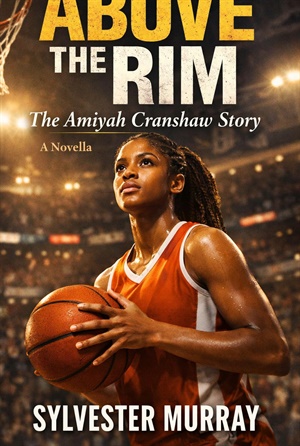
ABOVE THE RIM (The Amiyah Cranshaw Story)
THE CRACKED COURT
The ball wasn’t new. It wasn’t pretty. It wasn’t even fully inflated. But to eleven-year-old Amiyah Cranshaw, it was perfect.
She found it buried under a pile of rusted tools and old paint cans in her uncle’s garage, half-deflated and scarred with scratches that looked like it had survived a war.
The leather was peeling, the seams frayed, and the faded Spalding logo was barely visible.
But when she picked it up, something clicked inside her chest—like a door opening to a room she didn’t know existed.
Her uncle, a broad-shouldered man with grease-stained hands and a permanent squint, glanced over from the workbench. “You like that old thing?” he asked, wiping sweat from his forehead.
Amiyah nodded, bouncing the ball once. It thudded against the concrete, wobbling sideways like it had a mind of its own.
Her uncle chuckled. “If you can dribble that, you can dribble anything.”
She didn’t know what he meant yet. But she would.
The cracked court behind her apartment complex wasn’t much better than the ball.
The asphalt was uneven, broken in places, with weeds pushing through the cracks like they were trying to escape.
The chain-link fence surrounding it leaned inward, warped from years of kids climbing it.
The backboard was a sheet of plywood nailed to a rusted pole, and the rim was bent downward on one side, giving every shot a cruel tilt.
But to her, it was a kingdom.
She dribbled the ball around potholes, weaving through them like they were defenders. Every bounce felt like a heartbeat—hers, the ball’s, the court’s. She didn’t know how long she played. Time didn’t exist when she had the ball in her hands.
A group of older boys eventually wandered onto the court, their voices loud, their swagger louder. They were fourteen, maybe fifteen, wearing oversized jerseys and scuffed sneakers. They stopped when they saw her.
“What’s this?” one of them said, smirking. “Little girl thinks she can hoop?”
Amiyah didn’t answer. She kept dribbling.
Another boy stepped forward. “Yo, pass the ball.”
She shook her head.
The boys laughed. “Aight then. Let’s see what you got.”
He lunged toward her, trying to snatch the ball. She crossed over instinctively, the ball sliding from her right hand to her left with surprising speed. The boy stumbled, nearly tripping over his own feet.
The others hollered. “Damn! She cooked you!”
The boy tried again, more aggressively this time. She spun away from him, the ball glued to her palm like it belonged there. She didn’t know where the move came from. She didn’t know how she did it. She just… did.
Her uncle watched from the fence, arms crossed, a slow smile forming.
The boys challenged her to a game. She didn’t win—she was too small, too inexperienced—but she didn’t back down. She drove to the rim, she fought for rebounds, she chased loose balls like they were gold coins. And every time she scored, the boys looked at each other like they’d seen a ghost.
When the sun dipped low and the sky turned orange, her uncle called her home.
“You got heart,” he said as they walked. “But heart ain’t enough. You gotta work.”
She nodded, clutching the ball to her chest.
“I will.”
She meant it.
Her mother was sitting at the kitchen table when they came in, sorting through bills with a tired expression. She looked up, forcing a smile.
“You were out late,” she said softly. “Everything okay?”
Amiyah nodded. “I found a basketball.”
Her mother’s eyes softened. “Let me see.”
She held it up. Her mother laughed gently. “Baby, that ball’s seen better days.”
“I like it,” Amiyah said.
Her mother reached out and touched her cheek. “If you like it, then it’s perfect.”
Her uncle leaned against the counter. “She’s got something, sis. You should’ve seen her out there.”
Her mother sighed. “She’s got school. And chores. And—”
“And talent,” her uncle interrupted. “Real talent.”
Her mother looked at Amiyah again, really looked. The determination in her eyes. The way she held the ball like it was alive.
“Okay,” she said quietly. “If you want this… you can try.”
Amiyah smiled.
Her mother didn’t know yet. Her uncle didn’t know yet. No one knew yet.
But that moment—the cracked court, the broken ball, the challenge from boys twice her size—was the beginning of everything.
The next morning, she woke before sunrise. She slipped out of bed, grabbed the ball, and tiptoed past her mother’s room. The air was cool, the sky still dark. She jogged to the court, her breath forming small clouds.
She practiced dribbling around the potholes again. She practiced layups on the crooked rim. She practiced free throws, adjusting for the tilt. She practiced until her arms ached and her legs trembled.
She practiced until the sun rose.
She practiced until she heard footsteps behind her.
It was the same group of boys from yesterday.
“You’re back?” one of them said, surprised.
She nodded.
“You’re crazy,” another said.
She shrugged.
They watched her for a moment. Then one of them tossed her a better ball—newer, rounder, fully inflated.
“Use this,” he said.
She hesitated. “Why?”
“Because you earned it.”
She took the ball. It felt different—lighter, smoother, more responsive. She dribbled once. The bounce was perfect.
The boys nodded. “Let’s run.”
They played until the court filled with kids. Some watched. Some joined. Some tried to guard her. None succeeded.
Her uncle showed up again, leaning on the fence with a proud smirk.
Her mother came later, carrying a small bag of breakfast sandwiches. She watched her daughter weave through defenders, her ponytail swinging, her face focused.
She whispered to her brother, “She really loves this.”
Her uncle nodded. “Yeah. And she’s good.”
Her mother exhaled slowly. “Then we’ll support her.”
That night, Amiyah lay in bed staring at the ceiling. Her arms were sore. Her legs were tired. Her hands were raw from dribbling.
But she felt alive.
She didn’t know what the future held. She didn’t know about Whaley Junior High, or Morningside High, or UCLA, or Team USA, or the WNBA. She didn’t know about rivalries, shoe deals, heartbreak, jealousy, or the pressure of millions of eyes watching her every move.
She didn’t know she would one day disappear from the game she loved.
All she knew was the cracked court, the broken ball, and the feeling she got when she played.
The feeling that made everything else fade away.
The feeling that would carry her above the rim.