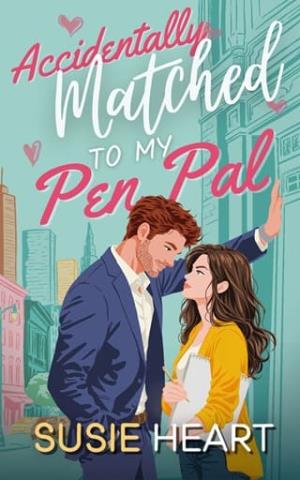
Accidentally Matched to my Pen Pal (Matched Married and Marketed #3)
1. Rosanna
Chapter one
Rosanna
“You know he’s not going to care what we say, right?”
I can practically feel the tension buzzing in the community center before the meeting even starts.
The place is buzzing with restless energy. There are folding chairs scraping against old linoleum, people shifting in their seats, anxious chatter rippling like a tide about to break.
My best friend, Luna, sits beside me with one leg crossed over the other, scrolling on her phone like she’s not surrounded by half of the neighborhood. Her eyes flick up long enough to catch my skeptical frown.
“Billionaires don’t change their minds because of passionate speeches.”
She’s not wrong, but it doesn’t stop the knot in my stomach from tightening as I stare at the front of the room.
A flimsy, fold-out table, two empty chairs. The developer isn’t even here yet, and already it feels like the entire building is holding its breath.
I’m three rows back with my trusty sketchbook open on my lap.
I’m not planning to draw tonight (no one’s in the mood for art) but having it comforts me somehow.
It’s as much a part of me as the chipped paint on the walls and the water-stained ceiling tiles are part of this place.
My gaze sweeps over the crowd, picking out neighbors I’ve known for years. Mrs. Chen, who ran the tea shop down the block until her rent tripled, sits in the front.
She whispers something to the person beside her, face tight with worry.
I don’t need to be a mind reader to know what she’s thinking: Heritage Street is one of the last corners of the city that still has any soul left. Pave it over for the next glass-and-steel monstrosity, and it’s all gone.
The side door opens, and in walk two men in suits. One has a tablet and a leather folder, the other is every inch the big-shot billionaire.
The tension in the room skyrockets. No one’s applauding his arrival, that’s for sure.
Seamus O’Malley looks precisely like the pictures I’ve seen. Tall. Dark hair cut so precisely it could have been measured with a micrometer. Shoulders broad enough to fill a doorway.
Not a single hint of apology in his expression.
Around me, a hush settles. It’s the simmering, angry kind of quiet that comes right before people start shouting.
He sets himself behind the table with the same composed confidence he wears like a second suit. His assistant (at least, I’m guessing that’s who the guy with the glasses is) sits beside him, opening up some official folder.
Seamus steeples his fingers, looking like he’s counting down the minutes until he can do something else.
Davidson, the city planner, stands at the podium in an ill-fitting jacket. He clears his throat, shuffling papers nervously.
“Thank you all for coming. Tonight we’ll be hearing from O’MalleyMart representatives regarding the proposed Heritage Street development project. We’ll have time for community questions later.”
What he really means is: We’re here to endure your yelling and attempt to keep it somewhat civil.
I spot Luna giving me a side-eye. “Steady, soldier,” she murmurs under her breath. “You’ll sprain your jaw if you clench it any harder.”
She’s right. I’m grinding my teeth so hard my dentist would have a field day. I force myself to breathe, ignoring the prickle of heat in my cheeks.
The assistant stands, flicks to the first slide of a presentation.
It’s full of shiny real-estate renderings, spiffy charts, and promises of progress.
They’re painting a picture of some glistening, sanitized future that has no room for quirks, no room for actual history, and definitely no room for small businesses like the one Mrs. Chen used to run.
I can feel my pen pressing into my sketchbook. I’m drawing angry lines across the page without meaning to. My hand is making sharp angles that match the branded, faceless towers on the screen.
Seamus O’Malley, for his part, is as still as a statue, gaze fixed on something invisible. Maybe he’s mentally balancing his next billion. Or writing his grocery list. Either way, he sure isn’t bothered by our presence.
Finally, the assistant clicks over to the next slide: the exact block on Heritage Street they plan to purchase.
My heart constricts at the sight of Miller & Sons. That old storefront with its tin ceiling and faded sign has been empty for years, but it holds so much history it practically hums whenever you pass by.
I’ve dreamed of saving it, even turned that dream into sketches and designs for a children’s art and literacy space. It would be somewhere warm, inviting, unpolished, and real.
And here it is on-screen, ready to be replaced by uniform lines of glass and steel.
When Davidson opens the floor for questions, my hand shoots up like a rocket. “You talk about ‘revitalization,’” I say, my voice carrying across the hush, “but that’s just a fancy way of saying you’ll bulldoze one of the few remaining historic buildings in this neighborhood.”
Nods and murmured agreement ripple through the chairs. Mrs. Chen turns, eyes bright with approval.
Seamus O’Malley looks at me. His gaze is level, unreadable. If he weren’t so unquestionably calm, he’d be intimidating. Actually, I take that back. He’s still absolutely intimidating.
His assistant tries to wave me off with more smooth PR talk. “Progress and preservation aren’t mutually exclusive—”
“They are when ‘progress’ equals demolition,” I snap, rising to my feet. Luna tugs lightly at my shirt, a silent warning to keep it together. But I’m past caring. “You're choosing scale over soul! The buildings on Heritage Street have decades of memories etched into them.”
Now Seamus chooses to speak. He leans forward, clasping his hands on the table. His voice is low and measured, with not a single note of anger. It's like he’s delivering a verdict.
“I understand your concerns. But our decision is based on rigorous structural assessments, market analysis, and overall benefit to the community.”
I can practically hear his assistant’s sigh of relief.
But I’m not finished.
“Your ‘benefit to the community’ is code for ‘profit margins.’”
It comes out louder than I intend, which sends another wave of murmuring through the crowd.
Seamus maintains that stoic calm. “Nostalgia doesn’t pay for infrastructure,” he says. “Or bring jobs. It doesn’t maintain the economy. We want sustainable growth.”
Chaos breaks out. People shout over each other. Some are supporting me, others pointing out that maybe we could use the jobs. After all, not everyone can survive on sentiment alone.
Davidson is begging folks to keep their voices down.
But Seamus and his assistant are already gathering their papers.
Right before he hits the door, Seamus glances my way again. His expression doesn’t give a thing away, but he offers the slightest nod, like a silent acknowledgment. Then he’s gone, and I’m left standing in the middle of a room that’s steadily devolving into small-group arguments.
Luna tugs me back into my seat. She’s got this grin on her face that’s half impressed, half disbelieving. “Wow. So you basically called a billionaire a soulless corporate robot in front of half the neighborhood.”
“And I stand by it,” I grumble, snapping my sketchbook shut with a shaky hand. The wave of adrenaline is crashing now, leaving me exhausted and more than a little defeated. “Not that it makes a difference. That building is as good as condemned.”
We step outside into the cool evening air, the city’s hustle thrumming around us like background noise that doesn’t care one whit about our heartbreak. The sky glows with neon reflections, a constant reminder of how fast everything changes.
“You spoke up,” Luna says softly, looping her arm through mine. “That counts.”
“It doesn’t count if they plow it all under anyway,” I say, swallowing the disappointment. My dream of turning Miller & Sons into some kind of creative haven feels as fragile as a half-finished sketch.
Luna stops dead in the middle of the sidewalk, then turns to me. “There might be another way. Something… crazy.”
I narrow my eyes. “Crazy how?”
She hesitates, which is never a good sign. “I’ve been hearing about this program. ERS—Elite Relationship Solutions. It’s kind of hush-hush, but it works with high-profile clients who need… structured relationships.”
“Structured?”
“Public appearances. Stability optics. Think reputations, not romance novels. So there wouldn't be anything…untoward happening. It’s contractual. Professional. And the partner—that would be you—is compensated. Very well.”
My stomach flips. “You’re talking about pretending to date someone.”
“Yeah,” Luna says. “But with boundaries. Legal protections. And other safeguards.”
I stare at her, words stuck in my throat. My heart thrums with a new, impossible idea. But oh, what a ridiculous idea it is.
Fake date some billionaire to save a historic storefront?
That is crazy.