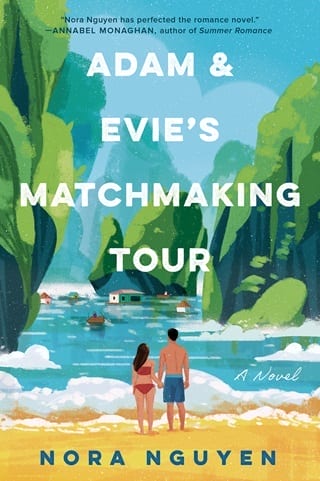
Adam & Evie’s Matchmaking Tour
1 Twenty Years Earlier
1 Twenty Years Earlier
San Francisco
“Green is your color, Evie-pie.”
Auntie H ? o removed the dangling jade earrings from the silk pouch and helped Evie secure the gold latches behind her ears. Evie swung
her head gently, shaking the smooth circles onto her cheeks. In Auntie H ? o’s enormous gilt mirror—bought at an estate sale of a minor Thai princess—Evie saw herself reflected. Gangly, too tall for
her age, and eternally uncertain; uncool by anyone’s standards, especially Queen Bee Tessa, who ruled the seventh grade with
steely determination. But with the jade earrings, Evie felt different. Older, maybe. Definitely more sophisticated. They looked
like they belonged.
“I love them,” Evie said, touching her ears. “They make me feel more Vietnamese.”
“Your father would have been proud,” Auntie H ? o said, smoothing Evie’s wayward hair from her forehead.
“Not my mother,” Evie muttered. “She hates anything that reminds her of Vi ? t Nam. And Dad.”
Auntie H ? o avoided her niece’s eyes. “Grace is still grieving.”
Evie didn’t say that Grace slept every moment that she wasn’t at work. Once, Evie tiptoed into her mother’s room and tried to wake her—it was dinnertime, and there was no food in the house—but Grace only flipped over and hugged the pillow tighter. “Why can’t everyone leave me alone?” she’d asked, her voice muffled. Evie wanted to scream, Because you have a daughter! And someone has to keep this family together! Was this how everyone grieved?
Evie’s father, Danh Lang, had died the previous year, and neither his wife nor his daughter had recovered. Evie’s brand of
grief was channeled into mournful stanzas in her journal, while Grace’s seemed to rise like a fog in the house, covering every
inch, every formerly happy memory. The rooms, once full of voices and laughter, became dreadfully quiet. Empty.
Now all Evie had of her father was Auntie H ? o. And Grace didn’t even want her to have that. She’d tried to stop Evie’s summer trip to San Francisco to visit Auntie H ? o, but Evie’s wheedling eventually worked. Maybe Grace needed a break from her melodramatic daughter too.
“I won’t forgive her for not letting me go to Vi ? t Nam with you,” Evie said.
“It’s a big trip. Your mother was right to put a stop to it; I should have talked to her before I invited you.”
“It wouldn’t have mattered,” Evie said sullenly.
“It matters to her.”
“Tell me about Vi ? t Nam,” Evie said, changing the subject.
Auntie H ? o enthusiastically launched into a description of all the places she’d visited—H ? Long Bay with its green-furred mountains and crystal-clear water; bustling H ? Chí Minh City; the night market in H ? i An, lit under swinging lanterns, where Auntie H ? o bought the jade earrings Evie wore now. Evie had seen plenty of photos of her father’s birthplace, but she never tired of
hearing the stories of Auntie H ? o’s travels. To her, these places were more than just beautiful sites to visit. Each new city represented an invitation. A
window into a life ready to be lived.
Sighing, Evie said, “I wish I could have gone with you.”
Auntie H ? o studied her. Evie could tell she was seeing her deceased brother in Evie’s features. Her face took on a solemnity that muted
some of the merriness in her eyes.
Eventually, she said, “I promise you, one day, I’ll make sure you get to Vi ? t Nam.”
“We’ll go together,” Evie said, brightening.
“We’ll light up that whole damn country, Pie.”
Evie could picture it so clearly: stepping off the plane with her hand in Auntie H ? o’s. Flopping on a hotel bed to plan their itinerary while they bit into pastries from the street stalls. A rare smile flickered
across her face.
Then the moment ended. Auntie H ? o stood briskly and pulled Evie with her, brushing the fabric from her ample lap. “Come on. Away from the mirror now; we have
a party to host.”
It was one of those balmy nights when the Pacific breeze drifted slowly off the water onto the balcony of Auntie H ? o’s magnificent row house, the envy of anyone who’d ever dreamed of owning property in the Bay Area. Auntie H ? o was rich. Not just normal San Francisco rich. She could travel every week of the year, eat at every five-star restaurant,
buy up all the designer boutiques in Union Square, and still have enough to go around. And she was husbandless and childless,
which meant that her generosity usually filtered down to her nieces and nephews. Not that it did Evie any good. Aside from
that blissful three-month summer vacation in San Francisco, Grace refused any help from H ? o, claiming that they were not a charity case.
But Evie didn’t care about any of that. She just wanted to be here , with her aunt, in this mess of noise and delightful smells and sparkling promise. Auntie H ? o’s parties were legendary. There was something about her joie de vivre that drew in all the local characters and even some
minor celebrities. In San Francisco, Evie lived a different, more glamorous life.
That night, the bar was stocked and the caterers were milling, putting the finishing touches on the chocolate fountain and
rearranging tiny sausage rolls that Evie snuck off the trays. Soon, there was the sound of the door opening—Auntie H ? o never locked her door—and thundering footsteps. The party had arrived.
Priya, Auntie H ? o’s best friend and sometime-nemesis, was the first to sweep Evie into a hug. She wore a midnight-blue caftan and a pair of
yellow flats with rhinestones on the sides. “My sweet little girl! I missed you. When are you moving to San Francisco?”
Evie laughed through the cloud of Priya’s rose perfume. “I missed you too, Auntie P.”
Priya pinched Evie’s cheek, then kissed it juicily, squeezing her tighter. “Oh, but you’re going to be such a beauty one day.
Then we will make you a match to end all matches.”
“She’s too young to be thinking of that,” Auntie H ? o cut in.
Priya shrugged. “Maybe. But when the day comes, she will have an epic love story, mark my words. A girl like Evie won’t settle
for anything common. There will be melodrama! Misunderstanding! Spice!”
“Um, thank you?” Evie said, a little breathless now.
Auntie H ? o scowled, her dark eyebrows drawn like angry eels. “Unhand my niece, you menace. You’re choking her.”
Priya eyed the sausage roll in Evie’s hand. “She’s more likely to choke from that nasty excuse for food you serve.”
“My caterer is very exclusive,” Auntie H ? o said indignantly. “He was on the ‘Restaurateurs to Watch’ list in the Chronicle .”
“Hmph. I told you time and time again I would help cook. I am the best samosa maker in town!”
“Did you give yourself that title?”
“You have always been jealous—”
“Of what , exactly, Priya? Your dry-ass rice pilaf? Your watery gazpacho?”
Priya’s eyes blazed dangerously, but an undeterred Auntie H ? o stuck her hands on her hips, puffing her cheeks out like a gibbon establishing dominance.
Evie made a hasty escape from the brewing storm and soon found herself passed around the party like a tray of hors d’oeuvres.
Liam, the semi-successful playwright who always seemed to be in a state of crisis, moaned about his difficulty casting the
lead character while sloshing his cocktail on Evie’s new Laura Ashley dress. Paris, a gender-fluid clothing designer, tried
to talk Evie into modeling for their next show. Samara, an art historian in a skintight black jumpsuit, pulled Evie aside
to ask if she’d started her period yet, then proceeded to tell her about the miracle of menstruation, to Evie’s abject mortification.
Even still, she loved Auntie H ? o’s friends. They filled her life with audacity and magic. In their example, she could believe that living outside the broad
strokes of expectation could be something wonderful, instead of something to be feared, as Grace had believed. Evie always
tried to position herself close to the writers, a morose bunch with cutting observations and tweedy good looks. Her dream
was to become a writer someday, though she had no inkling of what she would have to write about. Everything in her life seemed
so terribly predictable—and she worried that she was the most boring thing in it.
But Auntie H ? o never made her feel that way. She was convinced that Evie would do something great, and even if Evie didn’t believe it,
basking in her aunt’s confidence felt like chugging a soda—the bubbly joy went straight to her head.
As the party ended, she heard a commotion coming from the balcony. With surprising strength, a woman in a glittery silver
dress shoved the chocolate fountain onto a handsome man with a pointy beard—a famous magician, Auntie H ? o whispered, who had a reputation for kissing his assistants. Evie watched in horrified fascination as the chocolate exploded
onto the man’s white shirt, dripping all the way down to his shoes. To add insult to injury, the silver-dress woman shoved
a hunk of pound cake into the magician’s mouth, like an apple in a pig.
She shouted over her shoulder, “If you ever step out on me again, Phineas Ash, it’ll be a boiling pot of oil I dump over your sorry head!”
Phineas stared after her for a moment, then chewed the cake thoughtfully. After a moment, he grinned a chocolatey grin and
gave the crowd a bow. “And for my next act, I’ll piss off another woman with the bad judgment to date me!”
They clapped as he plodded stickily toward the napkins.
“Never a dull moment,” Auntie H ? o said at Evie’s side.
“Should we help Phineas?”
Auntie H ? o gestured at the magician, now surrounded by at least four tutting, spectacularly beautiful women. “I think he’ll be fine.”
Phineas smirked as he licked the chocolate off his finger.
Auntie H ? o continued, “This is why we don’t let ourselves get too entangled with men, Pie. They’re useful for a good time, but ultimately
disappointing.”
“My dad wasn’t like that,” Evie said defensively.
“Of course not. He was one in a million. Our bloodline has always been exceptional. But Phineas, much as I love him, is sadly
more representative of the general population.”
“You’ve never met anyone worth marrying yourself?”
Evie had never heard a whisper of romance around Auntie H ? o. It confused her; lovable Auntie H ? o could have had a million admirers in her lifetime, yet she’d lived alone for decades. It wasn’t even about Auntie H ? o’s warm beauty—cute, peachy cheeks, twinkly black eyes, permed black curls—but her whole air of mischief, of expectation.
That kind of delight was hard to find in life and would have surely drawn in many a man.
“Marriage is for the birds,” Auntie H ? o announced. “One day, I’ll tell you about the time my parents tried to force me to go to a matchmaker. You can imagine how
that went. Anyway, I’m not saying you can’t have fun with men, honey. But sometimes a woman only has herself to count on.”
Evie thought of Grace, sleeping with her back toward the door, completely drowned in grief. Maybe Auntie H ? o was right. Who was to say if love was worth the heartbreak? Or the chocolate mess.
“I can count on you ,” Evie said, wrapping her arms around her aunt’s waist.
“So you can, Pie. Forever and ever.”
Above them, the moon shone with a milky luster. Summer would soon end, and Evie would go back to her life in that lonely house,
trudging through her school days with kids who ignored her, bleakly marking holidays her mother refused to celebrate anymore.
But then another summer would come, then another. Of all the promises already broken in her young life, she knew she could
at least count on Auntie H ? o’s. And maybe someday, she would live a life worth writing about.