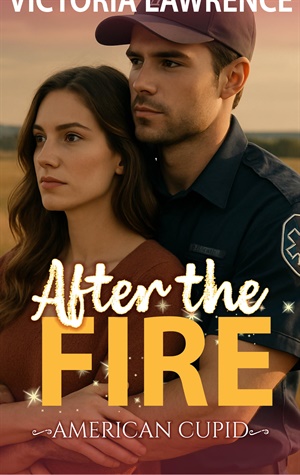
After the Fire (American Cupid #1)
Prologue
The truck’s restored red paint caught the street lights, a splash of color against the shadowed landscape of eastern Tennessee … or was it still Virginia? He’d crossed so many state lines in the past eleven months that they’d started to blur together like the center line beneath his tires.
Caleb’s right hand rested on the steering wheel, his left draped over the door frame, fingers drumming an absent rhythm against sun-faded metal.
The passenger seat held his entire life: a duffel bag stuffed with three changes of clothes, a shaving kit, and a St. Florian medallion he couldn’t bring himself to wear but wouldn’t throw away.
Behind the seat, a wool blanket that had seen him through more cold nights than he cared to count, and a toolbox that had earned him enough cash work to keep the gas tank full without dipping into his disability pension.
The truck itself was the only thing he’d kept from his old life.
Everything else had been shed like a snake’s skin.
The old Ford pickup had been his dad’s before it was his, restored over three summers in the garage behind their Southie row house.
His old man had taught him to rebuild the engine, to true the frame, to make something broken whole again.
“Good bones,” he had said, hands black with grease, eyes bright with purpose.
“That’s what matters. You can fix anything if the bones are good. ”
Turned out that wasn’t true for people.
Caleb shifted in the driver’s seat, trying to find a position that didn’t make his shoulder scream.
The physical therapist in Boston had given him exercises, rubber bands, and careful stretches meant to rebuild strength and flexibility.
He’d done them religiously for the first three months.
Then the divorce papers came, and he’d thrown the rubber bands in a dumpster behind his rented rooms and driven away.
The radio crackled with static between stations. Caleb didn’t bother fixing it. Silence suited him fine.
His shoulder ached. A deep, grinding reminder of the warehouse fire that had ended his career with the Boston Fire Department.
Eighteen months since the surgery. Eleven months since the divorce papers.
Eleven months since he’d pointed the truck south and stopped looking in the rearview mirror.
The physical therapy had worked well enough.
He could lift, carry, or swing an axe if a job required it.
But the Fire Department’s physician had been clear.
The torn rotator cuff and damaged joint meant he’d never pass the physical requirements again.
Never haul a victim down a ladder. Never breach a door with fifty pounds of gear on his back. Never be trusted with someone’s life.
The thought sat in his chest like a stone, smooth and cold from too much handling as the night slid by.
Caleb glanced at the dashboard clock. 9:47 PM.
He’d been driving since dawn, stopping only for gas and bad coffee.
The plan, such as it was, had been to make it to Knoxville by nightfall, find a cheap motel, maybe pick up a construction gig through one of those day-labor outfits.
A week’s work, two at most, then back on the road before anyone started expecting him to stay.
It was a good plan. A safe plan.
Then he saw the glow.
At first, it registered as nothing. Just the far-off lights of a city illuminating the horizon in shades of amber. But the next large town was in the west, and this light bloomed to the south, angry and orange, pulsing against the dark sky like a wound.
Caleb’s foot lifted off the gas pedal before his brain caught up.
Not your town. Not your fire. Not your problem.
The truck began to slow. His hands tightened on the wheel, knuckles whitening. The glow intensified, and now he could see the black smoke rising, thick and oily, the kind that came from structural fires, from homes and lives burning.
Keep driving. You’re not a firefighter anymore. You’re just a guy in a truck.
But his foot found the brake instead of the gas.
The Ford slowed to forty, then thirty. Caleb locked onto that distant orange glow, and something in his chest, something he’d been trying to bury for eleven months, stirred awake.
His pulse kicked up. His breathing changed, falling into the old rhythm.
Assess, plan, act. The muscle memory was still there, encoded into his DNA after fifteen years on the job, stronger than reason or self-preservation.
He’d tried to outrun it, this thing inside him that pulled him toward smoke and flame and people in trouble.
Tried to leave it behind with his badge and his turnout gear, tried to drown it in whiskey and bury it under miles of empty highway.
But it was still there, coiled and waiting, patient as a heartbeat.
You’ll just make it worse. That’s what you do. You make things worse.
The voice in his head sounded like Captain Morrison’s, the day after the warehouse fire.
The day after they’d pulled Jamie Rodriguez’s body from the rubble.
Twenty-three years old, six months out of the academy, dead because he’d trusted Caleb’s call.
Dead because Caleb had pushed too far, moved too fast, and ignored the signs that the building was ready to come down.
“You were reckless, Byrne. You put your whole crew at risk, and that kid paid the price.”
Morrison had been right. The incident review board had said so, even if they’d couched it in softer language. “Lieutenant Byrne exercised poor judgment in rapidly evolving conditions.”
Translation: Caleb had fucked up, and a rookie firefighter died for it.
But even knowing that, even carrying Jamie’s death like a stone in his chest, Caleb couldn’t make his foot touch the gas pedal. Couldn’t make himself drive away from that glow on the horizon.
Because what if someone was in there? What if they were trapped, screaming, dying, while he drove past because he was too broken and too guilty to do the one thing he’d ever been good at?
A mailbox appeared on his left. 1247 Hickory Ridge Road. A gravel driveway snaked away into the twilight, heading south toward that terrible light.
Caleb’s hands cranked the wheel before he could talk himself out of it.
The truck fishtailed slightly on the gravel, stones pinging against the undercarriage as he accelerated down the narrow drive. Bare trees reached overhead like skeletal fingers. His headlights caught split-rail fencing, a hay barn to one side, and then?—
The farmhouse erupted into view.
Two stories, white clapboard siding, wraparound porch …
or what used to be a porch. Now the entire right side of the structure was engulfed in flames.
Fire belched from the windows, glass exploding outward in crystalline showers.
The roof sagged ominously, smoke pouring from the eaves.
The heat hit Caleb even through the windshield, a physical force that made the air shimmer and dance.
He registered details in rapid succession, the old training taking over.
Working fire, heavy involvement, no visible victims, no fire trucks, no sirens in the distance.
This was rural Tennessee. The nearest station could be fifteen, twenty minutes out.
The house had maybe ten minutes before total structural collapse.
Caleb’s world narrowed to a pinpoint of absolute clarity. He slammed the Ford into park so hard the entire frame shuddered. The engine was still running when he threw open the door and hit the ground moving.
Someone cried out. The sound cut through the roar of the flames, high and terrified, a child’s voice.
Assessment: single-family dwelling, two-story wood frame, fire origin appears to be first floor right side, possibly electrical or accelerant-based, given the speed and intensity.
No victims visible outside. Screaming from the interior, second floor, if I have to guess.
No turnout gear, no air tank, no backup.
The rational part of his brain was cataloging, planning, while another part, the part that had gotten him through a decade and a half of fires, was already acting, already committed.
This is suicide. You know this is suicide.
Caleb ripped the wool blanket from behind the truck seat.
The stock tank sat thirty feet from the house, its metal edges crusted with ice.
He plunged the blanket into the frigid water, ignoring the shock of cold that bit into his forearms. The wool soaked through, heavy and dripping, and he slung it over his shoulders.
The world’s worst substitute for turnout gear.
Another cry, weaker this time. A second voice joined it. Lower, a boy, hoarse with smoke.
Caleb ran toward the burning house.
The heat intensified with every step, his exposed skin prickling, his eyes beginning to water.
The front porch was still mostly intact, the fire having started on the far side of the structure.
He took the steps in two strides and slammed his boot into the door just beside the handle.
The wet blanket steamed on his shoulders, his makeshift shield against the inferno.
The door held.
Caleb stepped back and kicked again, this time putting his full weight and the fury of eleven months of aimless driving behind it. The jamb splintered. Wood cracked. One more kick and the door exploded inward, hanging drunkenly from a single hinge.
And, then, he stepped into hell.
The living room was a chaos of smoke and firelight.
Flames crawled up the walls to his right, feeding on old wallpaper and dry timber.
The smoke layer had descended to about five feet, so he’d have to stay low.
The temperature had to be pushing 500 degrees near the ceiling, maybe higher.
He could feel his hair singeing, smell it even through the acrid smoke.
“Fire department!” he shouted, his voice raw and commanding even though he had no right to the title anymore. Habit, he supposed. “Call out!”