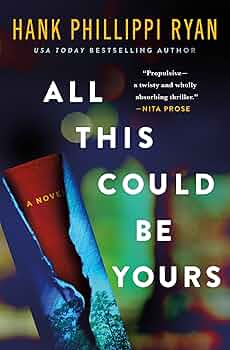
All This Could Be Yours
Chapter 1
THREE YEARS LATER
Tessa would never get used to this, not ever, and she would never cease being thrilled by it; the waves of affection as she strode by the rows of women, shoulder to shoulder and filling every beige folding chair the bookstore could hold.
She felt their admiration, felt their sisterhood, felt their support—they knew who she was, and she knew them, because even as strangers they were her friends, her readers, those who understood that a book could open your life and open your heart.
She tried to silence the warning voice in her head as she continued up the center aisle of the store’s bookshelf-lined event space.
She was Tessa Calloway now, best-selling author, and she had nothing to fear.
“Tessa, our book club loves you!” A woman in a periwinkle-blue cardigan reached out and touched Tessa’s arm as she walked by. Tessa stopped and turned to her, smiling.
“I love you, too,” she whispered, and now it seemed like every woman had a cell phone out, pointing it at Tessa, the tiny flashes popping like celebratory fireworks.
Capturing the moment , Tessa thought, and she wished she could do the same thing, save up every morsel of this, wrap herself in it, reassure herself that dreams could indeed come true.
“And we love Annabelle! She’s so kick-ass!”
Tessa’s laughing response was drowned in applause, and the room became a sea of periwinkle-blue book covers, some held in readers’ arms, some arrayed in a massive multibook display, backdropped by the oversized cover of All This Could Be Yours hanging behind the podium.
The portrait of her protagonist, Annabelle Brown, on the cover, with her tortoiseshell glasses, periwinkle earrings, and signature attitude, seemed to watch over the whole event, amused and approving. Confident. Empowered. Never surprised.
All this could be yours , Tessa thought.
Her husband had said that to her, joking, arms wide, the day they got engaged.
The phrase had stayed with her, but the more she thought about it, the more sinister it sounded.
How chilling the exact same words became in fiction when Annabelle’s boss said them, offering her that life-changing choice.
Tessa’s editor had instantly loved it. “Double entendre,” Olivette had pronounced. “Perfect.”
Now Tessa sent a silent thank-you to the writing gods, and to Annabelle, too. Maybe all this, and more, already was hers. After all this time, and after all of her own life-changing choices. For worse, and for better.
“Come on, you all, let Tessa by!” An amplified voice came from the front of the event space. Lisa Mooney, chignoned and chic in black linen, clapped her hands to get the crowd’s attention. “You want to hear her talk, don’t you?”
Tessa’s publicist had forewarned her that the savvy and influential Lisa was the doyenne of the women’s fiction world—and that a successful event at Excelsior Books almost guaranteed another week on the bestseller lists.
Tessa crossed her fingers, wishing, as she stepped onto the dais.
Then paused as Lisa motioned her to wait.
The bookstore owner tipped the black gooseneck microphone closer, then quieted the audience with two palms.
“You don’t need me to introduce Tessa Calloway,” she began.
“One life!” someone in the audience called out.
“Moms with dreams!”
Tessa touched a hand to her heart, seeing the women’s faces now, rapt and attentive, so many of them, like Tessa herself, wearing Annabelle’s signature periwinkle-blue earrings.
Lisa went on with the familiar paragraph of the careful introduction publicist Djamila Parekh had crafted for booksellers and librarians and book clubs—recapping the viral moment when Tessa walked out on her corporate career to focus on husband and kids in Massachusetts, her late-in-life debut novel, her starred reviews, the instant New York Times bestsellerdom.
Her devoted followers, and the almost cult of the life-empowering Annabelle.
Tessa had heard that intro, sometimes twice a day, for more than three weeks now, as her book tour, triumphant at every stop, took her to different cities and different bookstores and different audiences.
Three weeks to go. Aren’t you exhausted?
Henry would ask. But she wasn’t, not a bit, who needed sleep?
She was flying on love and success and, she had to admit, financial necessity.
Which Henry—and their brand-new mortgage—did not let her forget.
“So let’s give a big Indianapolis welcome,” Lisa was saying, “to our darling Tessa, who has introduced us to the instantly iconic Annabelle Brown.”
Tessa took a step forward, but Lisa stopped her again.
“Wait. Let me ask you,” Lisa said. “How many of you have had your lives changed by Annabelle? How many have learned from her sass, and her spirit, and her confidence? Let’s see a show of hands as we welcome Tessa to the microphone. I am honored to present—Tessa Calloway.”
Tessa opened her arms in gratitude as Lisa gestured her to the podium, the audience now a swell of waving hands, women cheering, some brandishing their periwinkle books in the air like prized trophies, or symbols of their sisterhood.
“I know you can’t tell with this podium in front of me.
” Tessa patted the air with her palms to settle the crowd.
“But my feet are not touching the ground. I am absolutely floating, floating with joy and appreciation, and with surprise, I must say, at all that’s happened.
And it has happened because of you . Thank you. ”
Her speech flew by; her desire to be a writer since she was a child, the love-at-first-sight meeting with her husband, Henry, her business career, her renunciation of corporate pressures, her devotion to her family, and then, at midlife, stepping into the world of fiction.
“And I loved being a mom, and still do, but when I had a good idea for a novel…” She went on, telling the familiar and reassuring story.
Creating the confident and inspirational Annabelle, with her search for happiness and her search for justice, her insistence on equality, and her resistance to the patriarchy.
It had been a lark when Tessa started the book, almost a personal rewriting of her own professional history, but then Annabelle had taken on a life of her own.
“Sometimes,” she said, “and I’ve heard other authors say this, too, it feels as if I’m simply transcribing what Annabelle says.
That it’s not me, Tessa, writing it, but me channeling Annabelle onto the page.
It’s almost magic, there’s no other way to explain it.
So. Enough of me yammering. Who has a question? ”
The hands shot up. Tessa pointed to a woman in the back, black jacket, long braided hair.
“Yes?”
The woman stood, clutching her book. “Do you, like, literally hear Annabelle’s voice?”
Someone always asked this. And if they only knew how true it was. Annabelle did talk to her, like a supportive older sister. There was no actual magic to it, she knew it was simply her subconscious, her writer brain, the clear and present voice of her imagination.
“Yes, funnily enough, I do. Annabelle’s voice was very distinct as I began to write the book, almost as if she had wanted her story to be told.”
Got that right, Annabelle said.
Tessa paused, knowing the audience could never understand the depth of her connection to the character in her head.
The voice of Annabelle. She’d heard it first when she was a child—and realized it was her own particular way of coping with stress and pressure.
“Annabelle” offered guidance. Confidence.
And grace. A way for Tessa to be her own best friend. She chose another raised hand. “Yes?”
“That’s so cool about Annabelle’s voice. I saw you, live, on Moms with Dreams, when you walked out on that job. How’d you have the courage to do it?”
“Oh, you’ve felt it, I’m sure, that inner voice saying you’re doing the right thing?
” Tessa nodded, remembering. “And thank you for being with me at that pivotal time. I was a corporate trainer, even before Kid One and Kid Two. I traveled constantly, taught classes in productivity and teamwork. It was—rewarding, sometimes, but the rest of the time it was soul- crushing. Still, it had health insurance. You all know about balancing that deal, right?”
“We sure do,” someone said.
“But that day—I’m not sure it was as much courage as it was—well, one last straw.
We’d been in a meeting, and I’d presented what I thought was a terrific idea.
And not one person seemed to notice I had spoken.
No one reacted. Until ten minutes later, when some guy presented exactly the same idea, and everyone applauded how genius he was.
I felt—invisible. I remember thinking I could go rob a bank, and no one would notice, because I was so invisible. You know?”
“Totally!”
“Every day!”
“And then I was assigned to ‘help’ on the project. And fix his mistakes!”
“No way.”
“Yup. But I was lucky,” Tessa went on. “My husband had taken a new job, and I knew we could handle it financially, and I was missing the kids so much, and sometimes—you gotta do what you gotta do.”
“One life!” someone called out.
“Exactly.” Tessa pointed to her, emphasizing. “And I was lucky enough to be able to reclaim mine. And you know I’m still on Moms with Dreams, because you all are my sisters. We all have dreams. And only one life. So. Who else has a question?”
“Yes, you certainly have been lucky. So far. As an adult.” The woman who stood was elegantly thin, her hair expensively casual. “But let me ask. Many successful authors say they had terrible childhoods. Traumatic. Did you? Were you ‘lucky’ as a teenager, too?”
Uh-oh, Annabelle said.