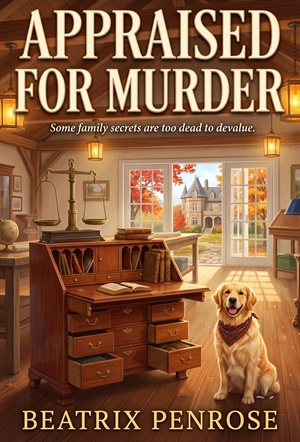
Appraised for Murder (The Antiquated Alibi Mysteries #1)
Chapter 1 A French Settee and a Sneering Appraiser
?
There are three universal truths when it comes to estate sales in the Blue Ridge Mountains: someone will always try to haggle over a cracked butter churn, the dust will settle directly into your pores, and nobody ever leaves behind a neat, explanatory list of their indiscretions.
At least, that had been my operating theory until seven o’clock on a Tuesday morning in October, when my golden retriever mix, Buster, decided that a hundred-year-old French settee was an acceptable place to deposit a half-eaten buttermilk biscuit.
"Buster, drop it," I whispered, lunging forward with all the athletic prowess a fifty-two-year-old woman in supportive orthopedic clogs could muster. "That is carved walnut, not a picnic bench. Do you know what upholstery cleaning costs in Buncombe County?"
Buster regarded me with warm, soulful amber eyes, gave one enthusiastic wag of his feather duster of a tail, and promptly swallowed the biscuit whole. He then gave the damask cushion a satisfied, slobbery lick.
"Fabulous," I muttered, wiping the mahogany arm with a microfiber cloth from my canvas utility apron. "Now it’s authentic nineteenth-century drool."
"Oh, stop fussing, Maggie. It adds patina. People pay double in Asheville for patina."
Bernadette Jenkins—known to everyone in Black Walnut Cove as Birdie—marched into the grand parlor of Blackwood Manor like a five-foot-two hurricane draped in a turquoise cashmere wrap.
She carried two oversized ceramic mugs of dark roast coffee and an aluminum clipboard that she wielded with the deadly authority of a medieval broadsword.
"Patina is aged wax and sunlight, Birdie," I said, gratefully taking the steaming mug she thrust into my hands. "Not carbohydrates and canine saliva."
"Semantics," Birdie declared, taking a sip and peering over her cat-eye reading glasses at the vaulted plaster ceiling.
"Besides, if the late Eleanor Vance cared about biscuit grease on her Rococo revival furniture, she wouldn’t have lived her final twenty years as a mountain hermit surrounded by forty-two feral stray cats and three barns full of hoarded heirloom silver. "
I sighed, inhaling the rich scent of chicory and dark-roasted beans.
Birdie wasn’t entirely wrong. Eleanor Vance had been the grand dame of Blackwood Manor—and the Cove’s most notorious eccentric.
When she had passed away peacefully in her sleep at age eighty-nine the previous month, she left no will, no direct heirs, and a sprawling, four-story stone manor overflowing with three generations of high-society accumulated clutter.
Her two surviving second cousins—an oily hedge fund broker from Raleigh and an estranged niece who lived in Boca Raton and communicated solely through curt, certified mail—had hired Callahan & Company Estate Liquidations to sort the gold from the dross.
For my boutique business, this was the Super Bowl. For my sanity, it was an endurance test.
"Did Luke get the second box truck backed up to the carriage house yet?" I asked, checking my watch.
"He’s working on it," Birdie said, her tone softening with a sudden, wicked arch of her eyebrows.
"And may I add, Maggie Callahan, that the man looks entirely too handsome for seven in the morning in flannel and work boots.
I swear that salvage lumber business of his does wonders for his shoulders. "
I felt a treacherous flush rise along my neckline. "Luke Sterling is our transport contractor, Birdie. He’s here to haul armoires, not audition for a mountain bachelor calendar."
"A woman can appreciate fine architectural salvage, Mags, and I’m not just talking about the reclaimed chestnut timbers.
" Birdie clicked her pen with relish. "You’ve been a widow for three years. Your kids are grown and thriving out in Denver and Chicago. It is high time you noticed that Black Walnut Cove’s most eligible carpenter always happens to bring you the extra-large cinnamon buns from the bakery. "
"He brings cinnamon buns for Buster," I countered, though my stomach gave an uncooperative little flutter.
Right on cue, Buster woofed softly and sat down on my feet, anchoring my toes firmly to the parquet floor.
Before Birdie could launch into her well-rehearsed lecture on my romantic inertia, the heavy oak front door of Blackwood Manor banged open. The sound echoed through the cavernous foyer like a gunshot.
"Hello? Is there anyone here with an actual credential, or am I addressing the yard sale committee?"
The voice was clipped, nasal, and dipped in the sort of high-gloss arrogance usually reserved for country club grievance committees.
Birdie and I exchanged a glance.
"That," Birdie whispered, "would be the serpent in our garden of vintage quilts."
Into the parlor strutted Julian Croft.
If central casting were asked to furnish an unbearable high-end art appraiser from Buckhead, Julian Croft would have been deemed too on-the-nose.
He was forty-five, possessed teeth that were aggressively white, and wore a pristine beige camel-hair blazer over an Italian silk turtleneck that had no business existing within fifty miles of a gravel driveway.
He carried a leather-bound folio tucked beneath one arm and looked around Eleanor Vance’s ancestral parlor as though he had accidentally wandered into a dumpster behind a bait shop.
"Good morning, Mr. Croft," I said, stepping forward and extending a hand, deliberately ignoring his opening remark. "I’m Maggie Callahan. We spoke on the phone yesterday."
Julian looked down at my hand, noted the traces of lavender beeswax polish on my knuckles, and gave me a limp, two-second fingertip clasp before wiping his palm against his trousers.
"Yes, Mrs. Callahan. The estate’s Raleigh executor felt it prudent to bring in a professional eye. Regional liquidators... well, you tend to price museum-quality American federalism as if it were lawn furniture."
Birdie made a small, strangled squeak behind her coffee mug. I planted an elbow gently into her ribs.
"Callahan & Company has managed high-value estates in Western North Carolina for eight years, Mr. Croft," I said with sweet, measured mountain politeness. "Our cataloging is thorough, our appraisals are bonded, and we are quite familiar with the Vance provenance."
"Provenance?" Julian scoffed, wandering toward the hand-carved fireplace mantel. He ran an immaculate finger along the dentil molding. "This house is a graveyard of neglected junk. The cousins expect six figures out of this dispersal. From what I’ve observed walking up the front path, you’ll be lucky to raise enough to pay the property taxes. "
He paused in front of a cherrywood secretary desk tucked into the alcove between two floor-to-ceiling sash windows.
It was an early nineteenth-century piece, likely made by a Moravian craftsman in Old Salem. The wood was rich as molasses, with dovetailed drawers, brass batwing pulls, and a small, delicate pediment. It was, without question, the crown jewel of Eleanor Vance’s personal sitting room.
Julian’s eyes narrowed behind his designer horn-rimmed glasses. For a split second, the sneer vanished from his face, replaced by an intense, predatory hunger that set every alarm bell in my head clanging.
He reached out and tapped the central pigeonhole of the desk.
"This," Julian muttered, almost to himself. "Where did she get this?"
"Eleanor’s great-grandfather brought it across the mountains by wagon in 1845," I said, stepping closer. "It’s cataloged as Lot 42. Family records indicate it was commissioned directly from the Wachovia settlement."
Julian snapped his head toward me, his expression hardening back into slick condescension. "Nonsense. It’s a late-Victorian reproduction. Good veneer, but structurally derivative. Worth perhaps eight hundred dollars at auction. A decorative curiosity, nothing more."
"Eight hundred?" Birdie blurted out, stepping around me. "Are you blind or just trying to swindle the heirs? The hand-planing on those interior drawers alone screams 1820s Salem. Maggie can spot machine-cut dovetails from fifty paces!"
"And who, pray tell, are you?" Julian asked, arching an eyebrow. "The local color?"
"I am the woman who will personally ensure you don’t walk out of here with a family heirloom tucked under your cashmere armpits," Birdie snapped.
"Ladies," Julian said, checking a gold wristwatch that probably cost more than my entire first inventory truck.
"I am the certified appraiser retained by the estate's primary heir.
My word is the final valuation. I will be conducting a private, uninterrupted inspection of the carriage house and attic today.
I expect the inventory keys to be turned over to me immediately. "
"The keys stay with me until five o’clock," I said calmly, holding his gaze. "Per my contract with the executor, all items remain under Callahan & Company’s custody until the public preview on Friday. You are welcome to inspect whatever you like, Mr. Croft, but you won’t be removing anything from the premises. "
Julian leaned in slightly, his smile cold enough to chill milk.
"Let me make something clear to you, Mrs. Callahan.
You are a hobbyist in an apron playing shopkeeper in a backward mountain village.
If you interfere with my assessment or attempt to hoard pieces beyond your intellectual station, I will see to it that your business license is revoked before the week is out. "
He turned on his heel, his Italian loafers squeaking indignantly on the hardwood, and strode toward the French doors leading out to the terrace and the stone pathway toward the carriage house.
"Have a lovely morning," he tossed over his shoulder.
The heavy door clicked shut.
Silence hung in the parlor for three long beats, broken only by the rhythmic thumping of Buster’s tail against the Morris chair.
"Well," Birdie said, letting out a long breath. "I believe that man just volunteered to be the villain in my personal memoirs."
"He was lying," I said, staring at the cherrywood desk.
Birdie blinked. "About your business license? He couldn't revoke a library card, Maggie."
"No. About the desk." I walked over to the secretary, running my fingers along the bottom seam of the small central cabinet.
"Julian Croft knows antiques. You could see it in his eyes the second he touched the wood.
He knows this isn't an eight-hundred-dollar reproduction. He wanted us to write it off as junk."
"Why?"
"Because if an appraiser tells grieving, ignorant heirs that a masterwork is worthless junk, it’s remarkably easy for a third party to buy it for pennies on the dollar and flip it in New York for fifty grand."
"The absolute vulture," Birdie hissed.
Before I could answer, the side door opened and Luke Sterling stepped into the parlor. At six-foot-two, with broad shoulders, work-roughened hands, and a faint dusting of sawdust clinging to his navy canvas jacket, he filled the room in a way that made Julian Croft look like a cardboard cutout.
"Morning, Maggie. Morning, Birdie," Luke said in his slow, rumbling mountain drawl. He smiled, his hazel eyes crinkling at the corners as he looked at me. "Saw Croft storming down the path toward the carriage house like somebody stole his birthday cake. You two already giving him hell?"
"We were models of southern decorum," Birdie declared innocently.
"Buster wasn't," I admitted, scratching the golden retriever behind his floppy ears. "He seasoned Eleanor Vance's settee."
Luke chuckled, reaching down to give Buster a thorough chest rub that elicited a low, contented groan from the dog.
"Good boy, Buster. Always keep the decorators on their toes.
" Luke looked up at me, his gaze lingering just a second longer than business required.
"You alright, Maggie? Croft looked like he was on the warpath. "
"I'm fine," I said, squaring my shoulders and pulling my clipboard close. "Just a man who thinks he can intimidate anyone who doesn't wear imported loafers. We’ve got four rooms to catalog before lunch. Carriage house is on the schedule for three."
"I'll have the heavy tarps set up out back by then," Luke said, tipping the brim of his ballcap. "Call me if you need muscle."
"Always," I said.
Little did I know that by three o'clock that afternoon, muscle would be the least of our problems—and Julian Croft would never be leaving Black Walnut Cove again.