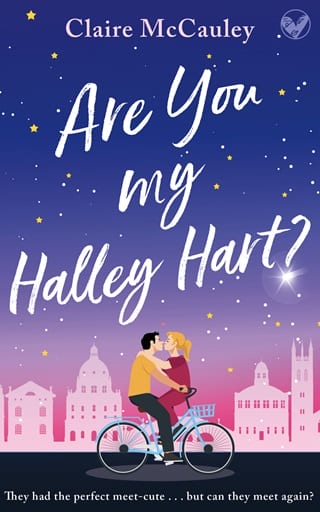
Are You My Halley Hart (Feel-good Romantic Comedies)
Part One
Saturday, 21 September
10.15 a.m. — Henry
Henry glanced into the window of the coffee shop, then paused. Every table was full, there was a queue at the counter, and he was in a hurry. Facing the day’s task without caffeine felt especially unappealing, when standing in the drizzle.
The rain began falling harder and faster. Internally, Henry swore.
‘ Oh shit ,’ a woman said, with feeling, from behind. The sensation that she’d given voice to his thought was so strong that Henry glanced over his shoulder, catching sight of a tail of bright, streaming hair, flying out behind the woman as she shot into the café.
Taking refuge indoors was the only sensible response to sheeting rain so, ignoring his qualms about lateness, Henry pushed through the door, its bell jangling.
Surveying the inside, he pulled back his hood and ran a hand through his hair, wavering again. This place made far better drinks than the chains, but wasn’t renowned for speed. And the queue stretched the entire length of the counter with five customers ahead of him — six, including the woman from outside, who now joined the end of the line.
With a wince of sympathy at how wet her hair and thin jacket were, he took his position in the queue. He’d give it a few minutes. The woman in front of him appeared to shiver and as she repositioned her shoulder bag and lifted her ponytail from her neck, droplets of water scattered and flew. He shifted backwards — but not nearly fast enough to avoid a fine misting of water across his face. He reached for the napkins on the counter. The movement seemed to alert the woman to his presence, and she spun around.
His first impression was that she appeared to be in her mid-twenties, not far from his own age of twenty-eight. His second, that in response to his damp face her own became dismayed. He tightened his fist around the napkin to conceal it.
‘I didn’t notice you there,’ she said, reaching back to catch her ponytail between both hands. She had an American accent, and a throaty tone. ‘I’m so sorry.’ Her skin had a slightly pinched look, presumably from the sudden deluge, and several flecks of mascara had migrated to her cheekbones. It didn’t detract from the impact of her eyes, which were large and grey within their round orbits.
‘Not at all,’ Henry murmured, finding himself suddenly much less despondent about the wait. He added, with a smile, ‘My fault entirely for standing too close.’
That won him direct eye contact, and a mirroring smile with a flash of dimples. He opened his mouth to speak again as the door jangled. A couple entered, moaning about the rain, and the young woman rotated away.
Absurdly, Henry felt bereft at losing her attention. He couldn’t stop watching as she nimbly twisted her hair, forming it into a crescent which she held against her head with one hand. She rooted inside her jeans pocket with the other, eventually drawing out a yellow pencil, which she thrust horizontally through the crescent. Somehow, pencil and hair remained perfectly in place.
Henry suppressed an urge to ask how she’d tamed gravity. His first question shouldn’t in any way reference her appearance. Do you come here often , he considered before scoffing at himself. He eyed her again, wondering if introducing himself would be unwelcome. With her hair up he could see the outline of her shoulder blades through her jacket, and the slender gold chain around her neck. None of that hinted at her interest — or disinterest — in conversing with him.
She inclined her head to examine the chalkboard menu on the wall behind the counter. Her profile revealed full lips balancing out a decidedly firm chin. He cleared his throat.
Unsure if she was listening, Henry began anyway. ‘I’m—’
‘Latte with a double shot,’ the young barista hollered at the same moment, drowning him out.
‘That better be mine — with oat milk, right?’ the customer at the front said with a scowl.
The barista frowned. ‘Was it? I forgot. Hey,’ he raised his voice again. ‘Anyone wanting a double-shot cow’s milk latte, to drink in?’
Without missing a beat, the young woman called, ‘I’ll take it.’
An instant later she was on her way to the till, and Henry snapped his jaw shut on a pointless protest.
She was asking how much she owed for the drink. Glancing around a taller man, he watched her press a bank card to the terminal then accept the proffered cup and saucer. She squeezed through to the only empty seat, where she sat down and disappeared entirely from Henry’s view.
At the counter, the belligerent customer was kicking up a fuss about how long he’d already waited, and the barista seemed to respond by remaking his latte even more slowly.
Henry released a long stream of breath. There was nothing for it but to make a dash for Costa. Before he reached the door, he took a moment to look again for the young woman.
She was lost from his sight in the sea of bodies.
* * *
12.13 p.m. — Halley
Radcliffe Square was surrounded on three sides by crenellated walls and varied university buildings, and on the fourth by a church with an ornate spire, but Halley’s attention was on the imposing circular structure in the centre of the quadrangle. It was tiered like a wedding cake, with symmetrical columns reaching up to a domed roof.
Halley resumed her walk around the perimeter of the cobbled square, dodging people and the puddles which, like her damp hair, were reminders of earlier rainfall. Pausing to drink in the view of the Radcliffe Camera from another angle, she pulled her pencil free, releasing her ponytail to dry. Behind her, someone commented on the building’s beauty at so high a volume that it cut straight through the general hum of sound. It was a fellow American, of course, and Halley winced. Until her arrival in Europe a few weeks earlier, she’d assumed their international reputation for loudness was overstated.
Another American piped up with a shrill question, and she glanced over. Both her compatriots were attached to a tour group, assembled in a semi-circle around a guide who was facing away from her.
His voice was authoritative yet kind, and Halley edged closer. He was explaining that the iconic landmark in the middle of the square, known as the Radcam, remained a working library, which she knew, and that it was connected to other sections of the Bodleian libraries by an underground tunnel, which she didn’t.
Deciding she’d too quickly dismissed the idea of an organized tour, Halley lingered to ask about the route. If it went past the place she was most keen to see, she’d try to buy a ticket.
‘Take a wander through the quad,’ the guide broke off to say. As the group collapsed into smaller clumps he half-turned to call after them. ‘We’ll move on in five minutes.’
Halley seized her opportunity and stepped forward, looking up into his face — though not very far up, since he wasn’t much above average, for a guy. ‘Excuse me. Do you go past—’
Recognition flashed through every nerve in her body and she broke off, struck speechless.
The tour guide was the guy from the coffee shop.
The cute guy, over whom she’d shaken droplets of water, like some wet dog.
The cute guy who was now meeting her gaze, so she witnessed his moment of recognition.
‘It’s you,’ he said blankly.
Heat spread up Halley’s face.
‘I beg your pardon,’ he added quickly. ‘That came out wrong. It’s just I... I thought I’d never... well, uh... anyway. How can I help?’
Poised on the balls of her feet for escape, Halley opened her mouth to tell him that it didn’t matter.
‘Sincerely,’ he said quickly. ‘I’d like to help, if I can. Do you need directions?’
She searched his face, now devoid of its odd expression. His mouth had relaxed and his blue-green eyes were alert with interest. She eased her tightened arches, rebalancing her weight from toe to heel.
‘I wondered about your route.’ Her voice sounded stiff so she employed a trick of her mother’s, to keep from sounding nervous, and smiled broadly. ‘Particularly, whether it takes you past Halley’s observatory.’
He blinked. His lashes were long, and a fraction lighter than his mid-brown hair and eyebrows.
‘It’s not what we’d think of as an observatory these days,’ she added quickly. ‘Just an old house in New College Lane. Edmond Halley — who predicted the return of the comet that came to be named after him — lived there in the early eighteenth century.’ She had to stop to take a breath, a sure sign she’d been gabbling.
He nodded, and gestured toward the exit at the north-east corner of the square. ‘It’s over there, but we head inside the library to look around the Old Bod next, so don’t pass it until the end of the tour.’
‘So could I?’
His lips rippled, and then he was reflecting her smile back at her. It made his eyes crinkle into creases. ‘Uh... could you ?’
‘Buy a ticket and join you for the rest of the tour?’
He hesitated. ‘Unfortunately not,’ he said eventually, sounding genuinely sorry. ‘Inside Oxford is a private walking tour — it can only be pre-booked online. But on Broad Street there are several tours that depart on the hour, with tickets available direct from the guides. I can direct you—’
‘Henry, is this the middle of the campus?’ a man scurried over to ask.
Aware of taking a few seconds too long to cover her disappointment, Halley was grateful for the interruption, though the guide himself — Henry, she now knew — appeared confused, surveying the questioner with an air of surprise. After a short pause, he expelled a deep breath, then seemed to refocus.
‘As I mentioned at the start,’ he said mildly, ‘the university’s made up of over thirty colleges and numerous department buildings that are spread throughout the city — there isn’t a campus, as such.’
His attention returned to her, and Halley smiled again. ‘I understand. Thanks for your time.’
‘No, wait ,’ he said instantly. ‘Thinking about it, the rotten weather caused several no-shows.’ He lowered his voice. ‘As long as you wouldn’t mind keeping quiet about it to the rest of the group, I could reassign one of those unused tickets to you — free of charge, of course.’
Halley didn’t need to think twice. ‘Really? That would be great!’
‘Brilliant!’ he said, as though she were the one doing him the favour. ‘I’m Henry, by the way.’
‘I heard,’ she said. ‘I’m Halley. Halley Hart.’ She beamed at him, but multiple members of his group were assembling beside them, so she didn’t add anything else.
He did a brief headcount then rounded up a few stragglers to sweep them all through into a smaller quadrangle, entirely enclosed by library buildings.
‘People are working inside, so we have to respect that they need silence,’ Henry said. ‘We will only talk in the stairwells, and even then, need to keep our voices low.’ His gaze travelled over them all, but paused on hers. Halley flushed, sure it was because she was American, and Americans, being loud, needed to be doubly warned about the sanctity of libraries.
Someone asked if students would really be inside the library on a weekend.
‘It’ll mainly be academics, today — and graduate students,’ Henry said. ‘The academic year doesn’t begin for another week or two, so undergraduates aren’t yet in residence.’ He continued as he led them inside the grand main entrance, explaining that Oxford University had three terms, each only eight weeks long, which rendered them immensely intense, and that students didn’t live in residential halls, but spread out through their colleges.
Halley hung back as everyone passed into the library, uncertain about not having paid for a ticket. But the whole group was ushered inside without challenge, and up a twisting staircase into a triple-height room of breathtaking beauty. Under a panelled ceiling, the full length of the walls were filled with leather-bound books in ancient oak cabinetry. A carved staircase and wraparound gallery offered access to the upper level of the collection. Only the far wall was empty of books, instead being taken up by a huge arched window, segmented by stone mullions, each set with a plethora of leaded-glass panes.
‘It’s stunning,’ the American woman beside her cooed, at volume.
Halley glared at her, shooting her index finger to her lips for good measure.
* * *
1.09 p.m. — Henry
Viola would absolutely marmalize him if she found out about this. Her company didn’t spend so much on advertising their expert-led cultural tours to all corners of the UK for him to turn around and give away a freebie. And he didn’t even want to imagine her reaction to hearing that he’d done so in response to a pretty young woman’s eyes lighting up at a library tour. She’d probably call him a creep.
Not that sharing a love of libraries was the only reason for his impulsive offer, he admitted to himself, leading his group down the final staircase. The biggest was an instinct that he couldn’t let Halley Hart slip through his fingers again, not after the serendipity of this second encounter. He intended to take the opportunity to ask what she was doing in Oxford — and how long she could stay. Then there was the fact that despite knowing so little about her, he already liked her. It was more than merely the way she looked ― he flicked his eyes to her, at the back of the group ― though that was certainly part of it. He shook his head at himself, and glumly reflected that Viola might be right to call him a creep.
Henry was recalled to the job in hand when one of his group stumbled, then shrieked. After going to help, he launched into his final section of spiel about the history of the place. Halley remained at the back, and Henry silently chided himself. He wanted her beside him, where he could indulge his curiosity, but by asking her not to mention joining them for free, he’d made her feel self-conscious.
He wondered if he was correct to visualize her name spelled like the comet, and if so, if it explained her interest in Edmond Halley’s observatory, of all things. It certainly wasn’t a place that appeared on any list of the ten best sights in Oxford. It didn’t even feature on Unofficial Oxford’s Forty-Two Nerdiest Things To See list, alongside the sweetshop that the real Alice in Wonderland used to visit, Tolkien’s grave and Einstein’s blackboard.
Ushering everyone through an exit leading onto a courtyard, Henry saw Rupert Peters, his boss at his proper job, hurrying toward him.
‘Henry! Glad I bumped into you. There’s an issue with the tutorial schedule—’
‘I warned you I’d be rather busy today,’ Henry said.
Rupert looked at him blankly. He was a good boss, aside from forgetting everything he considered irrelevant — from the unwritten rules of polite discourse, to what day of the week it was — though his memory was prodigious for everything he deemed important. Since he was a medieval history professor of significant renown, this basically meant every event that befell humanity between the fourth and sixteenth centuries.
‘How about I drop by your office later?’ Henry suggested, returning to his group before Rupert could object. They’d emerged, blinking and slightly dazed, to congregate past where he waited, which conveniently positioned him near Halley Hart. He directed everyone onto Broad Street, then right for the Bridge of Sighs, before falling into step beside Halley. ‘Your observatory’s the next stop after that.’
Her mouth quirked in a way he couldn’t begin to interpret. ‘More precisely, my eleven times great-grandfather’s observatory.’ He glanced at her uncertainly, and she laughed. ‘Edmond Halley is an ancestor of mine, via one of his granddaughters. Because they lost the Halley surname through marriage, a tradition built up of using Halley as a Christian name for the eldest daught— Hey, should you do something about that?’
His eyes shifted in the direction she was pointing, to discover his family of Norwegians had gone left, rather than right, to make a beeline for a bookshop. He waved his thanks to Halley as he scarpered toward them.
By the time he caught up with his group again, they were gaping up at the striking covered skyway that connected two parts of Hertford College above New College Lane. His attention was drawn, yet again, to Halley, neck craned and observing it in motionless absorption. He’d already noticed how purposefully she moved, and this sudden stillness had a purpose all of its own.
‘Ghost!’ a French teenager sniggered and Henry was obliged to look away from Halley to the figure, surrounded by swirling black, that could be seen rushing through the bridge, before disappearing from sight at the other end.
‘That was someone wearing an academic gown, in a bit of hurry.’ He added more quietly, recalling what had kept him busy the day before, ‘Probably late to an SCR meeting, discussing Hertford’s incoming freshers.’
‘Freshers are freshmen?’ an amused voice said from behind him, as he guided the group along the lane. ‘But what’s SCR?’
He glanced back at Halley. ‘Senior Common Room: the college’s academic staff — with graduate and undergrad students known respectively as the middle and junior common rooms. And also a physical space — generally a series of interconnected recreation rooms.’
‘Are you a member of Hertford’s SCR, or a different one?’
He darted a sidelong look at her. ‘Another college’s. How on earth could you tell?’
‘That guy who stopped you outside the library knew you, and he was the type of professor who only knows other academics. Besides, I don’t get the vibe that the tour-guiding gig is who you really are.’
‘You’re observant,’ he said.
‘I get told that a lot,’ Halley said, half laughing. Her eyes widened. ‘Oh, this is it...’ she breathed.
The three-storey house was set back from the street, and partially screened behind wrought-iron railings and mature foliage. Before he could suggest that she would get a better view if she moved down to look through the gate, she pointed up at a rectangular structure jutting up from the slate roof, her eyes shining. ‘That was his observatory. It was built for him specially. And look at this—’ He followed the arc of her gaze sideward, to a stone plaque on the gate post. It was engraved Edmond Halley, 1656–1742 . Above the words, the comet was depicted as a golden ball with a multi-stranded tail.
Halley traced her fingers over it and Henry recalled himself to duty, turning to gather the group back together. He raised his voice to project over the distant wail of a siren. ‘This was the home and workplace of the astronomer and mathematician who was first to calculate the orbit of the periodic comet that came to be named after him.’
‘We saw it in the eighties, didn’t we hon?’ a man said to his wife.
‘I was in grade school,’ said an American woman in her forties. ‘I don’t remember seeing it, only the project we did about it.’ She brightened perceptibly. ‘You’re meant to get to see it once in your lifetime, and maybe it’s not that I forgot, but I really didn’t see it. Which means I’m guaranteed to live until at least... at least...’
Henry recalled that Halley’s Comet was visible from Earth every seventy-six or so years, but was hazy on when in the eighties it had last appeared, so couldn’t help with the calculation.
‘2061,’ Halley supplied. She had got a proper camera out of her bag, and unclipped the lens cover. She didn’t tell the rest of the group about her link to the comet, so Henry didn’t mention it either, but did his best to answer the rest of the questions.
Halley photographed the sign then backed up, probably to get some of the entire property. But other members of the group kept stepping into shot, so she lowered her camera, no doubt biding her time.
Henry needed to walk the group back into Radcliffe Square but he was convinced Halley would remain behind to get her pictures. He was tempted to stay, dispensing with the formality of accompanying the group to the tour’s end point. But, visualizing his sister’s exasperated reaction, he knew he must follow protocol. Viola had rescued him when, after being awarded his doctorate, he was rejected from academic posts left, right and centre. She had hired him as a guide for the national cultural expedition company she helped run. It had kept him in full employment until last year when he began his current role as a junior research fellow at St Jude’s College, Oxford. The downside was that when short-staffed, Viola begged him to step in and conduct tours, and he didn’t like to refuse, though it wasn’t an ideal way to use his weekends.
He directed the group back the way they’d come, and as everyone else began retracing their footsteps Halley just watched them, remaining where she was.
‘I need a moment,’ he called after the departing group. ‘Turn left at the end, and you’ll be back in Radcliffe Square. I’ll catch up shortly.’ He glanced at Halley, and lowered his voice. ‘It was nice to meet you, Halley Hart.’
‘You too,’ she said. ‘Thanks for letting me tag along.’ But she was already looking through the camera’s viewfinder at the house. Castigating himself silently for thinking she’d, what — fall into his arms once they were alone? — he turned to trudge away.
‘Henry—’
He swung back instantly. ‘Yes?’
‘Would you have time to take my photo? My mom would love one of me here.’
‘Not a problem,’ he said, striding over and accepting her camera. It had an intimidating number of dials and buttons. ‘I’m afraid I haven’t taken photos with anything but a smartphone for a long time.’
‘Just point, and click the red button.’ She sidestepped until she stood adjacent to the sign. Grateful beyond belief to be able to look at her without pretending not to, he centred the house within the viewfinder, clicked once, and then a few more times for good measure.
‘Would you take a few close-ups — just me and the sign? Twist that same button to the left to zoom in.’
Henry twisted, and the lens lengthened. He trained it on Halley’s face. Her large grey eyes were screwed up slightly against the sun, which was also highlighting the palest streaks in her fair hair, so they shone. Her smile was broad, so her dimples had deepened to the point that they would be more accurately described as pleats bracketing her wide mouth, and they weren’t quite symmetrical, with the one on the right more pronounced. Her slender gold necklace had a tiny charm shaped like a five-armed starfish hanging from one side of it, but if there were other charms they were concealed beneath the crew neck of her top. Combined with her easy intelligence and careful way of examining and interacting with the world around her, she was irresistible.
He clicked the button several times, then lowered the camera and blurted, ‘What are you doing this evening?’
Her brows twitched up. ‘Finding someplace for dinner...’
‘Any interest in eating with a local?’ he asked on a rushed, single breath. ‘Though no problem if—’
‘If you can make 7 p.m., that sounds cool,’ Halley said.
Henry’s heart soared, and he ransacked his brain for quiet options with decent food, that would be easy for her to find... He had it. ‘How about we meet at the Hope and Anchor? It’s a pub on Nor—’
‘Yoo-hoo, Henry?’ someone called from far behind him. ‘Are you coming?’ Several members of his tour group were waiting at the bend in the street.
‘Go,’ Halley said, her eyes sparkling as she accepted her camera back. ‘I’ll see you at seven, at the Hope and Anchor.’
* * *
5.56 p.m. — Halley
The teenage boy behind the reception desk grunted when she returned to the cheap hotel she’d stayed at last night, in a janky room she’d been glad to check out of early that morning.
‘I left my backpack in your luggage store,’ she began.
He jerked his head toward a narrow doorway and mumbled a string of vowels.
‘I know it’s in there,’ Halley said. ‘The thing is, I’ve made dinner plans, but I’m not sure where the pub is — the Hope and Anchor? If it’s nearby I’ll return for my bag afterwards, but if it’s on the other side of the city I’ll have to collect it now.’
He cast her a gormless look.
‘You could look up the location for me,’ she suggested.
He grunted something she thought was no need for that, and pressed a grubby finger to the laminated Oxford map, Scotch-taped to the reception desk.
Halley bent closer to read the tiny street name. ‘Globe Road — that’s where it is?’ At his nod, she considered. When Henry had suggested the Hope and Anchor, she’d had a vague sense of recollection, and thought they may have passed it during the tour. But Globe Road appeared to instead be north of the city centre. Unfortunately, as her hotel was way to the south, it left her little choice but to turn up to dinner with luggage.
She sighed as she poked her head through the doorway, identified her mid-sized backpack and heaved it over one shoulder, rearranging the strap of her camera’s shoulder bag across the other.
‘Thanks,’ she called back at the boy, who didn’t even bother responding with a grunt. It served her right, she knew, for booking the cheapest room in the city, though that was less a choice and more a necessity, forced on her by the depletion of her funds after three weeks in Europe.
She hoped the pub wasn’t expensive, then stood, stock-still in the middle of the sidewalk, panicking in case it was. Maybe she shouldn’t go. Henry lived in Oxford, and she was leaving soon.
Halley resumed walking, weighing the matter over and over. She’d squeezed in a lot, in her short time in Oxford, but only managed to visit one of the multiple museums after the tour ended. Another museum stayed open late on Saturdays, and it was illogical to miss out on that for the sake of an evening with a near-stranger. However cute he was. Or courteous he was — but in an understated way, not like he was showing off about having good manners. And whether or not he listened intently when others spoke, and spoke eloquently without ever being glib.
Realizing she had been walking aimlessly, she decided to at least head in the right direction, and paused to ask a local for directions to Globe Road. She could scope the pub out before making up her mind. Maybe even head inside a little early, and check she could afford the prices on the menu.
* * *
7.04 p.m. — Henry
Henry careered up the narrow street, came to an abrupt stop beside the kerb, and swung a leg off his bike. As he fastened it to a half-empty rack, he glanced over at the Hope and Anchor, confirming that Halley wasn’t waiting for him outside. His second tour group of the day had been particularly garrulous, and afterwards he’d run to college to chat to Rupert. It had left him little time to return home to shower, and even with cycling back, he was a few minutes late.
He unclipped his cycle helmet and carried it under his arm, hastening past the coffee shop at which he’d first seen Halley, earlier in the day. He’d chosen this pub partly because it was on the same road, so it would be easy for her to find, though he hadn’t had time to explain that properly before the interruption.
He ducked under the low lintel and surveyed the small space: Halley hadn’t arrived yet.
‘What can I get you?’ the barman said. Henry forestalled ordering, explaining that he was waiting for someone who hadn’t been here before, and might need to pop outside to keep an eye out for her.
His phone buzzed, and he experienced a pang of dread in case it was Halley, cancelling on him. But, of course, they hadn’t got around to exchanging numbers, and the alert was for a new voice note. It would be Viola, since uninterrupted vocal utterances were his sister’s favourite mode of communication. She’d want an update on today’s tours, and to update him on their parents, whom she’d gone to see. Henry didn’t need to listen to it to know that Dad’s hip looked like it was painful, but he insisted it felt fine, or that Mum’s next appointment at the memory clinic still hadn’t come through.
The door opened and Henry raised his eyes expectantly. But it was a couple of strangers. He strode to a small table in the far corner and slid into the chair that faced the entrance. Hanging his cycle helmet from its arm, he told himself to calm down. He knew so little about Halley that he absolutely shouldn’t feel so desperate to see her again.
He went out and checked both ways along the street, as well as outside the coffee shop. There was no sign of Halley. On his return to his table he listened to Viola’s message, for something to do. All was as he had predicted, and he stowed his phone in his jacket pocket. Then he pulled it back out and checked his email then scrolled through the day’s news. None of it was an effective distraction from the question that was rapidly overtaking his attention... was Halley even coming?
He sprung up again to look outside, this time pacing the entire length of North Parade — the street on which the Hope and Anchor and the coffee shop were situated. He had expressly stated that address to Halley — or at least he’d started to, before being interrupted. But if Halley hadn’t heard it all, she only needed to google, or ask anyone, and she’d be given this address.
Something niggled in the back of Henry’s consciousness as he went back into the pub.
‘Cheer up,’ the barman said. ‘Either that, or drown your sorrows...’
Henry ignored the heavy hint. ‘This is the only Hope and Anchor in Oxford, isn’t it?’
‘Nah mate. It confuses everyone — especially with being so close by. They’re bigger and all, but we were named first.’
Henry was already racing to snatch up his cycle helmet. ‘Where is it?’
‘Globe Road.’
Henry sprinted out. He’d never been along Globe Road, which explained why he hadn’t been aware of a pub with the exact same name. It was under half a mile away — only two to three minutes, on his bike. He’d be there before half seven, he thought, reaching the bike rack, which was entirely empty.
Henry stared around, in case he’d forgotten which rack he’d leaned his bike against. But there was only one. He must have been so stressed by arriving late that he hadn’t locked it properly, and then so distracted by whether Halley would arrive that he hadn’t noticed when it was stolen, despite coming outside regularly. Worst of all, he thought, starting to run again, he now wouldn’t be there by half past.
Dusk was falling and he was breathing hard as he turned into Globe Road and spied the other Hope and Anchor, a red-brick Victorian building. He leapt up the step to push through the front door, and gazed around wildly.
Halley wasn’t in sight, but as the barman at the last place had pointed out, this was a bigger establishment, and Henry continued around the back of the bar and then into another room, filled with diners. Still no Halley. Finally he went to the bar.
‘I was meant to be meeting someone here. Halley Hart. She’s blonde, American, about five foot seven — have you seen her?’
The barman said that he hadn’t so laconically that Henry asked if he could check with the other staff. A bar manager came over, confirmed that she also hadn’t noticed anyone of that description, then went to confer with the waiters. ‘Unfortunately not,’ she said, on her return. ‘It’s been a busy start to the night.’
Henry had lost his appetite, but wanted to hang around, in case Halley was extremely late, rather than having been and gone — or never turned up. So he ordered a sandwich and cup of tea, which he took over to nurse at the sole empty table, against one wall.
Staring into the mug, he tried to come to terms with being down one bicycle — and one Halley Hart.
* * *
7.53 p.m. — Halley
A tumult of emotion plagued Halley as she neared the railway station. After she got to the quaint pub half an hour ahead of schedule, she’d wanted to stay, and even sat at a table. But then her rational self took over, and she’d listed all the reasons this was a dumb idea.
But she’d hated the thought of standing Henry up, so waited, her eyes fixed on the door, until 7.14, when he still wasn’t there, and she’d slumped back, annoyed. Maybe he had a succession of girls from tours turning up here, only for him to never show at all. At that, she sprung up, seized her backpack, and left swiftly. She paused only to queue at a food truck, paying with the last of her British cash for a falafel wrap that she could barely taste, on her mile-long trudge to the railway station.
Inside, she scoured the departure board for an earlier train to London, and saw one listed for 8.35, leaving her only forty minutes to wait, as long as her e-ticket allowed changes. She stomped to the information desk, groping at her side for her camera bag, to get her phone from the front pocket.
‘I wanted to ask if I can hop on the earlier train to London,’ she said, smiling perfunctorily at the station employee. She glanced down. Her backpack was slung properly over both shoulders, to lighten the load while she walked. But she didn’t have her camera bag.
‘That’s fine, love — I don’t need to check your ticket,’ the woman said. ‘Everyone’s got to get on the 8.35, because that’s the last. The later one’s cancelled.’
‘I don’t... I don’t have my bag,’ Halley said. Her voice reverberated curiously in her skull.
The woman clicked her tongue. ‘Thieves operate in here, though we do our best to—’
Halley shook her head vehemently. It hadn’t been stolen. It was a mile back, at the Hope and Anchor, under the table she’d left in such a hurry. And the last train was leaving in thirty-nine minutes. She broke into a run, darting around people and suitcases and bicycles, then out the double doors into the darkening evening, down the steps, and back the way she’d come.
Elite female runners could complete a mile in under five minutes. Unfortunately, preferring Pilates and yoga, she was far from elite, even without a heavy backpack. She’d been nearly five minutes already, she calculated as she slowed to cross a road, and was around halfway. That meant ten minutes to get there, five to find her camera bag, and fifteen to get back and onto the right platform. It was doable if she found her bag quickly. Panting, she increased her speed.
By the time she reached the Hope and Anchor Halley could only breathe in short, tearing gasps, and felt too exhausted even to push the front door open. Thankfully a group of giggling women exited, and she slipped through. Her eyes darted between the bar and her table from earlier, unsure whether to start looking herself, or ask if it had been handed in. Since the table, against the far wall, was empty, she tried there first, dropping to her knees and scrabbling under the long tablecloth.
Her hands alighted on the waxed canvas, and she drew her bag out, unfastening it shakily. Her camera was inside, with all its accessories, and her phone and sunglasses were in the front. She put those alongside her wallet in her jacket pocket, then squashed her camera bag into her backpack before heaving the whole thing onto her shoulders.
Outside, rain had started up again, and she shivered. The evening’s ordeal wouldn’t end until she made it onto that train. She sucked in a deep breath, readying herself for another run.
Her eyes alighted on a black taxi, which rounded the corner before pulling up in front of the pub. Even as she made a dash for it, she saw a figure, lit by the warm glow of a street lamp, who’d already held an arm out to hail the cab.
A figure she recognized, even from behind, and in different clothes to earlier. It was the shape of his broad shoulders, and his hair: close-cropped at the back and sides, neatly blended to a longer length up top, where it was textured and slightly wavy. Henry had been waiting for her, and without stopping to think, she hollered his name.
He froze, then rotated slowly toward her, his eyebrows sky high.
All of a sudden, the bottom dropped out of her stomach, like she was in free fall.
‘You came,’ she breathed, pacing forward to bridge the distance between them.
‘Forgive me,’ he said. ‘There’s two Hope and Anchors, and I went to the other. I’ve only been in Oxford for a year, I hadn’t realized.’
Under the illuminating street lamp she could make out faint freckles on his fair skin, and glints of stubble along his defined jaw. An unexpected longing burned through her lungs, but logic reasserted itself, yammering a protest.
‘I need that taxi,’ she said. ‘My train’s cancelled and the last one leaves in fifteen minutes.’
Henry locked eyes with her. ‘My bicycle’s been stolen.’
‘Will one of you just get in!’ the cab driver yelled.
Henry’s slanted blue-green eyes tightened, like he was thinking hard. Then he moved aside, opening the cab door. ‘Take it,’ he said.
It was too late to tell him that her desperation for the taxi had waned, replaced by a sudden desire to remain in his presence. Instead, even as she told herself she must have lost her mind, she rose onto tiptoes, leaned in and pressed her lips to his cheek. When he didn’t resist, she turned her head minutely and brushed her lips against his. His lips were warm, and he’d been drinking something she couldn’t identify, because his breath was woody and mellow and also slightly sweet.
His hands grasped hers and he leaned closer.
The cab driver blared his horn, and she flinched.
‘Thanks, Henry,’ she said breathlessly, tearing her hands from his and sliding into the cab, before slamming the door. The impatient driver screeched away before she’d even got her backpack off and seat belt on. Her eyes stinging, she didn’t dare look back.