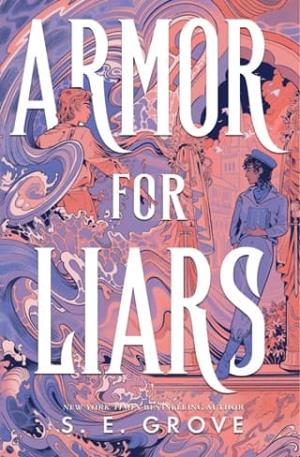
Armor for Liars
Prologue
The coach driver, a taciturn but responsible man who never indulged in drink, took the twisting path westward at a moderate pace.
Platt knew the route to Gardner well, and the falling dusk did not trouble him.
He also knew the Quinns well: the four of them had thrown open the windows and exclaimed at the views until, weary of the hours of travel on winding dirt roads, the two children had curled up and fallen asleep.
Now all was quiet in the coach, and the only sounds were the thudding of the horse’s hooves, the crunching of the wheels, and the muted cries of crows overhead.
Platt knew that it would be dark by the time they arrived in Gardner, but he favored the comfort of Mr. Quinn and his family over the relative ease of daylight travel.
The children would not have been able to sleep so soundly in a coach that careened through the woods, jolted this way and that by stones and potholes.
In the fading light, Platt didn’t see the figure in the road until they were almost upon it. The horse hesitated, and only then did Platt lean forward to squint and see there, lying in the dirt, a white bundle of some kind—something motionless, its shape vaguely human.
Platt brought the coach to an abrupt halt. He alighted slowly, his cold breath swirling about him as he climbed down onto the path. Mr. Quinn’s face appeared at the window. “Is something wrong, Mr. Platt?”
“Not entirely certain, sir. Something in the road. Spooked the horse a smidge.”
The door opened and Mr. Quinn stepped out. Platt would have preferred to investigate the matter on his own, but Mr. Quinn was a younger and quicker man, and already Platt was yanking his back in a painful manner to catch up with him.
The darkness fell quickly at this hour in November.
Hardly past four and the trees looked black, the sky struggling to keep its purchase on the fading daylight, already giving in to night.
Such dusky evenings are apt to distort and conceal; presence and absence cannot always be counted on; the innocent may appear menacing and the menacing may, for just a moment, appear innocent.
It was a woman lying in the road, her long white dress shapeless and vast, her downturned face obscured by an arm and tangled strands of black hair.
Her feet, limp and almost luminously white, were bare.
Mr. Quinn stood over her with an air of concern, his dark eyes troubled.
“Is she dead?” Platt asked, joining him.
“I think she must be.” Mr. Quinn frowned. She lay utterly still; her back did not rise and fall with breath.
A voice behind them cried, “Oh, but we must check! What if she is only unconscious?”
Platt turned with some consternation to confront this protest from Mrs. Quinn, who had somehow alighted noiselessly from the carriage and joined them in the road beside the fallen figure.
She was wrapped in a wool shawl to fend off the cold air, but already she’d begun shivering, and she huddled next to her husband for warmth.
Mr. Quinn hesitated. He wasn’t a callous man, but he did tend toward caution, and he had enough experience of the world to believe that very few delicate situations were improved by precipitous action.
Before he could give voice to his trepidation, a low moan sounded from the white figure, and the woman rolled slowly to her side, revealing a young, white face with languid eyes.
Afterward, Platt would wonder if he might yet have acted in time, had he given greater rein to the unthinking instincts that he relied on implicitly and that had saved him many times while driving.
He was closest to the woman, and as she turned, a briny scent filled the air: ocean and salt and decay.
A surge of fear filled him, and he took a step backward just as Mrs. Quinn, stirred by compassion, swooped down to kneel beside the white woman. “She’s alive!” Mrs. Quinn exclaimed.
The low voice that answered her, rich and resonant, spoke with surprising assurance.
“But I am not.” The woman smiled, opening her eyes fully, and her entire aspect changed.
The dusk seemed to lighten for a moment as she rose effortlessly to her feet.
She floated inches above the ground, her hair and dress billowing as they would have underwater, her white skin shining as if struck by sunlight beneath ocean waves.
Mrs. Quinn staggered backward against her husband.
“Cursed spirit thew,” Platt muttered, not quite under his breath. He spoke forcefully then, with more conviction than he felt. “Be gone from here. You have no claim on us.”
“But I do,” the spirit replied, still smiling. She gestured toward the coach with one long, white arm. “I am taking a child.”
“No!” Mrs. Quinn shouted, horrified.
Mr. Quinn said nothing, but the rigidness of his jaw and the trembling of his hand boded ill.
Platt understood then that they would not leave the woods that day in one piece, and he felt a sudden rage inside him, the kind of rage brought about by long decades of grievances never set right, swallowed for convenience in the moment but never truly gone.
Propelled by this rage, he stepped forward and did something he ordinarily would have considered impossible: he pushed the spirit with his bare hands.
Her solid form, oddly heavy, swung backward like a pendulum.
“Get out of here, spirit filth,” he spat at her.
“There is nothing for you in this place.”
She looked at Platt with dispassion as her enchanter stepped out from beside the path, obscured by a hooded cloak.
He was a man of average height, his hands concealed in dark gloves, and he moved with deliberate slowness.
“I dislike the way you speak to my thew,” he said coldly.
“It’s your tongue that is filthy, and you will be better without it.
” He reached outward casually and twisted his fingers in the air, as if turning a doorknob.
Platt’s knees buckled and he fell to the ground, his hands covering his mouth, which streamed dark blood.
In the darkness the small, inert lump of his tongue, lying in the dirt, was hardly visible.
He crouched over it, soundless, uselessly cupping the blood in his bare hands.
Mrs. Quinn gave a scream that ended in a sob.
“My thew has already spoken for us,” the enchanter said calmly, ignoring Platt. “You may choose elder or younger, but one is owed to us.”
“They are only children,” Mr. Quinn said, his voice shaking.
The spirit thew turned away from Platt and the Quinns, her expression aloof. The enchanter said nothing. Seconds passed. The Quinns stood staring while their children slept in the warm coach and Platt coughed blood into the dusty road.
Abruptly, Mrs. Quinn broke away from her husband and stepped toward the enchanter.
“Lydie!” her husband said sharply.
She did not reply, but slowly and deliberately kneeled before the hooded man and raised her clasped hands in supplication.
“Please,” she whispered, “let it be me instead.”
“Lydie, no!” Mr. Quinn cried. He dashed to her side and seized her by the shoulders. “You can’t!”
She couldn’t bear to look at him, and instead seized the edge of the enchanter’s cloak. “Please,” she said again. “I beg you.”
The enchanter reached into his cloak and withdrew a small vial; he placed it into Lydia Quinn’s outstretched hands.
Quickly, almost eagerly, she unstopped the vial and drank its liquid.
She swallowed. The enchanter nodded once and stepped backward into the wood.
Then he turned, and his hooded shape became a mere shadow among the trees. “How long?” Lydia called after him.
The spirit thew answered, and her voice had softened now to something more unguarded, something like pity. “Seven days.”
Lydia nodded. Her husband wrapped his arms around her and wept. “Come,” she said to him. “We must get Platt to a doctor. Let us get out of these woods.”
Slowly, Robert Quinn got to his feet. He bundled the bleeding Platt into the coach beside his sleeping children and drove with his wife beside him out of the woods and toward Gardner, where they arrived in time to save Platt’s life.
It could not be so for Lydia, who fell ill the next morning.
She did not fight the illness. Her husband and children, constantly at her bedside, watched her weaken by degrees.
She died in her sleep seven days later, after a fever that came upon her like a sudden storm and sent her swiftly to the spirit realm.