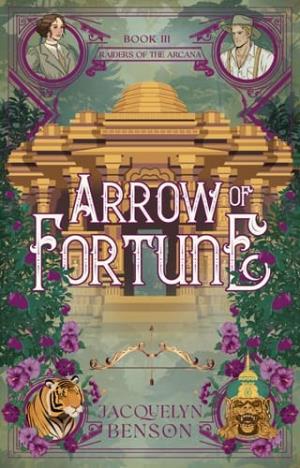
Arrow of Fortune (Raiders of the Arcana #3)
Prologue
Late Afternoon
Third Day of the Month of Asadha
Kingdom of Kosala
The renowned sage Valmiki meditated under the dancing leaves of the banyan tree, his humble ashram sprawled below him on the banks of India’s most holy river.
Valmiki’s meditation was, in all honesty, a breath away from a nap. He was an old man, after all, and had lived a long, strange life. He was entitled to rest his eyes on a lazy afternoon heady with the breath of summer.
The warm breeze brushed against his weathered skin, rustling the leaves over his head and the grasses at his heels. He allowed himself to lean back against the nested trunks of the tree in the interest of better facilitating that nap.
Small, hurried footsteps pounded up the slope. Valmiki felt them as a subtle thrum of the earth against his aching bones. High, sweet voices called out through the clear air in tones laced with excited urgency.
“Maharishi Valmiki!”
The revered sage cracked open a wary eye.
A half dozen of the ashram’s children gathered around him. They were led by one of the oldest girls, the dangerously quick-witted Iravati.
“There is a woman by the river,” she reported authoritatively.
The wind shifted. The whispering leaves overhead seemed to echo the lilting melody of a song hummed by low caste wives as they drew water from the nearby well.
The moonlit night is here. Come, now, my beloved…
“She is draped in silk and gold,” Iravati elaborated impatiently, hands braced on her bony hips. “She is either a princess or a goddess, and some warrior just left her alone here and went away with tears in his eyes. You must go to her and make sure that she is all right.”
Valmiki, greatest of all living ascetics, who had found enlightenment among the anthills and received the tribute of kings, knew well enough when to give up.
“I’m coming,” he grumbled, bones creaking as he rose.
?
He climbed down the hill, his feet long since hardened against the ground. His chest was bare save for a mala of ruddy, wrinkled rudraksha seeds and the white veil of his beard.
A woman stood on the banks of the river. She wore a sari of petal-soft silk in a hue like the pads on a hare’s foot, the cloth draped modestly over her head.
Something about her arms drew the sage as he approached—the curve of her bicep as full and soft as a ripe fruit in a color like pearl dust over amber.
Iravati’s impatient description echoed through Valmiki’s mind.
A princess or a goddess…
His toes sank into the mud of the riverbank as he stopped at the woman’s side.
Across the water, a nobleman rode away, dust rising from the wheels of his chariot. Even from a distance, Valmiki recognized his princely form and the dark, rich waves of his hair.
“That is Prince Lakshmana, son of Sumitra,” Valmiki noted. “Why are his shoulders bowed with sorrow?”
The lady graced him with a sad, slender smile—an expression of such aching beauty that Valmiki felt certain it would pierce him like an arrow and leave him bleeding on the ground.
When she spoke, her voice was the rush of water kissing a midnight shore.
“Because he has left me here and ordered me not to return.”
Wary caution shivered over Valmiki’s wrinkled skin. “And does this order come from his lord?”
“It does,” the woman confirmed.
Valmiki winced.
Lakshmana was ruled by his brother, the favored son of Dasharatha—the greatest king in the history of all India.
Lord Rama.
Valmiki found himself wretchedly certain of the identity of the woman who had just been abandoned on his riverbank by Rama’s loyal brother—and fought back the urge to groan.
She was not just any princess, but the Jewel of Ayodhya—daughter of King Janaka, who could transcend the prison of his own flesh. The woman for whom Lord Rama had conquered and slain ten-headed Ravana and his entire army of demons.
His queen. Sita.
Was the king mad? Or was this bizarre act the result of a godly wisdom greater than any that Valmiki himself possessed?
Why? the sage moaned inwardly—the thought more a momentary indulgence in self-pity than a question.
The lines of Sita’s profile were of unutterable grace as she gazed over the river at the puff of dust that marked the last sign of her retreating brother-in-law, her expression marked by an enduring, stoic grief.
Then Valmiki noticed the curve at the waist of her sari where the silk bent around the early swell of new life—and his knees started to wobble.
There must be some truly egregious sin in one of his past lives for the gods to have handed him this burden.
Fool, Valmiki cursed internally. Lord Rama, the great conqueror of demons, was a bloody fool.
“A great wrong has been done here today, Daughter of the Earth,” the sage declared. “I will travel to Ayodhya and make your husband see reason.”
Valmiki was quite sure that he could do it.
He was not a sage for nothing, after all.
He had once chanted a mantra so long and so deeply that he had come to live on nothing but the air itself and the earth under his feet, time itself slowing around him like a river turning to ice with the winter.
He had danced along infinity, the wisdom of the space beyond the gods laid open to his wondering soul.
And he had once been an adviser and companion to Lord Rama’s father, King Dasharatha.
Surely, he would be able to make the lady’s noble husband see reason.
Valmiki expected that his promise might meet with a nod of regal acknowledgment or a sob of relief—but Sita’s eyes remained on the land across the river, and her voice, when it spoke, was calm.
“There is an ashram of women hidden in the forest.”
Valmiki jolted with surprise. “The existence of that ashram is a great secret, my lady. How have you come to know of it?”
She did not answer him, speaking instead with the quiet authority of a queen. “I will raise my children there.”
The hairs at the back of the sage’s neck lifted with a creeping chill as instincts born of a lifetime of study and meditation flared softly to life.
Each word felt like a step through a quagmire.
“A decision that reflects your great wisdom. A prince cannot help but grow into a better man among the ascetics and the wild than he would ensconced in the flattery and luxury of the court.”
“Not one prince.” The queen laid a graceful hand over the swell of her belly. “There will be two.”
By the shape of her body, she could not have been more than four months gone. It was certainly too soon to have discerned through movement or pressure on the womb that she carried twins.
The uncanny chill on Valmiki’s neck grew stronger, and the space between his eyebrows began to itch with an uncomfortable, electric tension.
His gaze shifted to where a bow hung over the queen’s shoulder. The curved wood was elegant and supple, accented with slivers of carved bone—a warrior’s weapon, unfussy and lovingly maintained.
Intuition tugged his attention down. In her other hand, the queen carried an object as long and thin as Valmiki’s forearm, obscured by homespun wrapping like the tattered scrap of a vulture’s wing. The black fabric rippled softly in the gentle breeze from the river.
“What is that you carry, my lady?” Valmiki asked through a dry throat.
“Something I demanded of Lord Lakshmana,” she replied in a voice like silver. “Something that I would see kept safe.”
The wind pulled again, and a corner of the dark cloth fell away from the burden in her petal-soft fingers.
Light flared from the slender gap in the frayed fabric in ghostly, whipping threads—blue and gold, silver and crimson.
Hot wind buffeted across the plain, tossing the thick branches of the scattered trees like waves in a tempestuous sea.
Pebbles bounced around the calloused soles of the sage’s feet as the ground began to groan with the sigh of a rudely awakened giant.
Weathered flesh tugged against Valmiki’s bones, pulling toward the lady’s hand—and a freedom that could only mean death.
“My lady…” he pleaded, the word rasping like sand in his throat.
With a subtle shift of her wrist, she folded the cloth back into place.
The wind died. Little stones rolled to a crackling stop—and Valmiki realized what the Queen of Queens had taken from her brother-in-law into her keeping.
The knowledge twisted like fire in the sage’s gut.
“I will give you Lord Rama’s story, as you must tell it,” Sita commanded.
Valmiki reeled at the woman’s words. He was not a man prone to hubris—he had, after all, spent a lifetime working to shed himself of his earthly desires.
But Lord Rama’s story was one of righteousness, betrayal, and wild adventure, threaded through with gods and saints, immortal monsters, and unexpected allies.
To be the one chosen to record it was an honor beyond reckoning.
There were tales of ferocious battles. Of mountains moved across the night. Of the raising of the dead.
Of holy weapons of unimaginable power.
The sage’s gaze dropped to the cloth-wrapped secret the queen held in her hand—and her final words echoed uncomfortably through his mind.
“As I must write it?” he pushed back uncertainly. “Will it not be the whole story, then?”
The woman on the riverbank turned her head to look at him.
Her face was the image of perfection, black brows soaring like the wings of starlings over cheeks warm and rosy as a summer sunrise.
That beauty must have made a thousand hearts burn with regret that they had not had the good fortune to be born Lord Rama and enjoy the unimaginable splendor of this woman’s favor.
Past lips like sun-ripened berries, lashes thick as the fall of evening framed eyes like those of a new-foaled fawn.
But as the sage looked deeper into that still, relentless gaze, it seemed as though he saw past the flesh and blood that stood before him to a truth deeper than the reckoning of a single lifetime.
He tasted the bitter tang of copper on the back of his tongue. His ears rang with a sound like the clanging of gongs, and the shadow of another pair of arms fell over his soul.
A thought rose into his consciousness, echoing up from a place far beyond both space and time. Valmiki absorbed it with a wild sense of awe.
There have been skulls around her neck.
What had the child Iravati said when she had come up the hill to fetch him?
She is either a princess or a goddess.
The great sage, Maharishi of the Ant Hills, now knew with a trembling clarity exactly which of those stood before him on his riverbank.
“No story is ever complete,” She replied, Her words ringing with all the terrifying potential of the space between the stars. “Because every story has its secrets.”
“Shakti,” Valmiki rasped through a throat dry as dust, falling to his knees in the mud at her feet.