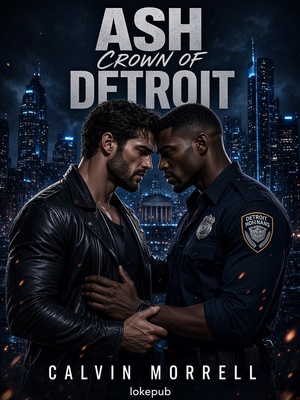
Ash Crown of Detroit
1. Chapter 1
He read the tablet a second time standing over the desk, one hand flat against the wood, and didn't look up until he was done.
Outside the window, the yard held its margins of dirty snow, plow-scraped, the color of pencil lead in the fading light.
Four o'clock, and Detroit was already giving up on the day.
He'd chosen this office for the window before he'd chosen it for anything else.
The view was a particular kind of shitty right now…
a gas station sign buzzing orange across the street, a bare linden tree, a bus stop where a woman in a red coat had been waiting long enough that her shoulders had given up their argument with the cold.
But it was his city. He needed to see it to remember the work meant something past the edge of his desk.
The first read he did fast and cold: not for content but for counterfeit.
He'd spent years building legal cases before he ever built Lakefront.
Old reflexes don't retire on schedule. He checked whether what came to him was the truth, or someone else's careful version of it, before he trusted a single line.
This brief held up. He read it again anyway.
This one he took slower. Line by line. The way you press a bruise to find out how deep it goes.
Building the case against himself before anyone else got the chance to.
The security itself he'd stopped questioning years ago.
Ghost had built the operating system from scratch, encryption and firewalls tight enough that the crew called it NSA-level and meant it as a compliment.
It was the only reason none of them were sitting in separate cells with numbers instead of names, not after what they'd buried over the years.
It was why Marcus still slept most nights, not well, but enough.
He made a mental note to actually thank Ghost for that.
He'd been making the same note for years.
The file before him was not yet a name. Just a shipping manifest and three coordinates, typed in a font so small he'd had to lean in, lining up with a pattern he'd tracked for longer than he'd let anyone else know about.
Jennison had done the legwork, probably because he hadn't understood who he was truly dealing with, intending to turn on Drakov eventually.
More the fool, him. Marcus's part was smaller and colder: confirm it, weigh it, decide whether the thread was worth pulling after years of leaving it alone.
Outside, a car alarm went off and then stopped. The cursor blinked.
It was.
He set the tablet down, screen dark, and didn't pick it back up.
He did not let himself want a thing before the evidence said he could have it.
He'd lived by that discipline long enough that it had stopped feeling like a rule and started feeling like the only version of himself he trusted not to get somebody killed, and Lakefront existed inside that same restraint: everything he'd built, built like a case, one confirmed fact laid on top of the last, nothing let in that couldn't survive turning out to be wrong.
He had never once asked what he'd find if he took it apart.
He was finding out now.
His hands stayed loose at his sides, fingers uncurled, nothing white in the knuckles.
Nothing a stranger passing the door would have called a reaction.
But his jaw had locked somewhere just short of pain, and his breath had dropped into the four-count he used to walk into arraignments: in through the nose, hold, out slow enough that no one in the room could time it against a pulse.
His eyes stayed fixed on the yard below and saw none of it, the same blank stare he'd worn in front of juries for years before Lakefront ever existed.
He looked at the yard instead: dirty snow, gray light already thinking about giving out. Whatever he'd decided, he'd decided it somewhere below the place where he usually did his deciding, and the rest of him hadn't caught up yet.
Not yet.
He kept the legal pad in the same drawer he'd kept it in for years, yellow, college-ruled, half the pages already gone to other arguments he'd built and then burned—the top sheet wavy and faintly ridged where old ink had dried into it.
The pen was the same brand it had always been, black, fine-point, the kind that didn't skip when his hand moved fast. He uncapped it and started where he always started: with the reasons not to.
He is DPD. Three words, underlined once, the line pressed hard enough to ghost through to the next page. Everything else followed from that.
A cross-precinct task force did not leave room for calls traced back to a factory that wasn't really a factory, to a crew that had buried what this crew had buried…
buried deep, in the kind of ground that didn't give anything back.
If it ever surfaced, if anyone with a badge and a subpoena pulled a phone log, there was no accounting for this much silence collapsing into one four-minute conversation with no case number attached.
But Marcus wasn't calling about a case. He was calling because one number had survived every phone he'd owned since, carried over by hand instead of trusted to a backup, written in the same cramped print onto the inside back cover of whatever he was carrying.
He crossed that line out, the ink thick enough to bleed through.
Then he wrote it again, because it was true, and true things stayed on the page even when they made the argument worse.
There was the cost to the other end of the call to consider.
The contact in his phone was listed only as "A," a single, stark letter against the pale screen, a precaution against prying eyes.
Even that abbreviation felt like a confession too bold on mornings when his thumb hovered over it, suspended between longing and dread.
Answering out of habit and answering because you wanted to were oceans apart, and he had no compass to know which shore he'd find.
To ask at all felt like slipping a hand into an unoffered pocket.
He wrote four more lines. Each one landed with the clean, final sound of a bolt sliding home. Somewhere by the fourth, without thinking, he'd used "he" instead of skirting around it. He caught it on the second read-through, the pronoun standing there plain as daylight, and let it remain.
Twice he read the full page back, testing each joint, each seam. Not a single crack showed. It was, by any measure, the most watertight case against action he'd constructed in years.
He was going to do it anyway.
He read the last line once more, his thumb pressing hard enough to leave a temporary divot in the pad's cardboard backing.
He capped the pen with a finality that felt both rehearsed and insufficient, setting it down exactly where it always went.
Then he did what he always did next, the ritual so practiced his body moved while his mind lagged two steps behind, already protesting.
He tore the page free at the perforation, the sound too loud in the quiet room.
Folded it once, a sharp crease made with more force than necessary, and set it into the ceramic tray.
The lighter was a cold, familiar weight from the drawer.
Plain. Functional. A tool for this one specific act of destruction.
His hand hovered, the pad of his thumb resting on the striker wheel. A breath held. Then he spun it.
The flame touched the corner. The paper resisted for a heartbeat, then caught, curling first at the edge where his own words blackened and vanished.
He watched, his jaw tight, as the fire consumed the page not in a rush of triumph but in a slow, inevitable surrender.
When it was done, there was nothing left but a fine gray ash and the acrid scent of regret hanging heavier than any smoke.
He didn't look at it again. Couldn't. He reached for the phone instead, his movement abrupt.
The weight of it was an accusation. It felt different than it had an hour ago, heavier, more dangerous, though nothing about the cracked case had changed. His thumb found the contact on its own, a traitorous muscle memory bypassing every circuit of doubt screaming in his head.
Andre.
He dialed before he could listen to that screaming for one more second, thumb jabbing the green icon like pressing a detonator.
One ring.
Two.
A silence on the line that felt like falling. Still open. Still reaching.
His pulse was a frantic drum against his ribs, a wild rhythm he hadn't felt in years, part fear, part something else he refused to name.
The window had gone dark enough to hold his reflection: a faint, fractured man standing too still with a phone pressed to his ear like a lifeline, waiting in the gray light for an answer.