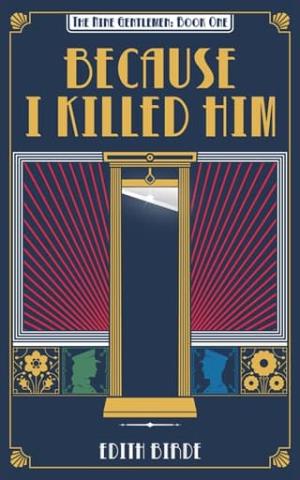
Because I Killed Him (The Nine Gentlemen #1)
CHAPTER 1
When did we become gods? Was it the day we ended poverty and famine? The day we cured disease? No. We became gods the day humanity finally understood that we are not meant to be believers. We are meant to be believed in.
—THEODORE REEVE,
There are thirty rooms in Waldsten Mansion, but one is always locked.
At the far end of the east wing, three floors up, the room waits with its paneled shutters thrown open.
An old walnut tree grows beneath the windows, and one branch reaches high enough to touch the glass.
From that branch, you can look directly into the room, which is empty except for a dry bar and a dusty, outdated television mounted on the wall.
Every Sunday night, my sisters and I flip a coin to decide who will climb the walnut tree and spy on Dad.
He’s never late.
At 6:45 p.m., he enters the room and stands in the blue glow of the television, striking a match to light his cigar.
The ridges of his face are as sharp as the cut of his fine wool suit.
Only his green eyes soften him, but when they harden and narrow on the flashing screen, I know the Sunday executions have begun.
Today is Sunday. Bloody Sunday.
For the first time in my life, I don’t join my sisters for the coin flip.
The ceiling fans cool the sweat on my hairline as I walk down the long corridor toward the execution viewing room.
The sliding door is half open, wide enough to reveal Dad pacing in front of the television.
His strides are quick and restless, stopping short before starting again.
He’s only three inches taller than me, but I always feel small next to him.
I rap my knuckles on the doorframe, and the sound makes Dad turn, smoke curling around his tense mouth. “I told you to get here at six-thirty.”
“No, you didn’t. You said to arrive around six-thirty.”
“Six-fifty isn’t around six-thirty, Loredana. It’s down the street from it.”
“I… lost track of time.”
Movement draws my attention to the window, where a blue jay perches on the ledge outside.
The bird pecks at the glass a few times, its feathers a brushstroke of color in the dusk, before its beady eyes lock onto me.
I meet the bird’s stare, and its head tilts as if it can see past my calm expression to the moment earlier, when I was crouched on the elevator floor, sweating as I stared at the control panel, working up the courage to press the third-floor button.
“You look like you’re about to lose a lot more than that.” Dad pulls a bottle of anti-vomit pills from the pocket of his suit jacket.
I take a pill and clench it in my fist. “I’m not gonna throw up. I’d just rather not watch people die for entertainment, even if they deserve it.”
“Well, get used to it. At Grandmaster University, you’ll see executions every day.” He puffs on his cigar, his face twisting grimly. “Some of them might even be your friends.”
“So, that’s why you want me to watch Bloody Sunday? To test me?”
“Test you?” Dad raises an eyebrow. “No, Loredana. If you’re not ready by now, you’re already laid out cold.
This isn’t a test. It’s a reminder. Being a Public Person is like running through a minefield buck-naked in the dark while it’s pissing rain.
One wrong move, and you’re done. The world out there isn’t classrooms and drills.
It’s teeth. And no amount of studying prepares you for when they sink in.
” He jerks his chin toward the television.
“Not even Bloody Sunday. Not until you’re backed into a corner with no one to save you but yourself. ”
“I already learned that a year ago,” I say quietly.
Dad pauses, his fingers tightening around his cigar, then sighs. “I know, honey. But as ugly as that night was, it was only a ripple compared to the wave that’s coming.”
I squeeze the anti-vomit pill until a chalky streak appears on my skin.
The memory of that night comes screaming back, raw and bloody, and I try to imagine its horror magnified, something I’ll have to relive on repeat for the rest of my life.
That’s what I’m willingly stepping into.
For eighteen years, the Civilized World allowed me to live under my parents’ protection as a Private Person.
My life here at home is small but full. Safe.
Tomorrow, when I leave to study at Grandmaster University, I’ll become a Public Person.
From that moment on, every mistake I make will be stamped on my record, a stain that can only be washed away with blood.
Dad stubs out his cigar in an ashtray on the bar and checks his wristwatch. “Almost time, honey. Last chance to take the pill.”
I stare at the pill, sweating in my palm, hesitating until I hear the blue jay dart away in a rush of feathers.
The bird’s wings spread wide, catching the wind as it circles the walnut tree.
Somewhere among the leafy branches, I know one of my sisters is watching, whoever won the coin flip.
Vivian thinks I’ll make it halfway through the execution, while Hillaire is convinced I’ll choke completely.
“You won’t last two beheadings,” she told me.
“What makes you so sure?”
“Because you want justice to be neat. You want it to feel right. But real justice is messy and has nothing to do with feelings at all.”
Hillaire’s words still sting, but I remind myself that neither of my sisters knows what happened a year ago. They think this is the first time I’ll watch someone die, so I don’t blame them for betting against me.
I slip the pill into my pocket, let out a slow breath, and turn to Dad. “I’m ready.”
He switches the television to the Civilized World’s main news channel, the Civilized News Network.
The broadcast shows a raised platform of polished marble, so clean and white it glows like moonlight.
The fluted columns are narrow, as sleek as rolled cigarettes, and their facades are carved with the stoic faces of former presidents.
The gold-plated insignia of a double-headed eagle is emblazoned on the platform’s floor.
I hear a loud, rhythmic tap before the executioner enters the frame, his bright red boots gliding smoothly as he ascends the platform and takes his place before the cameras.
A gold, visored helmet conceals his face, and he wears a red velvet three-piece suit with a silk ascot tucked neatly into his waistcoat.
The executioner bows solemnly, then clasps his hands behind his back and approaches the guillotine.
It’s an elegant structure of gold posts, with an angled blade that gleams like a crooked grin.
Beneath the blade is a yoke to hold heads in place.
The executioner tests the lever, then cuts his thumb on the blade, bright green blood welling from the split skin.
He raises his bleeding hand overhead and salutes with his middle and index fingers.
Cheers erupt from the television, but the noise barely registers. My eyes stay fixed on the executioner, on his proud, upturned head, on how he holds his blood aloft as if signaling the other Greens watching. Greens like me. Like Dad. Like everyone in our family.
“You think it’s hard for him to kill other Greens?” I ask.
Dad grunts. “If it is, he knows better than to show it. Every low-citizen knows better.”
The words cut deeper than a guillotine blade ever could.
I don’t hate my green blood—I never have—but I resent that it makes me feel inferior.
As a low-citizen, I have a will of my own, yet no freedom to exercise it.
The only freedom I have is to let the high-citizens tear out my spine and beat me with it.
“Here comes the preening peacock.” Dad turns up the television volume as a young man in a pinstripe suit joins the executioner on the platform.
His face draws every eye like a stage light, and when he smiles, his teeth gleam beneath his boxed Chevron mustache.
Hillaire says Benjamin Bogart has the highest ratings of any media pundit because he’s smart, but judging by his fan sites and stalkers, I think it’s because he’s handsome.
“Good day, ladies and gentlemen. Good day, my friends.” Bogart throws his arms wide. “Welcome to another week’s end, when our great and glorious Civilized World rebalances the scales of justice by purging the unvirtuous. Welcome to Bloody Sunday!”
The crowd erupts in applause.
My breath catches as the broadcast drones ascend and pull back, revealing the entire expanse of the Guillotine Yard.
The central platform sits at the heart of a four-story amphitheater, with tiered seating arranged in concentric circles.
The spectators—tens of thousands—appear like a mosaic, each a colorful part of a glittering, thunderous whole.
The broadcast drones avoid filming the fourth level, as if it doesn’t exist.
Bogart salutes the cameras with a practiced smile before introducing the three low-citizen groups.
He begins with his own, the Purples, arranged along the bottom tier like a living art gallery.
Even from a distance, their beauty distracts me from my unease.
The women’s eyes seem to call out like daydreams, and the men move as if the sun shines a little brighter wherever they go.
“It’s a wonder these bastards make it past their bedroom mirrors in the morning,” Dad mutters.
I force a weak smile, still staring. Every detail of the Purples’ bodies looks meticulously crafted, genetically engineered in labs to dominate the worlds of art, fashion, and entertainment.
Bogart lingers on the Purples a moment longer before moving to the second tier, where the Oranges sit.
His smile thins at the sight of their plain, unremarkable faces, as if their lack of beauty offends him.
The Oranges are less enjoyable to look at, I’ll admit, but Dad says they’re smart enough to talk a bullet out of a gun.