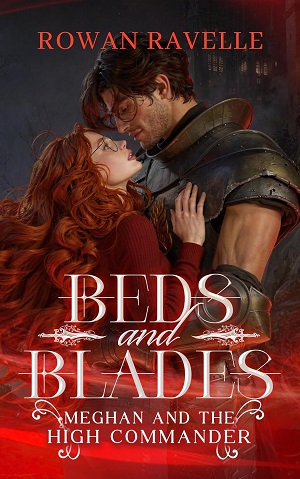
Beds and Blades (Meghan and the High Commander #1)
Pennsylvania
Chapter one
Ihad forty-three pages of notes on a dead Roman general, and I was going to need every single one of them.
I had not slept much. I was wearing the same jeans and red sweater I had pulled on at six that morning without a second thought. Practical, at the time. Now I stood before my doctoral committee in clothes better suited to grocery shopping than a formal academic presentation.
My hair, dark auburn and resistant to any arrangement I attempted, was doing what it always did—exactly what it wanted.
I was thirty years old, and this presentation would define my academic career.
The presentation was titled “The Art of the Inevitable Victory: Scipio Africanus and the Strategic Architecture of Decisive Command.” I had spent three years refining a single argument: Scipio won because he combined intelligence with decisiveness, and that combination made him exceptional.
My committee was assembled in front of me now. Four academics arranged in a row. They had blocked off ninety minutes and were already mentally drafting their objections.
This was fine. I was prepared for their objections. I had been prepared for their objections since approximately my second year, when I realized that being right was not, in academic settings, considered a substitute for being agreeable.
“Scipio Africanus,” I said, clicking to my first slide, “is the most consequential military commander in Western history, and the fact that most people would name Caesar or Alexander before him is a failure of historiography rather than a reflection of the historical record.”
Dr. Harmon, seated second from the left, uncapped his pen. He always uncapped his pen when he was preparing to disagree with me. I had begun to think of the sound as a kind of informal defense alarm.
“The argument I’m making today,” I continued, “is not simply that Scipio was brilliant, though he was—comprehensively so—but that he understood something about decisive action that his contemporaries could not conceptualize. He did not wait for the perfect moment. He created it. Every campaign, from Spain to North Africa, follows the same strategic signature: Scipio identifies what his opponent cannot imagine him doing and then does exactly that.”
I looked down at my notes. I had printed them at eleven the previous night, after four hours of what could charitably be called sleep. More accurately, I had spent most of that time lying in the dark, re-running my opening argument on a loop while my brain refused to switch off.
I was running almost entirely on chemical intervention at this point.
My brother Matt worked the night shift at a hospital, so he was naturally an energy-drink fanatic.
When I texted him from the Wawa parking lot at seven-thirty this morning that I needed a solid energy drink to carry my sleep-deprived brain through the presentation, he responded within ten seconds with a recommendation so specific it included a brand name, a size, and the instruction not to eat anything too heavy first or I’d crash around hour two.
The NeuroXCore 8000 was currently sitting in my bag—can number three—waiting.
I had done the math—three hundred milligrams of caffeine per can. I had consumed two cans before arriving. My heart rate was somewhere between that of a person doing a light elliptical workout and that of someone being chased by a grizzly bear.
I could feel my own heartbeat.
This was fine. This was manageable. I had given presentations in worse conditions.
I clicked to the next slide.
***
Scipio Africanus was twenty-five years old when Rome gave him command of the Iberian campaign.
Twenty-five. No prior independent command.
His father and uncle had both just died in Spain. The Roman Senate needed someone willing to take an assignment that qualified commanders were actively declining. Meanwhile, Scipio was young and unproven. Despite this, he raised his hand.
He took New Carthage in a single day.
The conventional military wisdom of his era said this was impossible.
New Carthage was the most strategically significant city in Spain.
Three Carthaginian armies were positioned across Spain to defend it.
Any rational assessment concluded that siege operations would require weeks at a minimum, during which those armies would converge and destroy the besieging force.
Scipio noticed something no one else had bothered to check. The lagoon protecting the city’s northern wall dropped to knee depth at low tide.
He had simply refused to stop asking questions after everyone else had gotten comfortable with their assumptions. The generals who lost to Scipio were not fools. They were men who had decided they already knew what they needed to know.
In contrast, Scipio was the man who checked the lagoon. That was the hinge on which the battle turned.
That was what I found so consuming in my study of warfare. Most men looked at war as a test of strength, courage, and endurance—who could strike harder, who could stand longer. They believed victory belonged to the strongest man in the room.
They were wrong.
Wars were won by intelligence. Insight. The willingness to look at the thing everyone else had already looked away from. The best commanders saw what others missed and understood the field better than their adversaries. That part came easily to me, and it was the part I trusted.
What didn’t come easily was the part that followed.
Intelligence only told you what should be done.
It didn’t make you do it. That required decisiveness—speed, commitment, a willingness to act without full certainty.
That was the quality I lacked. I could see the right move.
I could map it, annotate it, and cross-reference it against every comparable situation in the historical record.
I just couldn’t always bring myself to take it.
There was evidence for this conclusion. My ex-fiancé, for instance.
The engagement had lasted two years longer than it should have.
By the three-month mark, I could already see how it would end.
The remaining time was spent rerunning the same analysis, reaching the same conclusion, and choosing not to act on it.
I knew this was the exact failure mode I had devoted my academic career to studying.
Scipio looked at New Carthage and moved; I looked at my own life and did not.
By every measurable metric, my ex-fiancé had been a reasonable choice. Stable, gainfully employed, and approved of by my parents.
What he lacked was the ability to make me feel anything remotely resembling the things that occupied my private thoughts. He treated intimacy like it was a scheduled obligation. I owned a vibrator that understood my preferences more fully than he had managed to in two years of earnest effort.
I had ended the engagement and told my parents that “incompatibility” was the reason.
This was accurate. But it was not complete.
What I wanted, what I had been thinking about in the eighteen months since ending the engagement, was to be overwhelmed. I wanted a man to desire me totally, with no hedging and no half-measures.
I wanted large, capable hands. A jaw shadowed with rough stubble.
And yes, because I believed in thorough intelligence-gathering and had spent enough time alone with my imagination and the toys in my nightstand drawer to know exactly what I was asking for, I wanted a man who was generously proportioned in every dimension that mattered.
I wanted to feel claimed.
I wanted to be taken apart until I had no remaining capacity for coherent thought, let alone the finer points of Roman military strategy.
I paused on the slide showing the lagoon’s position. I had been doing this my entire adult life: presenting a controlled, analytical exterior while my desires ambushed me.
Two things running in parallel. The careful mind and the honest body, never quite in the same room at the same time.
Focus, Meghan Callahan.
Right. New Carthage. The lagoon. The man who had seen what everyone else had already looked past, and the fact that he had simply acted on it.
The fact that he had simply acted on it.
***
Also in the room, seated slightly apart from the committee, was Professor James Calloway.
He was not on my committee. Nothing required him to be here. He had apparently decided to attend for reasons that were not clear to me.
James was the kind of tall that made everything around him feel slightly disproportionate.
Broad-shouldered, narrow-hipped, solid in a way that suggested not just strength but discipline. The black shirt he wore clung without apology, outlining muscle that hadn’t happened by accident.
His hair was dark and a little too long, falling in loose, unruly waves that refused to stay controlled. It softened what might otherwise have been an uncompromising face—strong jaw, sharp cheekbones, a mouth that looked like it defaulted to restraint rather than ease.
There was stubble along his jaw, not careless, but not precise either. Intentional imperfection.
And then there was the stillness. Nothing about him was casual. It came from control and the habit of observing before acting.
I thought about his hands sometimes. Their size, relative to, for example, my waist. I thought about what it would feel like to have those hands settle at my hips. I thought about this involuntarily and at inconvenient moments.
His jaw. The way he filled a doorframe when he entered a room.
I imagined him stepping closer, his height swallowing mine whole. At five foot four, I’d fit against him too easily, my body aligning with his six-foot-four frame in a way that felt inevitable.
The more I thought about his body, the more my mind turned to my list. I was a person who made lists.
I started a list the night my last relationship ended. I opened the Notes app and gave myself permission to be forensically honest about what I had wanted and had not been getting.