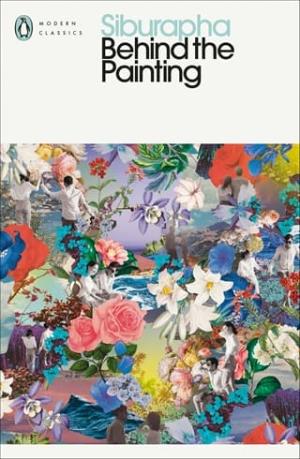
Behind the Painting
Behind the Painting
Three days passed before Pree noticed the picture I had hung up in my study. She showed little interest beyond pausing briefly for a closer look and asking, ‘Where is it, this Mitake?’ I was a little startled, but Pree did not notice.
‘It’s a lovely area of countryside outside Tokyo. People from Tokyo often go there on Sundays.’
‘Oh, so you bought it in Tokyo, then?’
I buried my head in the book I had been reading when Pree entered the room. ‘No, a friend of mine painted it for me.’ I felt uneasy about the way my voice sounded, because it resembled that of an actor, speaking in a guarded manner on stage.
‘That’s what I thought. It would’ve been a bit strange if you’d had to buy it, because it looks very ordinary, and I don’t see anything particularly special about it. But my eye may not be up to appreciating its merits.’
‘If you look at watercolours like this from close up, you might not appreciate them, but if you view them from a little further back, you might have a different opinion.’
Pree showed no inclination to do as I suggested, nor to ask any further questions.
I was glad. The painting was mounted in a jet-black frame and hung on the wall opposite my desk.
When I sat down to work, it was behind me.
I had thought of hanging it directly in front of me, so that I could see it whenever I looked up.
But later I changed my mind, being quite certain that if I were to follow through with my original idea, the painting would really disturb my peace of mind.
In fact, Pree was not far wrong in what she had said.
The painting was ordinary. There was nothing striking about it, and it bore no comparison to the pictures hanging in the living-room and bedroom, some of which were worth 40 or 50 yen.
It was a watercolour, depicting a stream which ran past the foot of a mountain.
Tall trees grew densely on the slope of the mountain.
On the other side of the stream was a small, uneven stone path which passed over an overhanging rock, rising and descending in places.
Creeping plants and wildflowers of various colours grew in a line along the rock.
Further down, on a large rock almost touching the water, sat two figures.
The scene was depicted from a distance, and it was not clear whether they were a man and a woman, or whether they were both men.
But one of them was undoubtedly a man. The words ‘By the Stream’ appeared on the painting; the artist intended this to be the title.
In a bottom corner, in small letters, was the word ‘Mitake’, with the date below it, indicating that it had been painted six years previously.
The painting, then, was ordinary, with nothing remarkable about it.
The artist’s talent was modest, and while it was quite pleasant, it was not going to draw forth cries of admiration from the viewer.
Lovers of nature might express some interest and appreciation, but that is not part of Pree’s character.
It is a pity because it is quite the opposite with me.
However, it is perfectly reasonable that neither Pree, nor anyone else, should show any interest in the picture, for as Pree had said, it was a very ordinary picture.
But I, and I alone, think very differently, for I know, all too well, that behind the painting was a life, a life which has stamped its indelible mark upon my heart.
To other people, behind that painting there is only a sheet of cardboard and, beyond that, the wall.
How else, then, could they see it, other than as just an ordinary painting?
Gazing at the picture when I am alone, I see the water meander by and then gather speed as its course descends.
I see even the pale, autumn sunlight. And the two people sitting on the overhanging rock, whom the artist has daubed on almost carelessly, I see quite clearly.
I even see the long, curling eyelashes of one of them, and the three bright red triangles drawn over thin lips, lending their very thinness a wonderful charm.
I know, all too well, that the artist put everything into that picture, that it was no half-hearted effort.
In that tranquil and apparently very ordinary picture, I see everything unfolding.
Every scene, every part, from the beginning to the final act, on which the curtain fell so tragically, only recently.