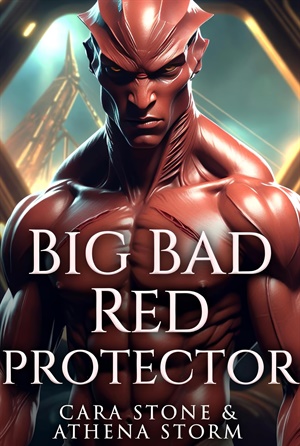
Big Bad Red Protector
1. Nina
NINA
The docking corridor spits me out like something it couldn't stomach.
One moment I'm inside the pressurized tube connecting the transport shuttle to the station, breathing recycled air and clutching the strap of my service bag—and then the doors open, and Orpheus Station swallows me whole.
The noise hits first. A wall of it: voices layered over voices in a dozen languages, two of which I don't recognize at all.
Station announcements blare in Standard and something that sounds like grinding stone.
Cargo lifts groan. A security siren cycles twice and cuts out.
Above all of it, a low, resonant hum moves through the floor, through the soles of my boots, into my teeth.
I've never heard anything like it. I don't know yet to associate that sound with the Bridge.
I stand still for approximately four seconds before the crowd breaks around me like water around a rock, and I realize standing still is not an option.
Orpheus Station is nothing like the orientation files.
The files said crowded. What they meant was this: a Shorcu diplomat the color of old bone moving in full ceremonial robes with two armed attendants at her back, her mechanical eye-lenses scanning every face she passes.
A group of Pi'rell traders arguing over a sealed cargo manifest in a clipped, escalating cadence that parts the crowd around them.
Three Vakutan soldiers in reinforced armor standing motionless at a security junction, arms crossed, expressions designed to make you feel guilty of something.
A human family—actually human—moving fast through the main corridor with their heads down and their bags held tight.
It's violent and fascinating and I am immediately, profoundly, out of my depth.
The customs processing center is a forty-minute orientation I spend taking notes on a data tablet while a tired Alliance officer explains, in the flattest voice I've ever heard, that Orpheus Station is League territory—an Interstellar Hub Commission post anchored at the trade superhighway that runs between the League and the Ataxian Coalition.
Not neutral ground, whatever the orientation files imply.
The League holds jurisdiction here; the Ataxian Coalition keeps the lanes profitable; and the Trident Alliance is permitted a presence and little else.
All three operate aboard, which means they are all always watching each other, which means everyone is always being watched.
The Bridge is mentioned once, briefly. The officer nods toward the outer viewing corridor and says, "Do not approach restricted sectors near structure L-7 under any circumstances.
Political incidents in that vicinity carry mandatory tribunal review.
" He says it the way you warn someone not to touch a hot stove. Like the danger is self-evident.
I write it down anyway.
The checkpoint happens because I take a wrong turn.
To be precise: I take a wrong turn because a cargo transport the size of a ground hauler cuts across my path and I sidestep into an unlabeled junction corridor that turns into a second corridor that ends at a security perimeter I absolutely should not be standing inside.
The warning markings are in Vakutan script.
I can read Standard and passable Pi'rell. Vakutan is on my list.
I hear the commotion before I see it—a sharp command in a language I recognize as Vakutan, then a crash, then something that sounds like a large body hitting a wall with deliberate force.
When I round the last corner into the checkpoint, I understand all at once that I have stumbled into the aftermath of a security sweep.
Three Vakutan officers stand in a loose perimeter around a man on his knees.
The man is also Vakutan, bigger than the officers, with cargo markings stenciled on his jacket and calculation already visible on his face.
In front of him—filling the corridor with a presence that seems to reorganize the air around it—stands the largest person I have ever seen in my life.
Dark crimson skin. Cranial ridges sweeping back from a broad forehead.
Old scars cutting across his throat and both forearms, the kind earned over decades and never treated for appearance.
He wears reinforced Vakutan armor modified for station work—lighter than battlefield gear, but the modifications tell you everything about what he expects from the job.
He doesn't move. Doesn't gesture. He simply looks at the man kneeling in front of him and the man stops trying to rise.
The commander says three words. The smuggler sags.
I should leave. I know I should leave. One of the perimeter officers has already clocked me and is actively communicating my presence with his eyes to the others.
The commander turns.
His eyes are gold. Sharp and entirely unimpressed. They take me apart in the time it takes to inhale.
"This area is under security jurisdiction," he says. His Standard is accented and precise. "You have five seconds to remove yourself before I add obstruction to whatever else today requires me to document."
"I took a wrong turn," I say. "The corridor isn't marked."
"It is marked in Vakutan. This station operates in seven languages. Ignorance is not jurisdiction." He turns back to the smuggler, dismissing me completely.
Something about that dismissal unlocks my better judgment and sends it out the nearest airlock.
The heat in my face is not embarrassment. It is entirely, specifically, fury.
One of the human techs near the wall gives me a tiny shake of his head. Stop. Let it go.
Naturally, I do the opposite.
"Customs jurisdiction doesn't disappear because you dislike the officer standing in front of you," I say, loud enough for every guard in the checkpoint to hear. "If illegal cargo moved through this sector, my division has a right to review it."
The corridor goes unpleasantly quiet.
Kheltor turns his head just enough to regard me again. The gold of his eyes is perfectly steady. "Your division has a right to file requests. You have a responsibility to survive your first day."
That lands harder than I want it to.
I leave before my mouth can get me arrested. But I make sure my departure is slow enough to count as disrespect.
Commander Vos finds me forty minutes later inside the customs administrative office, still filling out entry forms with more force than the data tablet strictly requires.
"Kheltor," he says, sitting across from me without invitation, "is not a problem you want to create for yourself. Not here. Not in the first twelve hours."
"He publicly?—"
"He does everything publicly. That's how he maintains order.
" Vos sounds like he has talked people off ledges for thirty years.
"He is also the reason Orpheus Station's criminal activity rate dropped forty percent since his posting.
Give him time to decide you're not a liability before you decide he's your enemy. "
I file the advice under noted but not accepted and finish my forms.
My quarters are small, functional, and placed on the station's outer ring with a direct view of the restricted corridor sector.
Through the narrow observation panel, I can see the distant shape of the structure the officers call the Bridge—ancient, asymmetric, lit from within by something that doesn't behave like any power source I studied in academy.
As I watch, it pulses.
Just once. Soft and deep, like a signal finding its frequency.
Like something looking for me specifically—and finally, after a very long search, finding exactly where I am.